The skies are thick with myths, archetypes and long-spanned story arcs coming home to roost in Peter Jackson's The Lord of the Rings: The Return of the King (2003). It isn't just a matter of concluding his epic, triumphant three-part film of J.R.R. Tolkien's landmark trilogy. Nor is it just about upping the ante with ever more massive battle sequences until good finally or at least provisionally --overcomes evil. It's a matter of resolution, of lives finally allowed to embark on paths heroically earned. And something more. When the Dark Towers of the evil wizard Sauron have finally crumbled, and the corrupting Ring has been cast into the fires of Mount Doom, out of reach for the foreseeable future, the beginning of the rule of Man over Middle-earth is overshadowed by the departure of Gandalf, Frodo and the Elves. A certain melancholy pervades that ending, making it a not altogether happy one. It has to do with the removal from an ancient world of an even more ancient magic.
It's in keeping with the conservatism of that lifelong classicist and professor of Middle English, Tolkien, with his love of myth, especially of the ancient Nordic kind. His belief in myth's power to connect us to eternal truths and spirituality is what gives Lord of the Rings its weight and heft, even more than his ability to root his high-flying fantasy in the humanity of salt-of-the-earth types as well as heroic icons, and the particulars of human behavior, including idealism. The surprise is that in an age even more given to modernism than the one Tolkien decried, Jackson has been able to connect with the same deep sources that Tolkien has, taking the book apart and reconstituting it according to the laws of film, some of which Jackson wrote along the way, and some of which he certainly expanded. Anyone can tell you to see the nearly eleven hours of Lord of the Rings on as big a screen as you can. Size and scale matter here.
But breadth and depth matter even more. These qualities have been underrated amid the waves of praise for Jackson's ability to overcome the daunting logistical difficulties of making the film with hordes of live bodies and even more pixels of computer enhancements superimposed upon the spectacularly primal and craggy landscapes of Jackson's native New Zealand an under-credited star of the film. Not since fellow New Zealander Vincent Ward's Vigil (1984) have those otherworldly mountains and gorges and deserts been so arrestingly deployed, to say nothing of being overlaid with gothic, medieval and renaissance visuals that suggest a collision between Breughel, Bosch and Leonardo.
Still, what elevates Lord of the Rings from sensational eye candy to electrifying cinematic achievement is Jackson's ability to anchor the sweeping arcs in small, vivid human moments Sean Astin's stalwart Sam suffering as he sees Frodo's will crumble before the seductive potency of the Ring, Miranda Otto's valiant Eowyn set her jaw resolutely before clamping on her head a gender-concealing metal helmet as she rides off to battle beside her uncle, Viggo Mortensen, looking miserable with the weight of office as Aragorn, drained of the fire of his Henry V-like Agincourt pep talk to the troops and invigorating battles won and done, is crowned king, Ian McKellen's Gandalf, taking a moment off from wizardry to advise Billy Boyd's savvy-disadvantaged Hobbit, Pippin, in throwaway style while heading into a prickly audience with the steward of Gondor, "It's better that you don't speak at all."
Tolkien always denied that Lord of the Rings was allegorically rooted in his experiences of both World Wars against Teutonic forces who had appropriated Nordic myths for their own self-aggrandizing ends. He wanted Lord of the Rings to be read more universally, more timelessly, more sexlessly than Wagner's tilling of the same mythic soil. Certainly in his re-imagining of an ancient world 7000 years ago, filtered through Eurocentric romantic medievalism, he emphasized elements Wagner and the Nazis ignored friendship, loyalty, an idealization of the bucolic, pre-industrial life of the Shire. Jackson realized he could project these elements even more readily with images than Tolkien could with words. It reminds us that the whole point of the various battles was to give Frodo, the unlikely little Everyman from the podgy little Shire, time to nullify the evil power of the Ring.
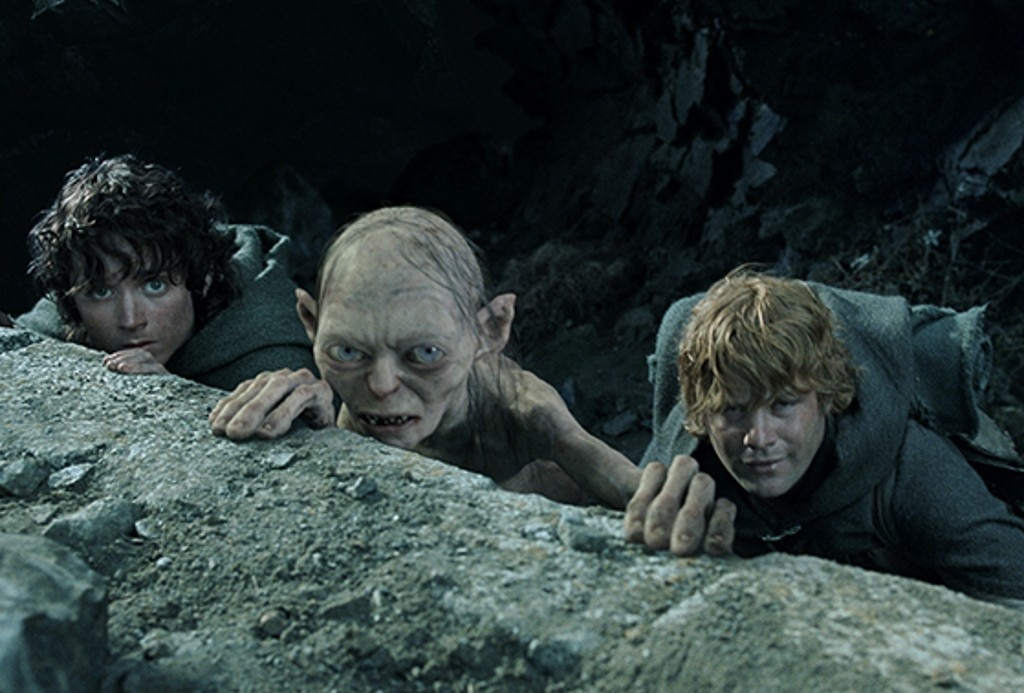
Thus, Elijah Wood's eyes turn ever glassier as the Ring fights back against its destruction by draining him of will, seducing him as it seduced Smeagle in the scene that begins the final film. Smeagle's obsessive quest for the Ring shrivels him into the slimy, treacherous Gollum (a computer-regenerated Andy Serkis), third of a great CGI triumvirate whose first two members on the right side of the good versus evil divide are E.T. and Yoda. Gollum's crazed, hissing mutterings and reptilian clambering almost stole the first two films. But in the third and final triptych, it's Astin's Sam whose purity of heart prevails and carries the day -- not to mention the civilized, or, rather, uncivilized, world. It's only right that one of Astin's perks involved employment for one of his young sons in the final sequence back in the Shire. (Jackson's two small children and Mortensen's son also were awarded cameos!)
The numbers attached to the film are potentially suffocating more than 6 million feet of film shot, 48,000 swords, axes, shields and makeup prosthetics, hundreds of horses, tens of thousands of actors and extras computer-morphed into hundreds of thousands, and so on. Never before had three giant films been shot in the same place at the same time, simultaneously shot in pieces. Tolkien and Jackson had two things in common. Both were phobic about spiders. As a boy growing up in South Africa, Tolkien was bitten by one. The similarly anachrophobic Jackson gave his giant spider, Shelob, the banshee voice of a Tasmanian Devil. The automobile-hating Tolkien got around by bicycle. So did Jackson, a high-energy, roly-poly, hairy field marshal, cycling from unit to unit day after day, keeping tabs on his three giant films shooting out of sequence, piece by piece, seeing to details, yet keeping ever focused on the larger whole into which he knew they had to fuse.
The film took eight years for Jackson and many of his associates, and half as many for the actors, a number of whom were called back for reshoots. The extended DVD edition should keep devotees happy for years to come, from the immensity and detail of Jackson's conceptualizing and execution to the on-set extra doffing his Elephant Man-like Orc mask to chat up a tech crew woman during a tea break. Apart from its eleven Oscars®, the book that planted the flag for the fantasy genre has become the film that has sired a dizzying multiplicity of videos, computer games and graphic novels. We weren't surprised that the final film should have been of a piece with the first two. They were, after all, made at the same time with the same people. Still, The Lord of the Rings: The Return of the King's ability to end on a rousing yet deeply resonating high note wasn't a given. What could have landed with a deadening thud not only flew, but soared -- and satisfied at the deepest levels the appetite within us that can only be fed by storytelling. This final chapter brings the saga home. Its scale and depth make it a high-stakes gamble that wins big and leaves a footprint for the ages.
Producers: Peter Jackson, Barrie M. Osborne, Fran Walsh
Director: Peter Jackson
Screenplay: Fran Walsh, Philippa Boyens, and Peter Jackson (screenplay), J.R.R. Tolkien (novel)
Cinematography: Andrew Lesnie
Art Direction: Joe Bleakley, Simon Bright, Phil Ivey, and Mark Robins (uncredited)
Music: Howard Shore
Film Editing: Jamie Selkirk
Cast: Frodo (Elijah Wood), Sam (Sean Astin), Aragorn (Viggo Mortensen), Legolas (Orlando Bloom), Gimli (John Rhys-Davies), Boromir (Sean Bean), Galadriel (Cate Blanchett), Gandalf (Ian McKellen), Celeborn (Marton Csokas), Bilbo (Iam Holm), Gollum (Andy Serkis).
C-201m. Letterboxed.
by Jay Carr
SOURCES
Lord of the Rings, by J.R.R. Tolkien
IMDb
Biography Resource Center
Wikipedia
Secrets of The King, article by Jeff Giles, Newsweek, Dec. 1, 2003
The Making of an Epic, article by Gillian Flynn, Entertainment Weekly, May 17, 2004
The Lord of the Rings: The Return of the King
by Jay Carr | December 05, 2007
SIGN UP FOR OUR NEWSLETTERS

CONNECT WITH TCM