In 1977 Billy Hayes, with the assistance of William Hoffer, wrote a best-selling account of his arrest and imprisonment
in a Turkish prison entitled Midnight Express. Hayes, an American student on vacation in Turkey, had been
apprehended at the Istanbul Airport on October 6, 1970, trying to smuggle 2.2 kilos of hashish out of the country (it
was concealed under his clothes and taped to his body). He was sentenced to four years and two months for
possession but in 1974, the Turkish High Court in Ankara overturned his original sentence, found him guilty of
smuggling and sentenced him to serve an additional 30 years. Hayes's account of the brutal prison conditions he
endured with his fellow inmates and his eventual escape to Greece in 1975 was a riveting cautionary tale for its era
and Columbia Pictures promptly acquired the film rights.
Produced by Peter Guber, Alan Marshall and David Puttnam, who would later have a brief, turbulent reign as Columbia
Studio's Chairman from 1986 to 1988, Midnight Express (1978) was directed by Alan Parker, who had only
one feature film to his credit - Bugsy Malone [1976], a peculiar gangster musical in which all of the key roles
were played by children - and an impressive resume of award-winning commercials which he produced during his
advertising career in the U.K. The screenplay was written by a relative newcomer to the film industry - Oliver Stone -
who had been shopping a script about the Vietnam War (which later became Platoon, 1986) around
Hollywood and had previously written, directed and edited the independent horror thriller Seizure in 1974. Their
collaboration produced one of the top box office hits of 1978 and launched both Parker and Stone on highly successful
solo careers with Stone establishing himself as a critically acclaimed writer-director with Salvador in 1986.
Midnight Express was also the recipient of numerous awards, earning six Oscar® and six BAFTA
nominations, a Golden Palm nomination for Best Director at the Cannes Film Festival, eight Golden Globe
nominations, a Directors Guild of America citation for Parker and a Writers Guild of America award for Stone. Yet,
despite all of the accolades and box office success, Midnight Express was a highly controversial film at the
time (and still is), one that sharply divided critics and audiences alike over the liberties it took with Hayes's non-fiction
book, the way it depicted the Turkish people and its officials, and Parker's directorial style which some felt was highly
exploitive and superficial in the style of the slick commercials he had made for the Collett Dickenson Pearce
agency.
From the beginning Parker and Stone had strong convictions about the material and shared the opinion that
Midnight Express was a story about "man's inhumanity to man" and to illustrate that it had to be a brutal,
violent and uncompromising film. According to author Frank Beaver in Oliver Stone: Wakeup Cinema, "Parker
looked to the Midnight Express material as documentary-like, with possibilities for "a bizarre theatrical edge,"
saying "I would like the audience to be shaken and shocked that such things happen almost to the point of disbelief -
but never to lose them."
The first thing that Parker and Stone had to address was the book's chronology of events and the screenplay's
structure. "In the book, as in a lot of prison stories," Parker noted, "the action wanders back and forth among a lot of
characters. But in a movie we had to concentrate on the story." So Stone wrote a first draft of the screenplay in six
weeks and then he and Parker went through it page by page, fashioning a final shooting script that retained "the
integrity of the book" while building enormous sympathy for Hayes so audiences would identify strongly with
him.
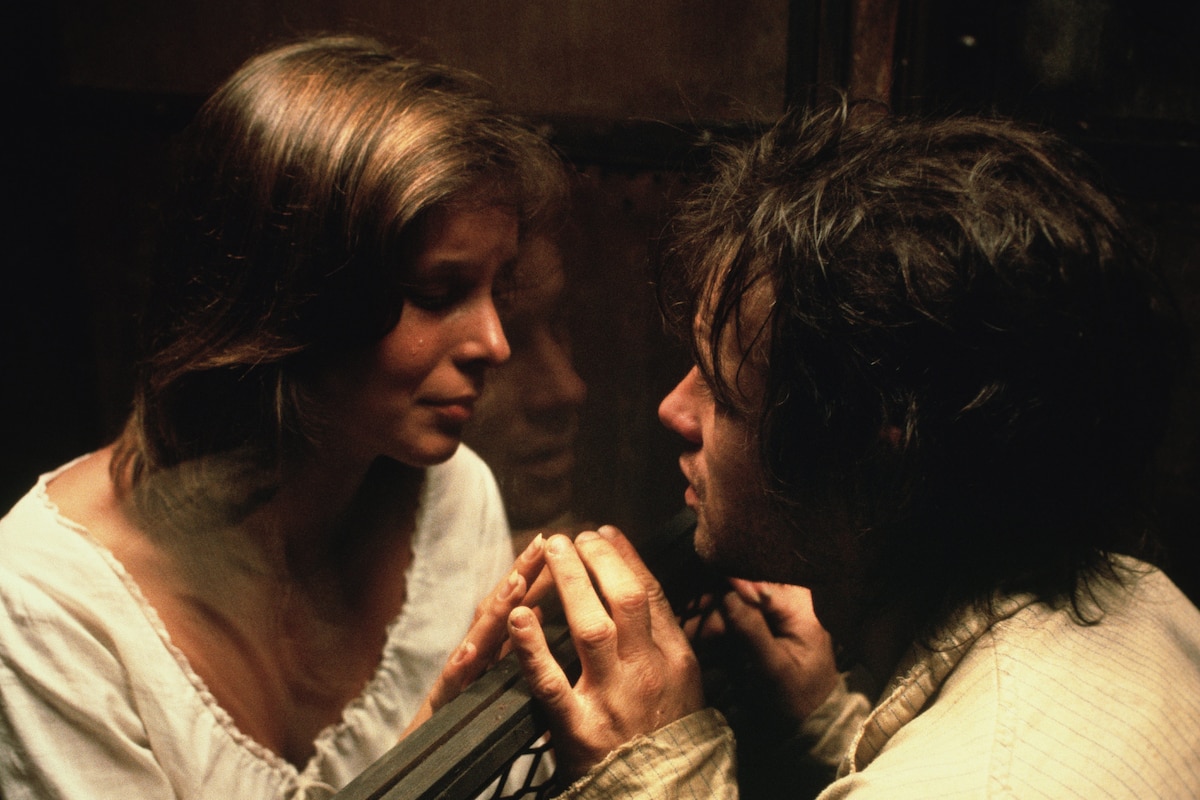
Among the many changes they made were making the love story between Hayes and his girlfriend Susan an
important dramatic subplot and writing Hayes's defiant speech to the Turkish judges at his second trial. In Hayes's
real account, he was alone when he was arrested at the Istanbul airport and in the film he is accompanied by his
girlfriend who has no idea that he is smuggling drugs onto the plane back to America. As for the scene where Hayes
is given a thirty year sentence, he goes ballistic with rage screaming "For a nation of pigs, it sure is funny you don't
eat 'em. Jesus Christ forgave the bastards, but I can't. I hate you, I hate your nation, I hate your people, and f*ck your
sons and daughters because they're all pigs..." In real life, however, Hayes delivered a speech "to touch those people
somehow" and he did it without emotion. "I tried to make a statement that would affect them, so I said that from one
society to another laws change, from one age to another laws change, but that's all. I was trying to maintain a
balance, and I had a simple secret - to smile, to send out good energy no matter what. I'd gotten past screaming and
yelling. I said to them, "All I can do is forgive you." (from The Cinema of Oliver Stone by Norman Kagan).
The chronology of the events were altered as well with Hayes's placement in the criminally insane wing of the prison,
for example, occurring toward the end of the film instead of earlier in the true account. The most controversial
changes, however, involved Hayes's attack on a fellow prisoner who was an informer, his relationship with a Swedish
inmate and his climactic escape from prison. In the film, Hayes becomes completely unhinged when Rifki informs on
his friend Max and beats him mercilessly before biting off part of the stoolie's tongue - an incident that never occurred.
On the other hand, Hayes did have a homosexual relationship while in prison but in the movie version, he resists the
advances of Erich because studio executives were afraid a homosexual encounter would "diminish the hero's
otherwise "All-American" appeal." Hayes later commented that "I like the dreamlike quality of the scene, but I wish
they'd have the steam come up and fade out. But I'm very happy that maybe somebody in the Midwest who is freaked
out by the very idea of homosexuality can look at the scene and feel the delicacy of it. The line from my book
expresses it best - "It's only love."
The biggest distortion of all in the movie is Hayes' escape from prison which has him accidentally killing the head jailer
Hamidou by pushing him against a wall where his head is impaled on a metal coathook. He then slips on a guard's
uniform, is given a set of keys by an oblivious jailer and slips out unnoticed into the streets where he escapes. The
scene with Hamidou, who was preparing to rape Hayes, also suggests that the jailer had been sexually abusing him
all along though Hayes states in his book that he never saw the Turkish prison guards sexually abuse any prisoners.
At any rate, Hayes' actual escape might have made an even more dramatic ending: he had been transferred to another
prison, located on an island far from the mainland, and managed to break out. He swam to a fisherman's dingy during
a storm, rowed through a churning sea to the Greek mainland where he had to swim across a river before finally
arriving at safety after walking through a minefield.
Midnight Express was filmed on location in Malta at Fort St. Elmo in Valetta after the Turkish government
refused to allow Parker to shoot the movie in their country. Nevertheless, Parker was allowed to get some exterior
footage of Istanbul when he sent a film crew there under the pretext of filming a cigarette commercial. During the
pre-production phase of the film, both Richard Gere and John Travolta were allegedly considered for the role of Billy
Hayes but Brad Davis, who was primarily known as a television actor (appearing opposite Sally Field in Sybil
[1976] and the TV mini-series Roots [1977]), eventually won the part.
The movie was, according to Alan Parker, the most grueling shoot of his career and lasted fifty-five days with the cast
and crew often working six-day weeks. John Hurt, cast in the role of Max, got into his character so completely that he
stopped bathing which made him reek so badly by the end of filming that nobody could stand to get near him. The
famous tongue-biting sequence was also so repulsive to most of the cast and crew that Parker was left to shoot it with
just the two actors present and Brad Davis had the unenviable job of carrying a pig's tongue around in his mouth
before spitting it out in the movie's famous slow motion shot.
When Midnight Express was first screened at the Cannes Film Festival in May of 1978, it generated an
enormous amount of both criticism and praise. "The Cannes festival had had a long-standing policy of not screening
films that might offend the "political sensitivities" of a particular country," wrote author Frank Beaver in Oliver
Stone: Wakeup Cinema. "Many argued that Midnight Express, in its one-sided attack on the Turkish
penal system, had done just that. Shortly after the Cannes showing, a statement of protest was released worldwide
by the Turkish Ministry of Foreign Affairs. The document asked that other countries deny exhibition rights to the film."
Of course, this only increased moviegoers' curiosity about the film and it went on to set attendance records in France,
England, Finland, the Netherlands and other countries before opening in the U.S. where it was harshly critiqued by
most major movie critics (with the exception of Rex Reed and Rona Barrett).
Janet Maslin in The New York Times noted that "Midnight Express offers its audience the vicarious
thrill of sharing Billy's depravity without making the viewer feel compromised." Newsweek's David Ansen wrote
"The filmmakers...evidently felt that we could sympathize with a hero given to biting another's tongue off....but not with
one given to physical affection for a man. After a titillatingly lyrical build-up to a kiss between Billy and his Swedish
friend, our hero draws back from any further contact - like an old-fashioned Hollywood virgin. Given the setting, the
sudden squeamishness is momentarily hilarious." Andrew Sarris of The Village Voice complained that Brad
Davis "is directed as more of a crybaby than the person described in the book....his hysteria is overemphasized.
Positive experiences have been written out of the screenplay...And no opportunity has been lost to depict the Turks as
fat, greasy, brutal, and perverted." This was an accusation mirrored by many other critics such as Stephen Farber
who added, "The movie has uncomfortable jingoistic and racist overtones...The movie goes for the crudest, basest
response - inciting the audience to hate another nationality." And under the header "Movie Yellow Journalism" in
The New Yorker film review, Pauline Kael said, "This film is like a porno fantasy about the sacrifice of a
virgin....The film is a crude rabble-rouser: like a wartime atrocity movie, it keeps turning the screws to dehumanize
Billy's jailers."
Regardless of the criticisms, Midnight Express, which was made for 2.2 million dollars, grossed more than
$100 million, and wound up with Academy Award nominations for Best Picture, Best Director, Best Film Editing, Best
Actor in a Supporting Role (John Hurt), Best Original Music Score by Giorgio Moroder and Best Screenplay by Oliver
Stone with the latter two winning statuettes for their work. Moroder would go on to win Academy Awards in the Best
Song category for Flashdance ("Flashdance...What a Feeling) and Top Gun ("Take My Breath Away")
and Stone would soon move into the director's chair and win Oscar®s for helming Platoon and Born on
the Fourth of July (1989). Alan Parker has yet to win the Oscar® for Best Director but that hasn't stopped him
from pursuing similarly edgy and challenging subject matter from Shoot the Moon [1982] to Mississippi
Burning [1988], for which he received his second Best Director Academy Award nomination, to Angela's
Ashes [1999].
The one person whose career didn't seem to greatly benefit from Midnight Express was Brad Davis who
played Billy Hayes. With a few exceptions - a cameo in Chariots of Fire [1981] and the lead in Rainer Werner
Fassbinder's poorly received final film Querelle [1982] - Davis returned to television almost exclusively but died
in 1991 as a result of having contracted AIDS in 1979 from his drug addiction, a problem he was already struggling
with, ironically enough, when he was on the publicity tour for Midnight Express.
Since the release of Midnight Express in 1978, Billy Hayes has been more open about the film's
weaknesses, agreeing that it "depicts all Turks as monsters." Interestingly enough, producer David Puttnam in a 1984
interview called Hayes's book a "dishonest" work. Oliver Stone, on the other hand, has since regretted aspects of the
film, saying "I think that there was a lack of proportion in the picture regarding the Turks. I was younger. I was more
rabid. But I think we mustn't lose sight of what the picture was about. It was about the miscarriage of justice, and I
think it still comes through." Stone has since made his peace with Turkey. He visited the country in 2004 and
personally apologized for the movie, acknowledging that "many hearts were broken in Turkey" due to Midnight
Express. But if a lesson is to be learned from the whole grueling experience it is this, according to attorney Dick
Atkins, "...the criminal justice systems in a lot of countries are just as bizarre as the one in the movie. It's important
to remember that when you travel abroad, your rights as an American citizen don't come with you."
Producers: Alan Marshall and David Puttnam
Director: Alan Parker
Screenplay: Oliver Stone, William Hayes and William Hoffer (book)
Cinematography: Michael Seresin
Art Direction: Evan Hercules
Music: Giorgio Moroder
Film Editing: Gerry Hambling
Cast: Billy Hayes (Brad Davis), Susan (Irene Miracle), Tex (Bo Hopkins), Rifki (Paolo Bonacelli), Hamidou (Paul
Smith), Jimmy Booth (Randy Quaid), Erich (Norbert Weisser), Max (John Hurt).
C-121m. Letterboxed.
by Jeff Stafford
SOURCES;
Oliver Stone: Wakeup Cinema by Frank Beaver
The Cinema of Oliver Stone by Norman Kagan
"The Real Billy Hayes regrets 'Midnight Express' cast all Turks in a bad light" by John Flinn, San Francisco Chronicle,
January 10, 2004.
Wikipedia
IMDB
Midnight Express
by Jeff Stafford | December 05, 2007
SIGN UP FOR OUR NEWSLETTERS

CONNECT WITH TCM