In 1929 in Imperial, Pennsylvania, three coal company policemen murdered a miner named John Barkowski. The judge who presided over the trial, M.A. Musmanno, wrote a story about the case called "Jan Volkanik" and that story later became the basis for the 1935 film Black Fury. Actor Paul Muni, who played the central character, thought the script needed help, so he bought the rights to the play Bohunk by Harry R. Irving and transferred them to Warner Bros. The final screenplay for Black Fury is actually a combination of these two works.
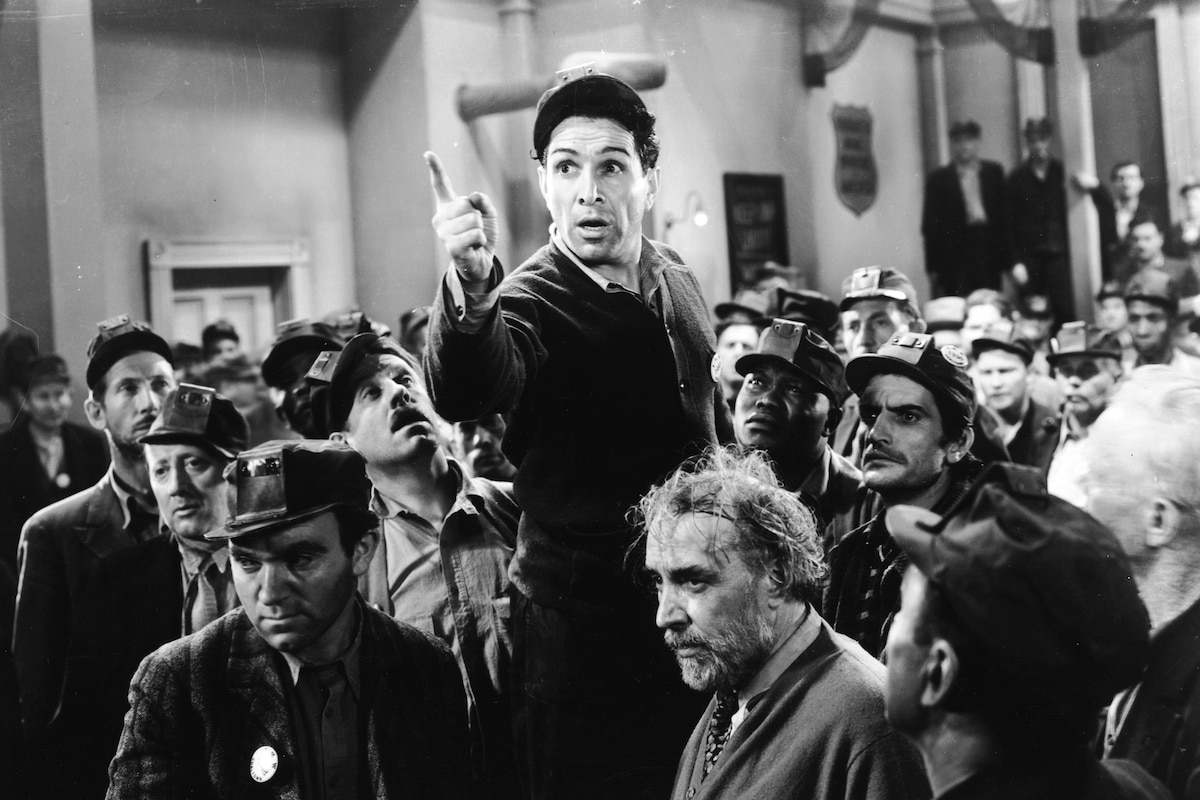
In the film, Muni plays Joe Radek, a coal miner who is engaged to Anna Novak (Karen Morley). When Anna leaves Joe for another man, Joe gets drunk and wanders into a meeting for the miners where an agitator is trying to get the men to reorganize their union. Roused to action, Joe becomes very vocal and by the end of the meeting a group has broken off and formed a new union under his leadership. The next day, however, company officials prevent the men from working. A fight breaks out and a company officer kills Joe's friend, Mike Shemanski (John Qualen). In the fracas, Joe is beaten so badly he has to be hospitalized but despite his injuries, Joe returns to the mine and barricades himself inside with dynamite. Through this desperate act, he hopes he can force the mine owners to recognize the union.
Warner Bros. was careful not to publicize Judge Musmanno's connection to the production during filming since he was NOT very popular in the mining communities after the publication of his story. The studio knew mining companies would not want to cooperate with a film Musmanno was affiliated with and, since another strike was looming on the horizon, the studio wanted to keep things peaceful on the set for director Michael Curtiz and his crew. Eventually, Curtiz and cinematographer Byron Haskin took a crew to Pennsylvania to get footage of actual mines and to examine the miner's living conditions. Once the film was complete however, Warner Bros. played up the connection to Musmanno since they thought the judge's controversial reputation would help bring in audiences.
In addition to the footage from real Pennsylvania mines, Warner Bros. created their own coal mine on the Warner Ranch at Calabasas, California. The mine was complete with tunnels, shafts, elevators, and coal. Filming began on Black Fury on October 18, 1934, just one week after Paul Muni finished Bordertown (1935). Muni originally expected to finish the latter film over the summer, but a series of script revisions kept pushing it back, making the actor overly anxious about the short turnaround time between projects. In addition to the psychological shift he had to make between his role as Ramirez in Bordertown and the character of Radek in Black Fury, Muni also had to change his physical appearance. With the help of make-up artist Perc Westmore, Muni decided Radek should have blonde hair. According to Jerome Lawrence in Actor: The Life & Times of Paul Muni, "Muni approved but felt a wig, no matter how expert, would seem false, so they went to work on his own hair. Muni himself had brewed up walnut stain for the jet-black hair of Ramirez. Westmore found that walnut stain doesn't unstain easily. They bleached and bleached, including his eyebrows and the stubble on his chin. Then Westmore literally turned a cereal bowl over and gave Muni a typical 15-cent Pennsylvania coal-town haircut. When he stared into the mirror, Muni said, "That I guarantee you is a Polack, born and reborn." Then he laughed. "Nobody can say I'm not willing to dye for dear old Warner Brothers!"
While there were rumors that Muni and Curtiz clashed during the making of Black Fury, they basically respected each other though Muni did occasionally try to use his clout as Warner Brothers' most prestigious actor. In one incident, he tried to have co-star Vince Barnett taken off the film because he felt Barnett's performance was inappropriate in the context of the film. According to Barnett in the Michael Druxman biography, Paul Muni: His Life and His Films, "There was nothing personal in his actions, since we had been friends since Scarface. He just felt that, in such a serious film as Black Fury, there shouldn't be any comic relief. Lucky for me, Mike Curtiz disagreed with him and I stayed. There were no hard feelings on Muni's part and I worked with him again on The Woman I Love."
When Black Fury was released, it sparked a wave of controversy. According to Lawrence's biography, "The state boards in Maryland and Illinois banned it outright. There were long debates before it was shown, reluctantly, in Pennsylvania (They objected to the unflattering portrayal of Pittsburgh). The New York board demanded the cutting of the scene of the brutal killing of Mike Shemanski, John Qualen's vivid parallel to the real-life John Barkowski." Since it had only been a few years since Barkowski's death, the events in the film stirred up volatile emotions and not just due to the political and social issues. Some local state censor boards blocked the film's exhibition due to its steamy love scenes between Karen Morley and her two co-stars, Gargan and Muni. Interestingly enough, the Hays office unanimously approved the film. However, when Hays himself later saw it, he "wondered whether he and the Production Code boys had screened the same print. He believed that Black Fury violated Code regulations on criminal behavior." But Production Code administrator Joe Breen held his position calling Black Fury "a fine social document" and "distinguished artistic achievement."
Despite receiving some critical acclaim for handling such a controversial topic with intelligence and compassion, Black Fury did not receive any Academy Award nominations. Some believe the film was simply too political to be acceptable in Hollywood.
Director: Michael Curtiz
Producer: Robert Lord
Screenplay: Abem Finkel, Carl Erickson. Based on the play Bohunkby Harry R. Irving and the story "Jan Volkanik" by Judge M. A. Musmanno.
Cinematography: Byron Haskin
Art Direction: John Hughes
Music: Howard Jackson, Bernhard Kaun
Cast: Paul Muni (Joe Radek), Karen Morley (Anna Novak), William Gargan (Slim), Barton MacLane (McGee), John Qualen (Mike Shemanski), J. Carrol Naish (Steve Croner), Mae Marsh (Mary Novak), Ward Bond (Mac).
BW-95 min.
by Deborah L. Johnson
Black Fury
by Deborah L. Johnson | January 17, 2003
SIGN UP FOR OUR NEWSLETTERS

CONNECT WITH TCM