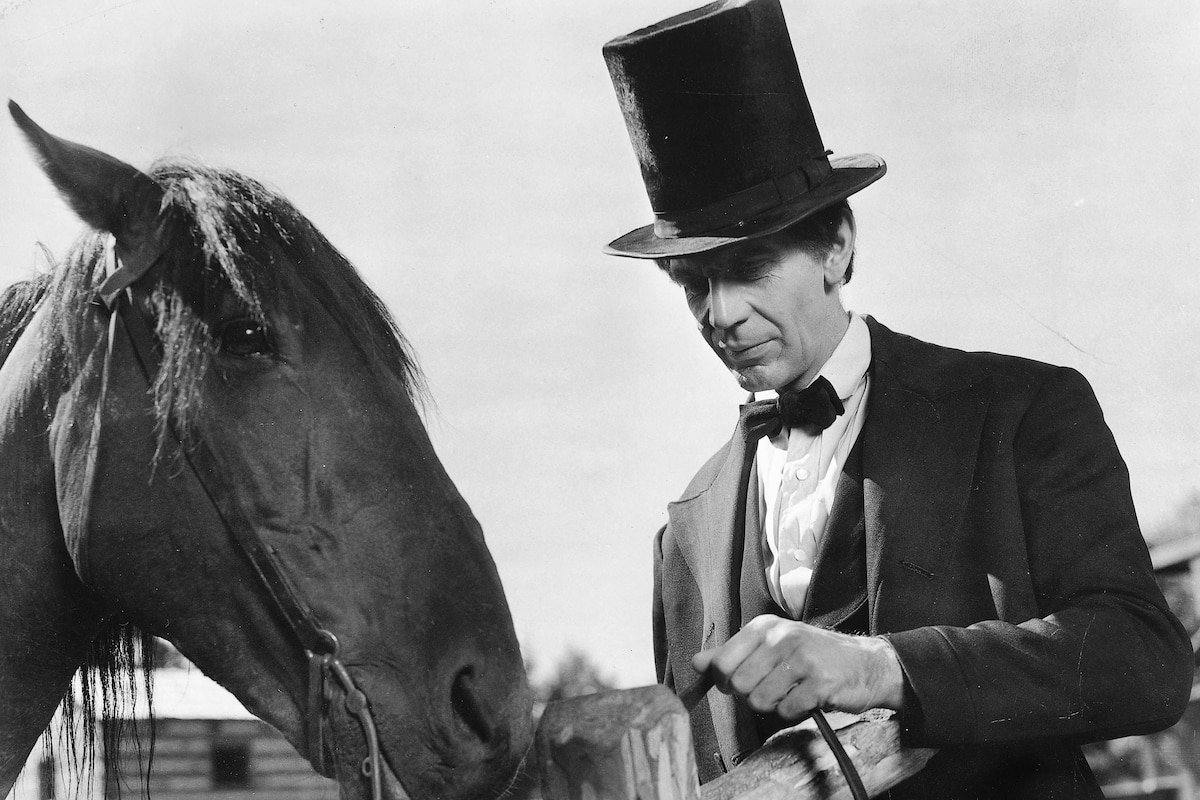
On Feb. 12, 1940, RKO released Abe Lincoln in Illinois a mere nine months after Twentieth Century Fox had released Young Mr. Lincoln. Both pictures covered the same events in Lincoln's life, and both featured major stars portraying the President - Henry Fonda in the Fox film, Raymond Massey in the RKO film.
Ironically, Young Mr. Lincoln was the more successful of the two and is better known today even though Massey's performance as Lincoln is the one for which he will forever be remembered. Massey had perfected the role on Broadway in Robert Sherwood's masterful play, which opened in October 1938. The play had special resonance in Depression-era America; Lincoln's determination to fight for the moral principles upon which the United States was founded felt urgent and timely. As the play became a huge hit and won the Pulitzer Prize, Hollywood took notice, even though the industry knew that Fox was already in production on Young Mr. Lincoln. Offers for the movie rights started pouring in.
Massey did not hold out much hope that he would get to reprise his role because, as he later explained, "In the twenties and thirties a stage actor was hardly ever chosen to repeat his role on the screen. Good plays were reserved for the many stars on contract. In trade papers and gossip columns, about the only star who was not mentioned as a probability for the screen Abe was W.C. Fields." But as it turned out, independent producer Max Gordon wound up with the film rights (for $250,000, a hefty sum in those days) and chose Massey to play the role. Massey was still performing on Broadway and agreed to do it with the assurance that he would rejoin the original Broadway cast for a touring production once shooting was over.
The picture was shot mostly in Hollywood with three weeks on location in Oregon, doubling as Illinois. Writing in his memoirs, Massey recalled sharing the screen in Oregon with many barnyard animals, including "fifty pigs which the young Lincoln managed to deposit in the McKenzie River when, by his inexpert navigation, a raft carrying the pigs careened over a waterfall. It was a scene which could only be shot once a day, for it took some eight hours to get the raft back above the waterfall. But without any rehearsal, the pigs entered into the spirit of the scene and all gave superb performances, acting with porcine abandon. They were all tilted into the river and showed the onlooking salmon how swimming should really be done. We got it on the first take with all the cameras."
All that work on the pig sequence resulted in about one minute of screen time. By contrast, the crew shot the Lincoln-Douglas debate scene, one of the highlights of the movie, in a single night on the RKO lot - resulting in 13 minutes of finished film.
When the release print was ready in December 1939, Massey was touring with the stage company in Detroit. He saw the film there and was surprised to see that a key scene of the story had been deleted: "the prairie scene with the beautiful prayer for the sick boy, the scene which explained Abe Lincoln's recognition of his destiny. Without it the story had become a documentary, a procession of episodes." Massey called Robert Sherwood, who was "heartbroken" about the cut but had resigned himself to it. Determined to fix the problem, Massey then called the film's producer, Max Gordon, but all he got was a terse, "You've been paid, mind your own business!" That was that.
Abe Lincoln in Illinois debuted in Washington, D.C. The night before the official premiere, Massey, Sherwood and their wives had dinner at the White House with President Franklin D. Roosevelt, followed by a special screening for the President. Massey remembered, "Bob and I sat next to President Roosevelt. He was in jovial spirits and seemed to enjoy the picture. He muttered, 'He wrote those speeches himself!'" Critics loved Abe Lincoln in Illinois and Raymond Massey was nominated for a Best Actor Oscar®. James Wong Howe also was nominated for his black and white cinematography. But the public stayed away and the studio took a $750,000 loss. Perhaps they'd just been Lincolned out.
Massey would play Lincoln again in the movie How the West Was Won (1962), the play The Rivalry, and on TV and radio.
Producer: Max Gordon
Director: John Cromwell
Screenplay: Robert E. Sherwood, Grover Jones
Art Direction: Van Nest Polglase, Carroll Clark
Cinematography: James Wong Howe
Editing: George Hively
Music: Roy Webb
Cast: Raymond Massey (Abraham Lincoln), Ruth Gordon (Mary Todd Lincoln), Gene Lockhart (Stephen Douglas), Mary Howard (Ann Rutledge), Dorothy Tree (Elizabeth Edwards).
BW-110 min. Closed captioning.
by Jeremy Arnold
Abe Lincoln in Illinois
by Jeremy Arnold | January 29, 2008
SIGN UP FOR OUR NEWSLETTERS

CONNECT WITH TCM