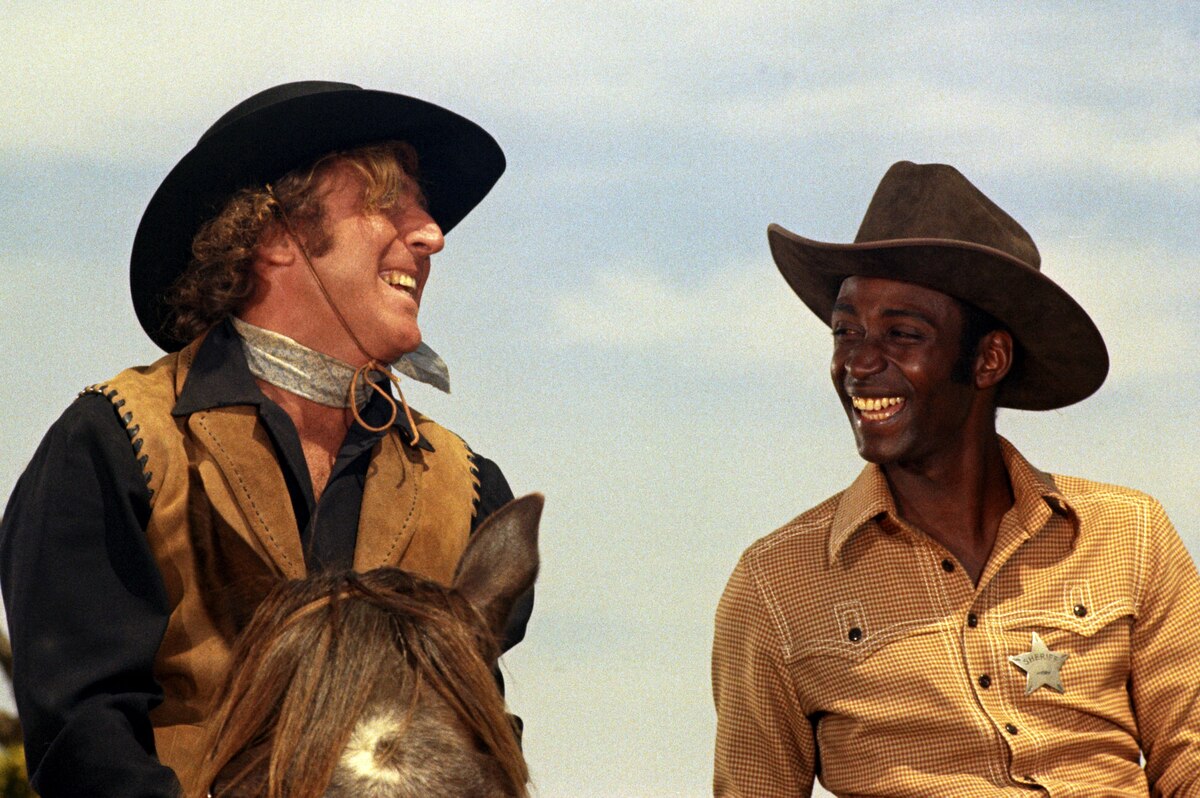
Blazing Saddles (1974) is quintessential Mel Brooks -- a Western spoof loaded with inside jokes, anachronisms, toilet humor and the director's favorite actors performing his favorite form of broad burlesque comedy. Cleavon Little is Bart, a black sheriff hired by the nefarious Hedley Lamarr (Harvey Korman) to get the residents of Rock Ridge, who live in the way of his railroad, to sell out. But the plan backfires and the new sheriff and his deputy, the Waco Kid (Gene Wilder), a reformed gun-and-bottle-slinger, stand up against Lamarr and his thugs.
Blazing Saddles was a huge box-office hit and remains the highest-grossing Western of all time, though critical reviews were mixed when it first opened theatrically. Newsweek proclaimed the picture an "insane take-off on the classic Western. . . .triggering laughs that measure a full ten on the Richter scale." Variety wasn't so sure, however, finding the R-rated language "incessant" and that "if comedies are measured solely by the number of yocks they generate from audiences, then Mel Brooks' 'Blazing Saddles' must be counted a success. . . .Few viewers will have time between laughs to complain that pic is essentially a raunchy, protracted version of a television comedy skit."
The film's opening theme song, "Blazing Saddles," is a "Mule Train" send up. It's sung by Frankie Laine (the western singer who made "Mule Train" a hit) and sets the stage for a tongue-in-cheek parody of the genre. Reportedly, Brooks put out the call for a Frankie Laine-like singer, never imagining he'd get the real McCoy when the singer showed up in his office saying he'd like to do it himself.
Gene Wilder plays the Waco Kid, Sheriff Bart's one ally. Gig Young was originally cast in the role (John Wayne had already turned the part down as being too silly), but on the day of the scene in which the Kid, drunk in his cell, first meets Bart, Young, a certified drinker himself, was doing some serious method acting and was carried away with the tremors. Wilder, who had reportedly begged Brooks for the part early on, was on a plane a day later to take over.
The role of Bart was originally supposed to go to Richard Pryor, one of the film's writers, but the actor/comedian was considered too controversial at the time, and Brooks couldn't secure financing with Pryor in the film, so the role went to the less problematic Little.
Blazing Saddles is rife with cameos. Naturally, Brooks is everywhere (he also wrote three songs for the soundtrack) - as Governor LePetomane (the stage name of a French stage performer famous for punctuating his stories with flatulence) and as a Jewish Indian Chief who speaks Yiddish and a WWI aviator. Gilda Radner (later to become Gene Wilder's wife) has a cameo in the church, and Count Basie is the bandleader Bart passes in the desert.
Brooks enjoyed working with a repertoire of actors during this period. Harvey Korman (Hedley Lamarr) is a long-time Brooks fixture, appearing in High Anxiety (1978), History of the World, Part 1 (1981) and Dracula: Dead and Loving It (1995). Reportedly, actress Hedy Lamarr sued Brooks over the use of the name Hedley Lamarr and settled out of court. Madeline Kahn and Wilder would also star in Brooks' Young Frankenstein (1974) and Wilder, of course, had his first major screen role in Brooks' debut feature, The Producers, in 1968.
For sheer offensive-jokes-per-minute Blazing Saddles may still hold the world record though the recent Scary Movie (2000) probably comes close. Still, many hail Blazing Saddles as an unflinching satire of racism, while others dismiss the film as an excuse to revel in fart jokes. And let's not forget that the film was nominated for three Oscars - Best Supporting Actress (Madeline Kahn, doing a hilarious takeoff on Marlene Dietrich in Destry Rides Again, 1939), Best Editing and Best Song. But whatever the opinion, Blazing Saddles has staked its claim in film history as a one-of-a-kind take on the American West.
by Emily Soares
Blazing Saddles
by Emily Soares | January 23, 2003
SIGN UP FOR OUR NEWSLETTERS

CONNECT WITH TCM