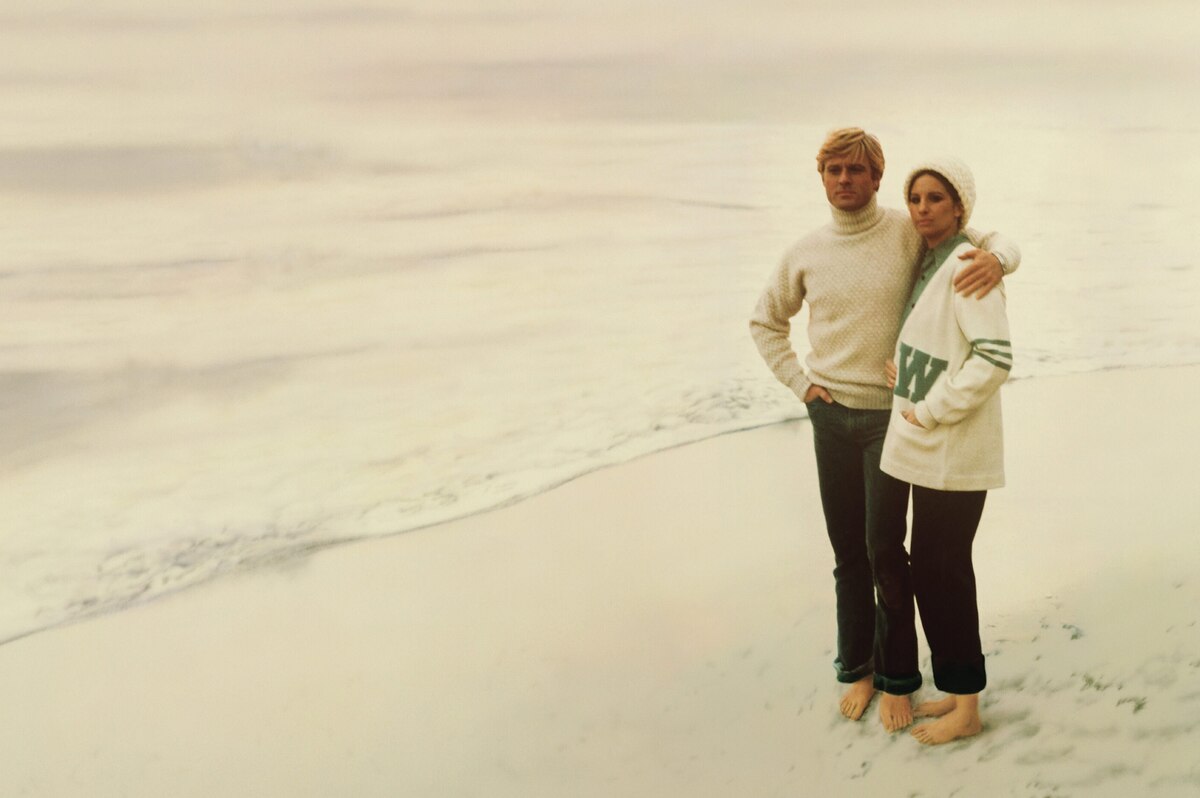
Robert Redford made the transition from rising star to international sex
symbol when he teamed with his most memorable leading lady, Barbra
Streisand, for the 1973 romantic drama The Way We Were. So strong
an impact did the film make that almost 30 years later, fans and
interviewers continue to ask them when they will be joining forces for
another film. And although the re-teaming has yet to happen, it's
interesting to note that their first get together barely made it to the
screen either.
Playwright Arthur Laurents (West Side Story, Gypsy) had been
asked to write a dramatic film script for Barbra Streisand by producer Ray
Stark, who had helped make her a star with both the stage and screen
versions of Funny Girl (1968). Struck by Streisand's fiery nature and
political interests, Laurents started a story inspired by a campus radical
he had known in the '30s, giving her an unlikely crush on her exact
opposite, a blond writer from a privileged background. To this he added
his own memories of campus political protests and life in Hollywood during
the anti-Communist Witch Hunts to forge the romance of Katie Morosky and
Hubbell Gardner. Stark loved the treatment, and Laurents turned his
original 125-page narrative into a novel that reached publication before
the film's release.
Originally Stark and Streisand were interested in casting her co-star from
What's Up, Doc? (1972), Ryan O'Neal, in the male lead. The stars had
started a romance during filming, but by casting time the relationship had
cooled, and so had their chemistry. Then Stark and Streisand decided that
Redford was the perfect choice for leading man; his blond, blue-eyed
coolness would provide the perfect contrast to her. But Redford didn't
care for the first draft screenplay and turned them down, complaining that
the male character was undeveloped compared to the female lead.
Fortunately, their first choice for director, Sydney Pollack, had worked
with Redford and was instrumental in promising him the re-writes that would
make the role more acceptable. When Laurents' final draft didn't please
him, they fired the original writer and went through 11 others, including
Francis Ford Coppola and Dalton Trumbo, trying to come up with the right
balance.
By this point, shooting had begun. Locations for the college scenes had
been set for Williams College in Massachusetts, but the delays caused by
getting Redford to sign and going through re-writes had pushed production
too late for the school to accommodate, so they had to move to Union
College in Schenectady, N.Y., instead. By this point, the screenplay was a
mess, filled with holes left by the many different writers, so Stark and
Pollack begged Laurents to return, at a much higher fee. Streisand had
been fighting all along to restore some of his cut material. With his
help, they tried to get even more back in, though they didn't always
succeed. Adding to the on-set problems was a big difference between the
two stars' approaches to acting. Although they respected each other a
great deal, Streisand liked to discuss her work in copious detail before
shooting, while Redford felt that discussions robbed his work of freshness.
Pollack had to bring their different methods together, often by spending
hours on the phone with Streisand each night to discuss the next day's
shooting.
Despite all the problems, however, previews indicated that The Way We
Were was going to be a winner. For all his initial misgivings,
Redford's performance registered very strongly with viewers. Afraid that
he was stealing the picture, Streisand reconsidered an earlier decision not
to sing in the film (she wanted to be appreciated solely as a dramatic
actress) and agreed to record the title song for use in the soundtrack.
The song helped make the film an even bigger success, bringing Streisand her
first number one hit and first gold record. It also made Marvin Hamlisch
the first composer to win all three Oscars®: for music in a single year.
He won for Best Song and Best Original Score for The Way We Were and
Best Adapted Score for Redford's other big 1973 hit, The
Sting.
With the movie's strong showing at the box office and continuing popularity, fans have long demanded a sequel from the two stars. Laurents actually wrote one set in the late '60s at Redford's urging. His story would have had Katie and Hubbell brought back together by their
daughter's involvement in the anti-war movement, with a major sequence
involving them in the riots at the 1968 Democratic Convention in Chicago.
At one point, Streisand was even planning to produce and direct the picture
herself, but nothing has ever come of it. A few years back, Stark
approached Laurents with another proposal for using the material -- as a
stage musical to star Kathie Lee Gifford. That this never came to pass may
bring fans of the original at least some consolation.
Producer: Ray Stark
Director: Sydney Pollack
Screenplay: Arthur Laurents
Cinematography: Harry Stradling, Jr.
Art Direction: Stephen B. Grimes, William Kiernan
Music: Marvin Hamlisch
Principal Cast: Barbra Streisand (Katie Morosky), Robert Redford (Hubbell Gardner), Bradford Dillman (J.J.), Lois Chiles (Carol Ann), Patrick O'Neal (George Bissinger), Viveca Lindfors (Paula), Allyn Ann McLerie (Rhea Edwards), Herb Edelman (Bill Verso), Sally Kirkland (Pony Dunbar), James
Woods (Frankie McVeigh).
C-119m. Letterboxed. Closed Captioning.
by Frank Miller
The Way We Were
by Frank Miller | January 21, 2003
SIGN UP FOR OUR NEWSLETTERS

CONNECT WITH TCM