New York came to life as never before in MGM's The Clock (1945), even
though no scenes with any cast members were actually filmed in the Big Apple. Thanks to
rear projection, ingenious art direction and the memories of director
Vincente Minnelli, who had started his career as a designer and director
there, MGM created one of the most vivid images of New York City life ever
captured on screen.
None of that would have happened, however, if producer Arthur Freed hadn't
had to resort to a third choice to direct the film. In 1943, he had fallen
in love with Paul and Pauline Gallico's story of a soldier who meets and
marries a girl during a whirlwind two-day leave, so MGM picked up the
rights for $50,000. Then, when Judy Garland's erratic behavior on Meet
Me in St. Louis (1944) created concern in the front office, he convinced them
to make her next film a smaller picture and her first non-musical since
joining the studio ten years earlier. Originally, Jack Conway, a studio
veteran best known for breezy comedies and tough adventures, was assigned
to direct, but health problems forced his replacement by Fred Zinnemann,
who had recently made the transition from shorts to B-movies. Zinnemann had just
scored with his first big-budget film, the World War II drama The
Seventh Cross (1944), starring Spencer Tracy. But he and Garland
couldn't communicate. His laid-back approach didn't work for an actress
who was desperately insecure about undertaking her first dramatic role.
After 24 days of trying to work together, Garland begged Freed to take him
off the film. Aware of their problems, Zinnemann had no problem stepping
down. The studio might have scrapped the picture altogether if they hadn't
already invested a good deal of money in it, including over $60,000 to
build a copy of Grand Central Station. Garland then asked Minnelli, whom
she had dated for a while after their work together on Meet Me in St.
Louis, to take over the picture.
Minnelli threw out most of Zinnemann's footage and also expressed concern
over some of the writing. Over the screenwriters' protests, he used
improvisation on the set to flesh out the characters and create a number of
surprising comic vignettes. He also worked with the art direction team to
re-create various locales he remembered from his New York days, turning the
city itself into one of the film's major characters. In addition, he
lavished attention on Garland and her performance, and before long, the
romance that had waned after their previous film had ended was in full
bloom again. After completing their work on The Clock, Minnelli
introduced Garland to the real New York when MGM sent them there to promote
the premiere of Meet Me in St. Louis. Early the next year, they
announced their engagement.
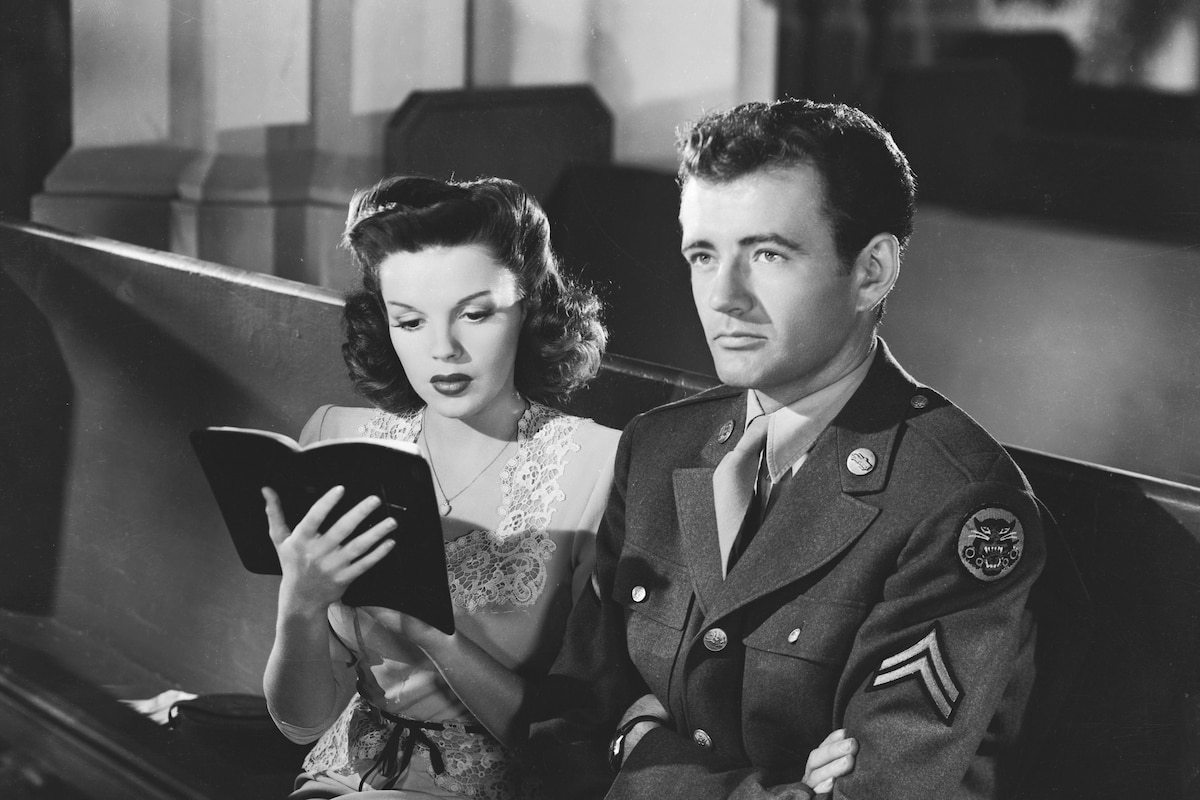
The Clock provided a strong role for another troubled MGM performer,
Robert Walker. After a series of comedies, the film showed him at his best
in the understated dramatic role of Garland's military suitor. Actually,
they had been slated to team for Meet Me in St. Louis before MGM
decided he was becoming too important for the role of "the boy next door"
in that film and used it to build up newcomer Tom Drake. At the time,
Walker was suffering terribly from the break-up of his marriage to Jennifer
Jones, who was being wooed by independent producer David O. Selznick. His
problems led to an alcohol addiction that would eventually kill him. He
never drank on the set, but Garland was aware of his situation. One night,
when she and her friends were supposed to be having a girl's night out, she
got word that Walker was on a bender. Garland searched the bars in
Hollywood until she found him, sobered him up and got him into bed in time
for a few hours sleep before the next day's filming. Even after they had
completed the film, she and Minnelli continued their efforts to help Walker
overcome his drinking problem.
MGM turned a tidy profit from The Clock, $2.8 million in grosses on
an investment of $1.3 million. The film won strong reviews, too,
particularly from the New York critics, who marveled at Minnelli's
re-creation of their city. Though it came up empty when the Academy
Awards® nominations were announced, it now ranks as a minor classic,
proving both Minnelli's facility as a director and Garland's power as a
dramatic actress.
Producer: Arthur Freed
Director: Vincente Minnelli
Screenplay: Robert Nathan & Joseph Schrank
Based on the Story by Paul and Pauline Gallico
Cinematography: George Folsey
Art Direction: Cedric Gibbons, William Ferrari
Music: George Bassman
Principal Cast: Judy Garland (Alice Mayberry), Robert Walker (Cpl. Joe
Allen), James Gleason (Al Henry), Keenan Wynn (The Drunk), Marshall
Thompson (Bill), Lucile Gleason (Mrs. Al Henry).
BW-91m. Closed captioning.
by Frank Miller
The Clock
by Frank Miller | July 28, 2003
SIGN UP FOR OUR NEWSLETTERS

CONNECT WITH TCM