A dramatic change of direction occurred in 1993 when director Martin Scorsese's film adaptation of Edith Wharton's novel The Age of Innocence debuted. Wharton's 1920 Pulitzer Prize-winning novel of manners and social mores in 19th-century New York was a marked departure from Scorsese's usual stomping ground of street-savvy criminals and mobsters in films like Mean Streets (1973) and GoodFellas (1990).
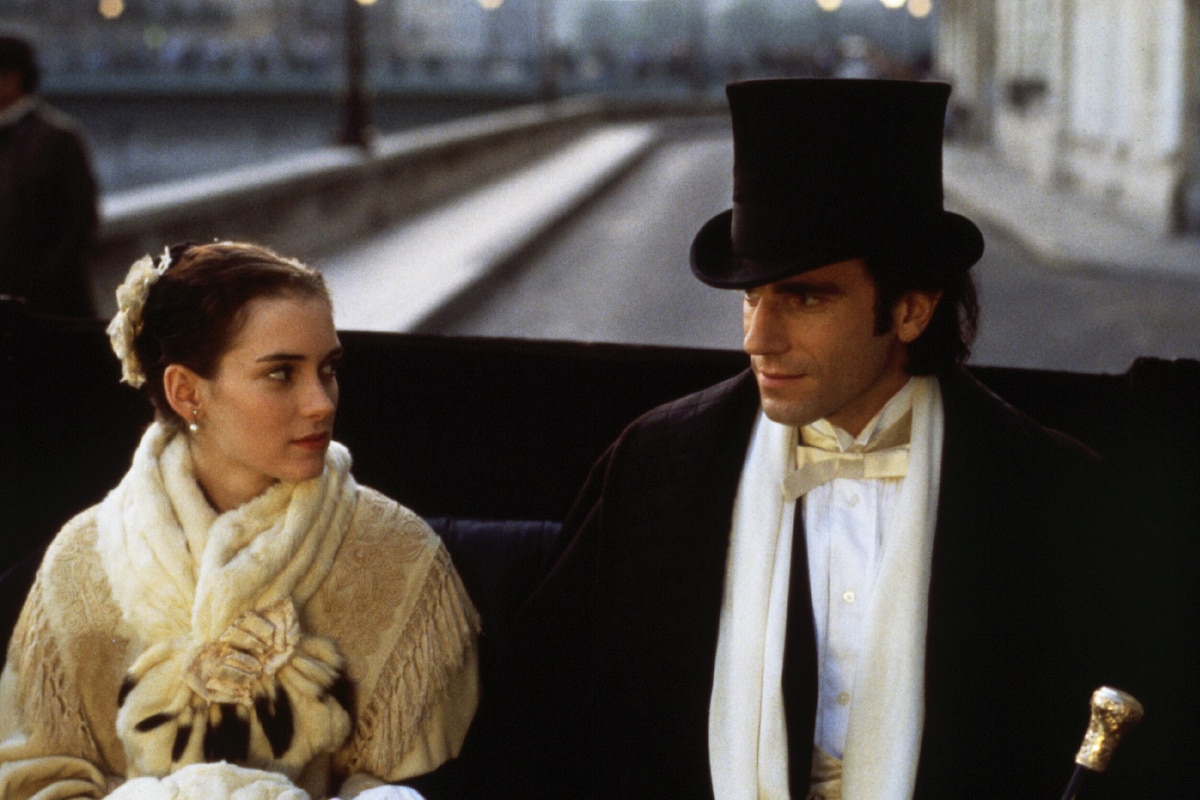
British actor Daniel Day-Lewis stars in The Age of Innocence (1993) as Newland Archer, a well-connected, socially correct lawyer, beginning to question the rigid code of behavior that governs the upper-class society in which he lives - even as he makes plans to further guarantee his place within its conservative ranks. By marrying the equally refined but unimaginative, vapid May Welland (Winona Ryder), Newland will be assuring his safe, dull position within this emotionally constrictive world.
Newland is jolted out of his complacency and a predictable future, however, by the arrival in New York of May's cousin, the mysterious, controversial but exquisitely beautiful Countess Ellen Olenska (Michelle Pfeiffer), who has fled Europe and a disastrous, unhappy marriage to a philandering Polish aristocrat. In Ellen, whose sordid, dissolving marriage places her on the periphery of polite society, Newland also sees a woman who marches to her own unique tune. With her Continental sophistication and intelligence, Newland glimpses the chance for an escape from repressive, deadening propriety and a hope of true love. That dramatic choice, between two entirely different life courses, between conformity or rebellion provides the pulse-quickening tension and eroticism in Scorsese's beautifully realized treatment of suffocating social codes and how they deform Newland's chance for real happiness.
Some critics were quick to look beyond the opulent opera and dining room settings of The Age of Innocence and find a common ground between the closed society of 1870s New York and the separate worlds of criminals found in other Scorsese ventures. A shared, rigid, unbreakable code of honor and loyalty exists amongst these aristocrats and Scorsese's more familiar duty-bound mobsters.
Though nominated for five Academy Awards, the film's almost reverential treatment of the plush, perfect order of Wharton's sumptuously appointed wealthy upper class, from its elaborate table settings to its exquisite ball gowns, struck many as strained and artificial, and evidence of Scorsese's uncharacteristic awe of this posh aristocratic milieu. Others noted Scorsese's inability to fully convey Wharton's observant authorial "voice" and her satirical skewering of the same social class she also revered. Wharton's vantage is delivered throughout the film by voice-over narration taken directly from Wharton's book, spoken by Joanne Woodward. In an unusual attempt to stick to the rhythms of Wharton's prose, Scorsese actually fit scenes around Woodward's narration, so that shots were planned after the fact, to fit the rhythm and context of the narration.
Others were rightly amazed at Scorsese's ability to render so much of the tone and look of Wharton's world, as well as the heartfelt manner in which the director treated this painful story of unconsummated love. Laden with complex levels of repression, The Age of Innocence reveals depths of characters and knowledge previously hidden, most startlingly in the supposedly passive May, who reveals a stronger will than Newland ever imagined. Ryder won an Academy Award nomination for her nuanced performance as the lovely but inert May. The Age of Innocence also boasted strong performances from key and peripheral characters as well. Michelle Pfeiffer's subtle expressions of fear and sadness are especially moving, making the frustrated passion between Newland - yearning for one woman while promised to another - sizzle with a genuine erotic charge noted by several critics.
Critics like New York magazine's David Denby were especially impressed by how convincingly the principal actors conveyed emotion in a society that refused to acknowledge passion or intense feeling of any kind. Said Denby of Day-Lewis's pained, moving performance, "Newland is in a state of despair that his training as a gentleman gives him no way of expressing." The secondary performances in The Age of Innocence are equally noteworthy, especially Miriam Margolyes as the obese, sedentary society matron Mrs. Mingott, who holds court in her lush Manhattan mansion and holds the fates and fortunes of many of New York's upper class in her hands.
Approaching the elaborate codes of behavior of Wharton's world with some trepidation, Scorsese devoted a full 18 months to research. Evoking that lost world of 19th-century society proved not mere affectation, but crucial to the director's vision for the film. As Scorsese observed of the need for historical accuracy, "If you can make the world where Newland Archer lives real, and his obligations real, then you can make his passions real." But Scorsese's script (co-written by New York Times critic Jay Cocks) and astute direction managed to convey the painful gravity to people who give up everything they desire for propriety's sake, and wind up empty and unfulfilled for their fear. The Age of Innocence, which had been adapted twice before by Hollywood (in 1924 and 1934), continued a recurring theme in Scorsese's films, of individuals gravely rebelling against social constraints. Though it was said to take the notoriously non-bookish Scorsese seven years to read The Age of Innocence, it proved intoxicating to the director as a way to treat the theme of unconsummated love in a modern age when the very concept was anachronistic.
While some similarity could be found between the rigid codes of the New York aristocracy in Wharton's time and the criminal demimonde of Scorsese's film universe, the novelist herself bore some resemblance to the iconoclastic, maverick Scorsese, who was part of an elite coterie of directors including Francis Ford Coppola, Brian De Palma, Paul Schrader, Steven Spielberg and George Lucas -- who redefined cinema in the seventies. A complicated woman and rebel of some degree herself, Wharton was almost 60 when she wrote The Age of Innocence, considered her best work. And though she came from the world she wrote about, Wharton was also an outsider who managed to thrive outside its rigid codes. Divorced from a passionless husband, Wharton took a lover in middle age and fled - like Countess Olenska - to the relative freedom of Europe, where she dabbled in writing pornography and was a friend to writers Sinclair Lewis and Aldous Huxley.
Producer: Barbara De Fina
Director: Martin Scorsese
Screenwriter: Jay Cocks and Martin Scorsese, from the novel by Edith Wharton
Director of Photography: Michael Ballhaus
Production Design: Dante Ferretti, Robert J. Franco
Music: Elmer Bernstein
Principal Cast: Daniel Day-Lewis (Newland Archer), Michelle Pfeiffer (Countess Ellen Olenska), Winona Ryder (May Welland), Alexis Smith (Louisa Van Der Luyden), Geraldine Chaplin (Mrs. Welland), Mary Beth Hurt (Regina Beaufort), Alec McCowen (Sillerton Jackson), Richard E. Grant (Larry Lefferts), Miriam Margolyes (Mrs. Mingott).
C-139m. Letterboxed. Closed captioning.
The Age of Innocence (1993)
by elicia Feaster | January 21, 2003
SIGN UP FOR OUR NEWSLETTERS

CONNECT WITH TCM