Tillie's Punctured Romance, directed by Mack Sennett and released in November 1914,
holds the distinction of being the first feature-length comedy film ever
made. At the time, feature films were only two years old and were
generally the domain of "important" literary adaptations and historic epics,
such as Cleopatra (1912), Shakespeare's Richard III (1912)
and D.W. Griffith's Judith of Bethulia (1913). Comedy was
considered best served in small doses, but Sennett, already a pioneer in the field of slapstick, was confident that the two-reel barrier could be broken.
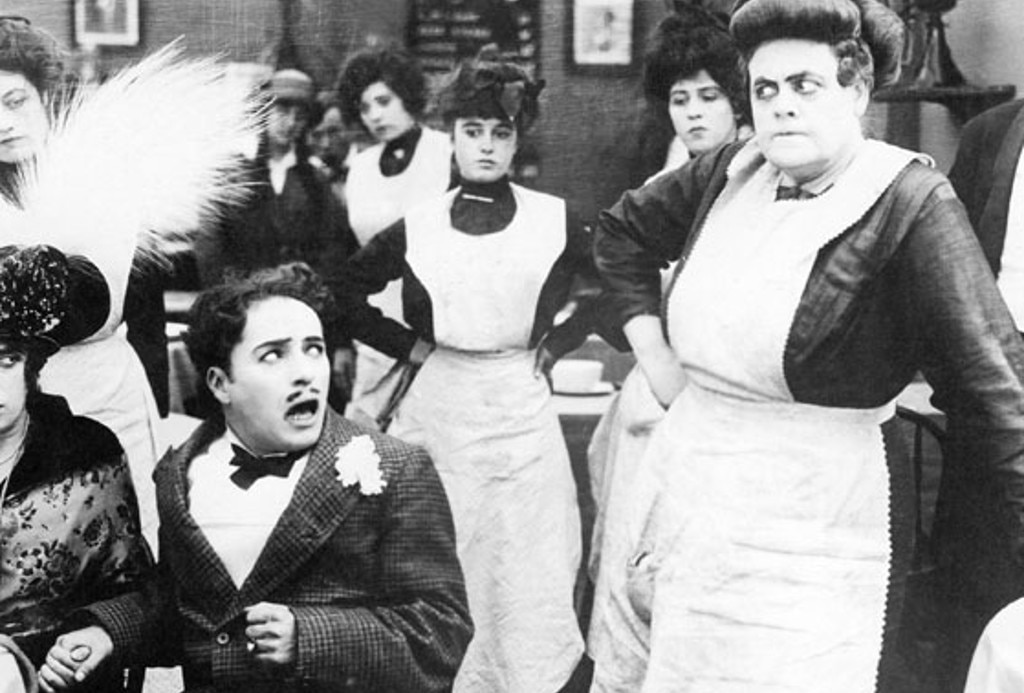
Marie Dressler stars as Tillie Banks, a vivacious if ungainly farm girl who
falls under the spell of Charlie, a big-city chiseler (Charlie Chaplin). Charlie
romances Tillie, steals her money, and flees the scene with his
girlfriend/confederate (Mabel Normand). When Tillie's wealthy uncle falls
from a mountaintop, she stands to inherit a massive fortune, inspiring
Charlie to resume their romance. Charlie marries Tillie and they move into
a lavish estate, and the jealous Mabel takes a job as a housemaid to be
close to her former partner in crime. A series of comic episodes,
including a hilariously inept tango, Tillie's discovery of Charlie in a
compromising position and the sudden return of Tillie's "deceased" uncle
launches the film toward its madcap finale, in which the Keystone Kops are
called in to restore order to the newlyweds' disrupted domicile.
Tillie's Punctured Romance originated as a vehicle for Dressler (1869-1934), who had achieved great fame as a star of the musical comedy stage but had never appeared in
a motion picture. After securing the actress's services for the
phenomenally expensive price of $2,500 per week (for a minimum of 12
weeks), Sennett and company began searching for a story suitable to this
high-profile groundbreaking comedy. Keystone Studios screenplay editor
Craig Hutchinson struck upon the idea of retooling one of Ms. Dressler's
previous successes, Tillie's Nightmare, which had opened at New
York's Herald Square Theater on May 5, 1910 (and which debuted the popular
song "Heaven Will Protect the Working Girl"). Screenwriter Hampton Del Ruth and Hutchinson supplied the revamped title of the film, which had at various stages of production been known as
Dressler No. 1 and She Was More Sinned Against Than Necessary.
Curiously, the trade publication Moving Picture World stated that
Tillie's Punctured Romance would be Dressler's first and last screen
appearance but, probably due to the movie's overwhelming popularity, she
quickly changed her mind and pursued a film career. Dressler was a screen
comedienne throughout the silent era, and even appeared in two
revisitations of her lovelorn creation, Tillie's Tomato Surprise
(1915) and Tillie Wakes Up (1917), neither of which were produced by
Sennett. She faded from the screen in the 1920s, but at the dawn of the
sound era, in one of Hollywood's most remarkable comebacks, Dressler
suddenly became a top star again. After her Academy Award-winning
appearance in Min and Bill (1930), Dressler -- in various
incarnations of the aging, overweight battle-ax -- became filmdom's most
unlikely leading lady, named the number one box-office attraction in
America.
While its unfettered slapstick (complete with pie fight) continues to
provoke laughter today, Tillie's Punctured Romance has not aged
gracefully, in cinematic terms. But its crude staging and the actors'
shameless mugging offer a historic snapshot of cutting-edge comedy in the
mid 1910s. Sennett's film would certainly occupy a more obscure spot in
film history were it not for the presence of the young Charlie Chaplin, who
had landed a contract with Keystone Studios earlier in the year. In his
memoirs, Chaplin was rather dismissive of the film, remarking, "It was
pleasant working with Marie, but I did not think the picture had much
merit." The truth was, Chaplin had begun to direct his own films and
enjoyed the creative spirit of on-the-spot experimentation that
characterized his sets, and found it difficult to suddenly follow the
demands of another filmmaker. Said Chaplin, "I was more happy to get back
to directing myself again." With the exception of a few cameo appearances,
Chaplin would never again appear in a film directed by anyone other than
himself.
Among the directors Chaplin had worked for in the early months of his
career was his co-star Mabel Normand. An often overlooked silent screen
personality, Normand was among the first women filmmakers in Hollywood, as
well as one of its most popular stars. Her skills at comedy were so deft
that she could share the screen with slapstick legends such as Chaplin or
Fatty Arbuckle without being outshined. For years Normand was involved in
an on-again/off-again romantic relationship with Sennett but the pair never
married, even though they remained friends and collaborators until
Normand's death in 1930.
Before proving his genius at comedy, Sennett had been an actor at the
Biograph Studios, often appearing in the films of D.W. Griffith, including
The Lonely Villa (1909) and The Last Drop of Water (1911).
Supposedly Sennett's entry into show business came about via Dressler. In
1902, he introduced himself to the actress with a letter of referral from
the Sennett family's lawyer, Calvin Coolidge. Impressed by the
22-year-old's ambition, Dressler in turn wrote a letter of recommendation
to New York producer David Belasco. Although the legendary impresario did
not hire Sennett, the young actor's pursuit of stardom was thus set in
motion.
While producing films first at Biograph, then at Keystone Studios, Sennett
developed a roster of stars that would become a who's who of slapstick
cinema: Chaplin, Arbuckle, Al St. John, Ford Sterling, Chester Conklin,
Edgar Kennedy, Charley Chase and Mack Swain, among many others. Even
though Dressler was instrumental in Sennett's climb to power, the two did
not work well together. Sennett wrote in his autobiography, King of
Comedy, "In the midst of a comic scene I had planned carefully
beforehand, Miss Dressler would say, 'No, Mack, that's wrong. Now this is
the way we're going to do it.' I was the head of the studio and I was
supervising this particular picture, but neither of these things influenced
Marie Dressler. My arguments didn't influence her either. 'Okay, Marie,
you do it your way,' I'd say. And I would leave the set. Usually a
sweating messenger would arrive within an hour [to summon me back]."
Disputes over the distribution of the film (which had been promised to
Dressler's husband, James Dalton) caused the actress to file various
lawsuits and appeals against Keystone, but without success, mainly because
the promise was verbal rather than written. The actress later claimed that
it was she who discovered Chaplin and selected him and Normand to appear in
Tillie's Punctured Romance: "I think the public will agree that I am a good picker for
it was the first real chance Charlie Chaplin ever had." This was, of
course, a bit of an exaggeration. By the time Tillie's Punctured
Romance was produced, Chaplin had already appeared in more than 30
films and was soon to leave Keystone for a lucrative contract at the
Essanay Studios.
Dressler did, however, have a say in who was cast in the film -- or rather,
who was not cast in the film. She refused to allow Roscoe "Fatty"
Arbuckle to co-star with her. Both in terms of screen popularity and
physical girth, Dressler insisted upon being the "biggest" star to appear
in Tillie's Punctured Romance.
Producer/Director: Mack Sennett
Screenplay: Hampton Del Ruth
Based on the play Tillie's Nightmare by Edgar Smith and A. Baldwin
Sloane
Cinematography: Frank D. Williams
Music: Organ score by John Muri (if David Shepard/Blackhawk version)
Principal Cast: Marie Dressler (Tillie Banks), Charles Chaplin (Charlie, the city
slicker), Mabel Normand (Mabel, his partner), Mack Swain (Tillie's father),
Charlie Murray (Detective), Chester Conklin (Guest), the Keystone Kops.
BW-73m.
by Bret Wood
Tillie's Punctured Romance
by Bret Wood | December 17, 2002
SIGN UP FOR OUR NEWSLETTERS

CONNECT WITH TCM