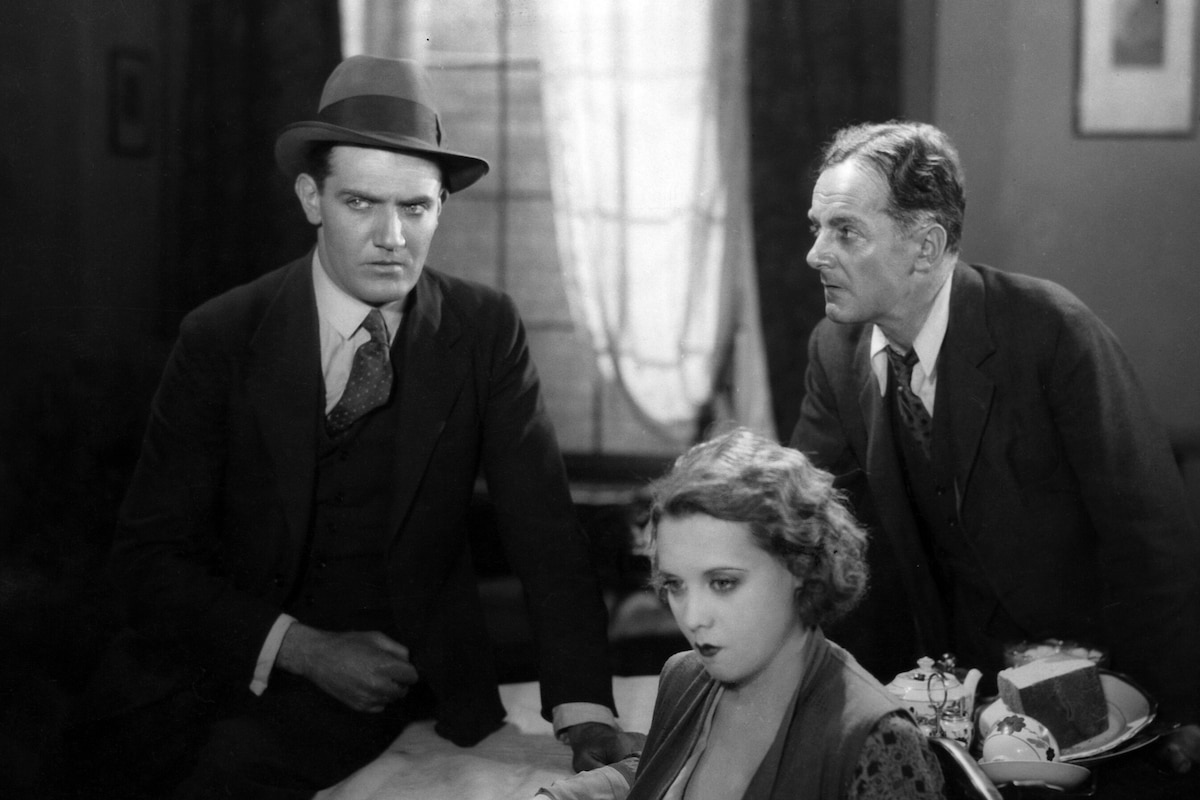
Alice White is the girlfriend of Frank Webber, a
talented young detective in Scotland Yard. After the couple quarrels in
a restaurant, Alice naively flirts with and later goes home with Crewe,
an artist who wants her to "pose" for him. When he attempts to rape her,
Alice stabs Crewe with a knife and flees the apartment. Webber, who is
assigned to the case, soon discovers that Alice is the murderer. He
plans to hide an incriminating piece of evidence--one of Alice's
gloves--in order to protect her from prosecution. Tracy, a petty
criminal, is in on the secret and wants to blackmail Frank. However,
Crewe's landlady witnessed Tracy leaving the apartment that night and
now he, rather than Alice, has become the main suspect.
The first artistically significant sound film produced in Britain,
Blackmail (1929) is a key film in the history of British cinema.
During the mid-to-late 1920s, the British film industry proved
ill-prepared to compete with the more polished and financially
successful American studio product; production in Britain declined from
136 features in 1921 to 37 features in 1926. In 1927 a quota system was
established which required a certain percentage of the screens to be set
aside for domestic films. While this helped improve attendance and
increase production, the arrival of sound film in the late twenties
complicated matters still further. A contemporary report in
Variety stated that "thirteen out of 14 first run London houses
have American talkers or synchronized pictures." One problem was that
British films typically sat on the shelf for a year before being
released to the general public. Since the introduction of sound in the
late twenties and early thirties involved extraordinarily rapid
technological change, British films were thus in danger of becoming
obsolete before they were even released to the public. In addition, the
expense of converting to sound drove many exhibitors out of business.
While Blackmail may not have been the very first talking film in
Britain (a few part-talkies were produced around the same time) it was
one of the few British films at the time that could compete to any
degree with American product. The reviewer in Variety writes: "At
this stage of talkers, mighty near the best yet. But with the certainty
of quick developments in talking technique, it needs a quick
release."
Many of the first sound films were hybrids;
Blackmail, which was initially planned as a silent, is no
exception. The opening prologue and other portions of the film are
silent with music and sound effects added. In certain portions of the
film, dialogue was apparently added to shots that were originally filmed
silent. In addition, the voice of the lead actress Anny Ondra was
dubbed. Ondra was a Polish-born actress who made films in
Czechoslovakia, Germany and Austria before moving to Britain; she had
previously worked with Hitchcock in The Manxman (1928), a
beautifully filmed and often underrated melodrama. Because of Ondra's
heavy accent (and according to some, a "reedy voice"), Hitchcock hired
the actress Joan Barry to read the character's lines off camera while
Ondra mouthed the words. While this technique may seem crude by today's
standards, it apparently convinced at least some viewers at the time; a
critic in the New York Times wrote: "Anny Ondra, a
Czechoslovakian actress who does not speak with any noticeable foreign
accent, officiates as Miss White. She has a well-defined personality and
does creditable work. The failing in her acting in some scenes is due to
the direction."
In fact, a silent version of the film
was produced alongside the far better-known sound version. Today the
silent version is rarely seen, though it does surface occasionally at
retrospectives of the director's work. Charles Barr, in his essay in
Sight and Sound, points out that two versions use different takes
even in the sequences which supposedly correspond shot-for-shot. He
hypothesizes that Hitchcock, anticipating the need to make both sound
and silent versions, deliberately filmed at least two acceptable takes
for each shot in order to create two separate negatives for the sound
and silent versions. Today some critics even prefer the silent version,
though few would deny that the sound version was ultimately more
influential.
Today Blackmail is regarded as an
important work in Alfred Hitchcock's artistic development as a director.
Together with the silent film The Lodger (1927), it helped
establish Hitchcock's critical reputation as a director of thrillers.
While the quality of sound recording in the film may seem dated to
contemporary audiences, Hitchcock's use of sound for dramatic purposes
is still striking. Hitchcock once wrote: "There have always been
occasions when we have needed to show a phantasmagoria of the mind in
terms of visual imagery. So we may want to show someone's mental state
by letting him listen to some sound--let us say church bells--and making
them clang with distorted insistence in his head." Accordingly, in
several places the film uses sound to represent the psychological state
of the protagonist. The most famous example is when Alice's gossipy
neighbor describes the murder and the word "knife" is emphasized while
the other words become increasingly blurred. Another example is when
Alice is in her family's shop and the bell attached to the door begins
to ring ever more insistently, drowning out everything else. These
devices betray the influence of German Expressionist cinema on
Hitchcock's work, as do visual motifs in the film such as stylized
shadows and the frequent use of stairs.
From a thematic
standpoint, as critic Robin Wood has pointed out, Blackmail
introduces the motif of the "guilty woman" that made for some of
Hitchcock's most profoundly resonant films: Rebecca (1940),
Notorious (1946), Vertigo (1958), Psycho (1960),
The Birds (1963) and Marnie (1964). The original source
material for Blackmail was a play by Charles Bennett; Tallulah
Bankhead, incredibly, played the leading role on the stage. According to
Hitchcock, he originally wanted to end the film with Alice being pursued
by the police, bringing the young detective's moral conflict ("love
versus duty") to a head. This ending, he claims, was turned down by the
producers for commercial reasons. However, the ending as it was made,
with its ingenious use of a clown painting to symbolize Alice's
lingering feelings of guilt, is if anything darker and more subtly
ironic than the ending Hitchcock originally had in mind.
Blackmail also establishes the classic
Hitchcockian convention of staging the climax at some famous landmark.
Here the final chase takes place in the British Museum. Other
examples include the use of Albert Hall in both versions of The Man
Who Knew Too Much (1934 and 1956), the Statue of Liberty in
Saboteur (1942) and Mount Rushmore in North By Northwest
(1959). During the British Museum sequence, the Schufftan process was
used extensively (due in part to insufficient lighting in the interiors)
to depict Tracy and the Scotland Yard detectives running through the
museum and over the dome of its reading room. The Schufftan process
was developed by cinematographer and special effects pioneer Eugen
Schufftan, who was best known for using the process in Fritz Lang's
Metropolis (1927). It involved scraping away the silver on part
of a mirror and placing the mirror at a 45-degree angle to the camera.
The action was then photographed through the clear portion of the mirror
while the silvered portion reflected the artificial background,
combining the two into a single image. That the British Museum sequence
works so well today is tribute to the technical ingenuity of the crew
and Hitchcock's unparalleled skill as a director.
Director: Alfred Hitchcock
Producer: John Maxwell
Screenplay: Charles Bennett, Alfred Hitchcock, Benn W. Levy and Garnett Weston, based on the play by Charles Bennett
Photography: Jack Cox
Set Design: C. Wilfred Arnold
Music: Campbell and Connelly, arranged by Hubert Bath and
Harry Stafford
Editing: Emile de Ruelle
Cast: Anny Ondra (Alice White), Sara Allgood (Mrs. White), Charles Paton (Mr.White), John Longden (Detective Frank Webber), Donald Calthrop (Tracy),
Cyril Ritchard (Crewe, The Artist), Hannah Jones (The Landlady), Harvey
Braban (The Chief Inspector), Ex-Det. Serg. Bishop (The Detective Sergeant).
BW-82m. Closed Captioning.
by James Steffen
Blackmail (1929) - Sound Version - Blackmail
by James Steffen | December 16, 2002
SIGN UP FOR OUR NEWSLETTERS

CONNECT WITH TCM