Director James Whale's adaptation of Mary Shelley's novel
Frankenstein became an instant horror classic when it premiered
in Santa Barbara in 1931. As remarkable for its grasp of elemental horror as it is for its
visually arresting set design, the groundbreaking Universal film set a
new standard for the genre that has continued to influence contemporary
film.
Frankenstein opens on an eerie, atmospheric note at a hillside
funeral that looks like a set piece for the German Expressionist film
The Cabinet of Dr. Caligari (1919). Whale, in fact, screened
Caligari as well as The Golem (1922) and
Metropolis (1927) to refresh his memory of German
Expressionism, a notable influence on the striking look of his
Frankenstein.
Assisted by the hunchback Fritz (Dwight Frye), probably the most famous mentally deficient sidekick in horror cinema, Dr. Frankenstein (Colin Clive) can be seen in the
film's opening waiting for the funeral to end so that he can dig a
freshly buried corpse out of its final resting place before skulking
back to his gothic lab. That night Dr. Frankenstein sends
Fritz to a local university to carry out the final step in his
reanimation project -- to steal a brain to use in their experiment crafted
from stitched-together corpses. But Fritz mistakenly selects an
"abnormal" criminal brain, which when placed in the creature unleashes
terror on their small Bavarian village.
The scene where the Monster inadvertently drowns a village girl Maria (Marilyn
Harris) was deemed too shocking and deleted from the film upon its
original release, though it was later reinstated. Mindful of the macabre aspects of its production, Universal also added a prologue to the film, spoken by Edward Van Sloan (who also provided an epilogue, now lost, to Dracula,1931) was also added, to warn viewers of
the shocking nature of what lay ahead.
Though Frankenstein had been made into other film versions,
including a 1910 Edison Company production, a 1915 version called
Life Without Soul and the Italian Master of Frankenstein
in 1920, none of them offered as memorable a movie monster as the one created by Boris Karloff. And though a flurry of movies were inspired by Whale's penultimate
horror film: The Bride of Frankenstein (1935), Ghost of
Frankenstein (1942) and many others, none has yet matched the
original power of a film which broke important ground in two regards:
in its representation of a scientist who tampers with power reserved
for God and of a monster who is not entirely evil, but has sympathetic
qualities too.
Tod Browning's Dracula, released 10 months prior to
Frankenstein, had a significant impact on Whale's film. Dwight
Frye, as Fritz, had also played Dracula's half-wit assistant Renfield in
Browning's production of Bram Stoker's novel and that film's Van
Helsing - Edward Van Sloan - was recast in Frankenstein as Dr.
Waldman. And Bela Lugosi as Count Dracula was so memorable and
successful in that film he was initially cast to play the Monster in
Frankenstein. Lugosi, however, was said to be outraged by the
prospect of playing such a one-dimensional half-wit, preferring the
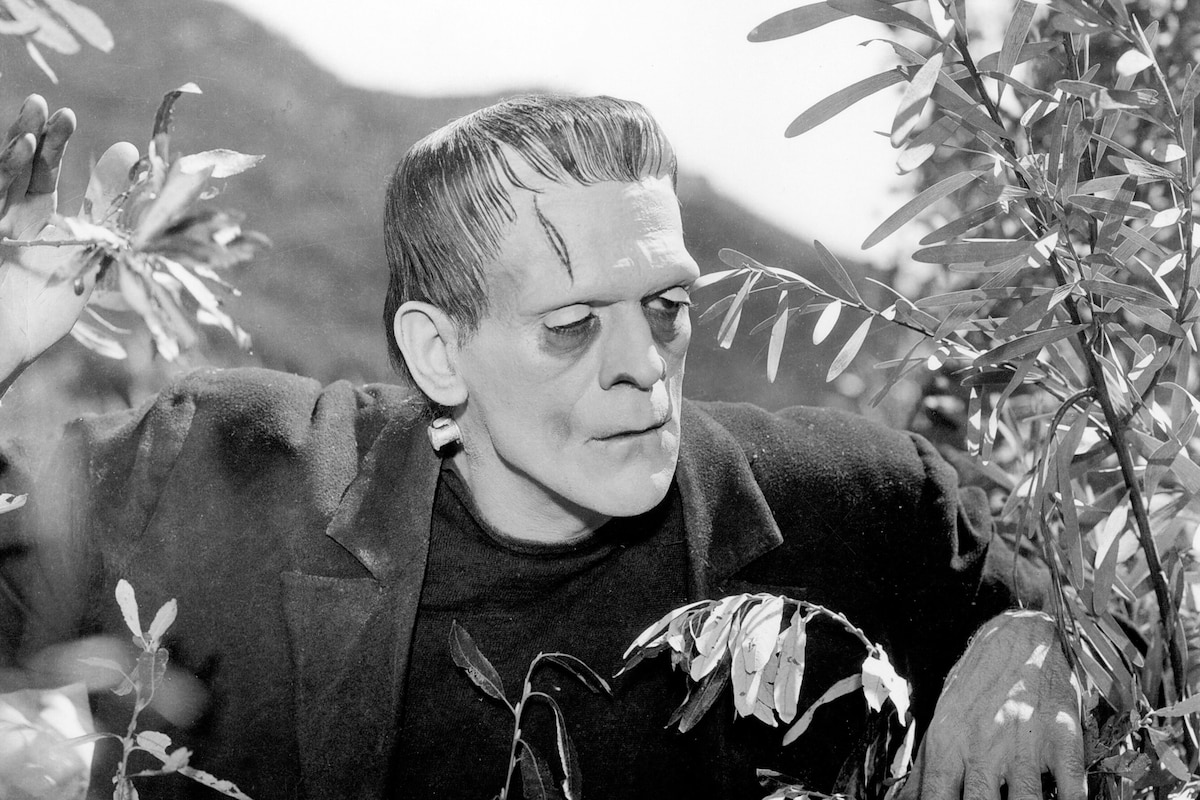
role of Dr. Frankenstein. Nevertheless, he attempted to play the monster but his interpretation was deemed too sensitive and understated. Though Shelley's 1816 novel had featured a sympathetic monster, Universal wanted a more sinister creature so they hired 43-year-old B-movie veteran Karloff to play the role and the actor worked hard with Universal's makeup artist Jack Pierce to insure that their malevolent creation would
be unforgettable.
Pierce, who also created the look of Bela Lugosi's Dracula, researched
the look of the Monster for three months. Pierce studied anatomy,
surgery, medicine, criminal history, criminology, burial customs and
electrodynamics, before he even began the grueling daily 5 hour make-up
application (followed by two hours of make-up removal) to create
Frankenstein.
As part of creating this innovative movie monster, Karloff was also
given boots to increase his height to seven feet six inches. The boots
weighed a cumbersome 30 pounds, and were combined with steel struts on
Karloff's legs to give the reanimated beast his signature lurching walk, part nightmare, part toddler. Ultimately, this Monster created by Karloff, Pierce and Whale did have poignance and played upon viewers' sympathies, causing some to see the Monster as a stand-in for
the troubled director himself, who also yearned for understanding.
The struggle of bringing this monster to life on the screen was
considerable and caused Karloff to lose 20 pounds over the six weeks it
took to film Frankenstein. The strain of carrying Dr.
Frankenstein to the summit of a windmill at the film's climax was so
great, in fact, that Karloff required hospitalization for back
problems.
Though Karloff's performance went unappreciated by the Universal
Studios executives, which even excluded the actor from the movie's
premiere, Karloff sufficiently impressed his movie audiences. Many
viewers were reportedly so terrified by his appearance they fled from
the theater in fear. Karloff called the Monster his favorite film role
and film history has tended to agree with him -- the actor was
identified with the part until the day he died.
In addition to its classic status in the annals of movie making,
Whale's Frankenstein was an enormous financial success. Made
for only $250,000, the film returned $12 million upon its
release.
The production history surrounding Frankenstein is as
fascinating as the film itself. Bette Davis was initially considered
for the role of the delicate Elizabeth, but Whale -- probably rightly
-- believed that Davis was too aggressive to play an ethereal horror
movie victim. Instead, Mae Clarke was tapped for the role, an actress
best remembered as the dame who gets a face full of grapefruit from
James Cagney in The Public Enemy (1931).
Though referred to simply as "the Monster" in Shelley's novel, it is
one of the quirks of history that this movie monster's name was so
often confused with his symbolic father and creator, Dr. Frankenstein.
But in Karloff's hands, the Monster turned out to be a greater star
than the titular scientist who created him and ever since the name Frankenstein is synonymous with the monster, not the doctor.
Director: James Whale
Producer: Carl Laemmle, Jr. for Universal
Screenplay: Garrett Fort and Francis Faragoh; based on John
Balderston's adaptation of the novel of the same name by Mary
Wollstonecraft Shelley
Cinematography: Arthur Edeson
Production Design: Charles D. Hall
Music: David Broekman
Cast: Colin Clive (Dr. Henry Frankenstein), Boris Karloff (The
Monster), Mae Clarke (Elizabeth), John Boles (Victor), Edward Van Sloan
(Dr. Waldman), Dwight Frye (Fritz, the Dwarf), Frederick Kerr (Baron
Frankenstein).
BW-71m. Closed captioning.
by Felicia Feaster
Frankenstein (1931)
by Felicia Feaster | September 25, 2003
SIGN UP FOR OUR NEWSLETTERS

CONNECT WITH TCM