Boris Karloff rose from the grave -- again -- when Universal Pictures
decided to add a new monster to their repertoire in 1932. Where
they had drawn on legend and literature for such past hits as
Dracula and Frankenstein, however, they invented their own
horror mythology with The Mummy, introducing to the screen the idea
of "the dead who walk." Not that the 1932 feature was the screen's first
depiction of a revivified mummy. That honor goes to a 1911 silent with the
same title. But it was Universal and writer John Balderston who created
the idea of a reanimated mummy trying to bring back the woman of his
dreams. Their version of The Mummy would inspire a string of sequels
in the '40s and a similar series from England's Hammer Studios in the '60s
and '70s.
Studio head Carl Laemmle, Jr. got the idea from the furor over the
discovery of King Tut's tomb in 1922. Shortly after archaeologists
unearthed the intact tomb, members of the expedition began dying in
mysterious ways. Public interest in the so-called curse was at an all-time
high in the early '30s, so Laemmle thought to cash in on it with a new
monster and a new vehicle for the studio's top horror star, Boris Karloff.
The initial treatment, Cagliostro, told of an ancient Egyptian who
uses nitrate injections to keep himself alive for 3,500 years while he
kills anybody who resembles the woman who once betrayed him. Laemmle
approved the story idea, then passed it on to John Balderston, co-author of
the hit stage adaptation of Dracula. Balderston re-shaped the
material, borrowing liberally from the vampire tale, to tell of an Egyptian
priest buried alive for trying to revive his lost love from the dead. When
archaeologists inadvertently bring him back to life, he goes in search of
his love's current reincarnation, fighting her young lover and an older
expert on Egyptology to possess her. Also pointing up the film's
resemblance to the earlier Dracula was the casting of that film's
elderly expert (Edward Van Sloan) and young lover (David Manners) in
similar roles. Balderston named the villain Im-Ho-Tep, after the high
priest serving under Pharaoh Zoser, then gave him the alias Ardath Bey, an
anagram for "death by Ra." After the working titles of The King of the
Dead and Im-Ho-Tep, Laemmle changed the name of the film to The
Mummy during filming.
Having scored triumphs in Frankenstein, The Old Dark House
and The Mask of Fu Manchu, Karloff was considered the successor to
Lon Chaney's mantle. With The Mummy he achieved an almost unique
honor; he was billed solely by his last name as "Karloff the Uncanny,"
putting him on a par with Greta Garbo in terms of audience recognition.
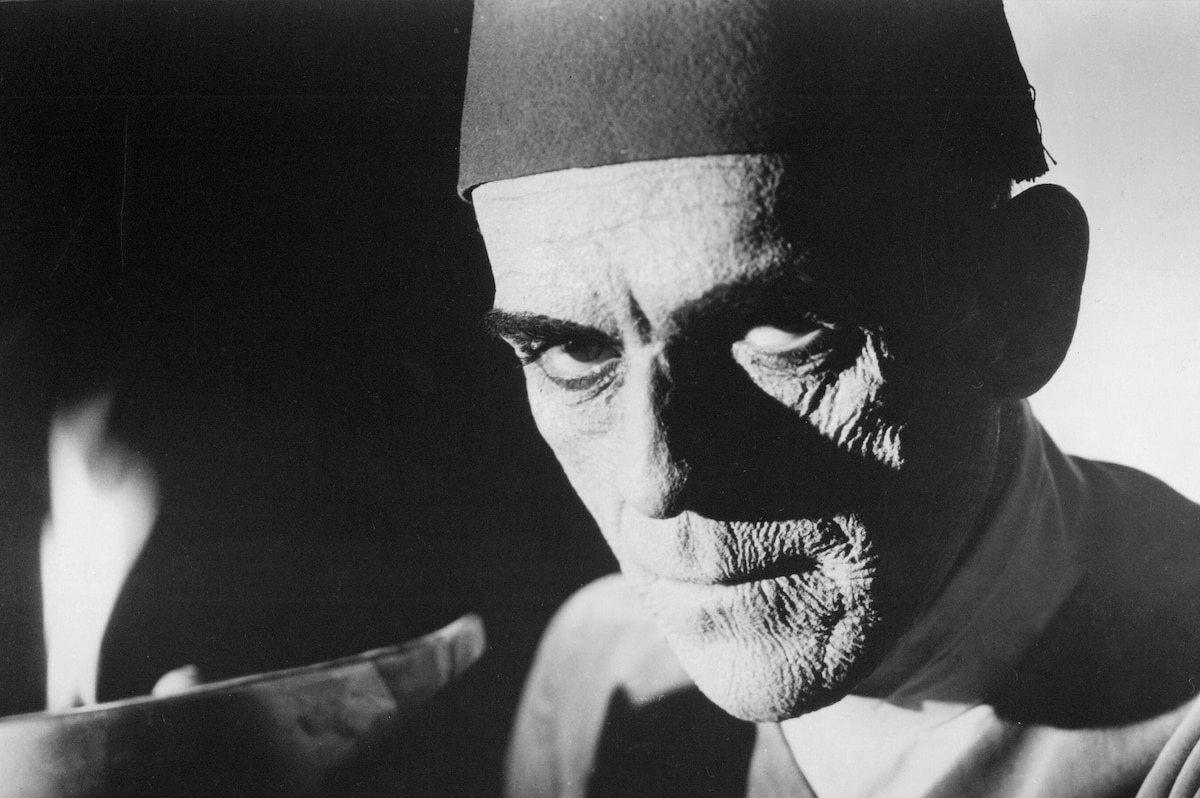
The price he paid for stardom was high, however. For the few scenes in
which he is in full mummy regalia, he had to sit in the makeup chair for
eight hours. Make-up artist Jack Pierce applied layers of Fuller's Earth,
beauty clay (the same clay used to remove wrinkles on women), cotton soaked
in collodion and 150 feet of rooted linen bandages to his body. When
director James Whale, who had cast Karloff as the monster in
Frankenstein, saw the makeup for the first time, he said it looked
as though the star had had a pail of garbage dumped over him. Of course,
that was exactly the effect Pierce wanted; he always considered it his
favorite of all the many make-ups he had created. Through the day, the
Fuller's Earth kept getting in Karloff's eyes. Afterwards, the whole thing
had to be melted off. Things improved only slightly once the mummy took on
human guise. Karloff still had to sit for hours as more cotton strips were
applied to his skin to cover his face and hands with wrinkles for the
remaining seven weeks of filming.
To direct The Mummy, Laemmle gave a chance to pioneering
cinematographer Karl Freund. Shooting silent films in Germany, he had
invented the dolly shot and several special effects techniques. He was
also one of the first to use a handheld camera. After filming
Dracula at Universal, he got his shot at directing. He even
improved on a trick he had created for the earlier horror film. To give
Karloff's eyes an unholy light, he focused baby spotlights on them while
dimming the rest of the lights. It was one of the film's greatest
effects.
Freund worked his cast and crew tirelessly in the days before Hollywood
unionization. He frequently kept them on the set until after midnight,
which was particularly grueling for Karloff, who had started in the makeup
chair eight hours before shooting began. But he finished the film ahead of
schedule and under budget (for less than $200,000). His visual sense paid
off. Later critics have hailed The Mummy as a photographer's film,
while critic and historian William K. Everson called it "the closest that
Hollywood ever came to creating a poem out of horror" (in Classics of
the Horror Film). The film did huge business, with patrons lined up
around the block for its Christmas-season opening. Clips from the picture
would resurface in all of Universal's later mummy films, while the giant
statue of Isis in the final scene would be reused as "the great god Tao" on
the planet Mongo in Flash Gordon (1936).
Karloff would continue as the screen's reigning monster king for decades,
acting until his death in 1969 and even after that (some of his low-budget
films wouldn't be released until 1971), but this would remain his sole
appearance as the mummy. Freund would direct a few more films, including
the Peter Lorre classic Mad Love (1935), but soon returned to camera work ,
claiming that it was a more creative line than directing. His innovations
would continue with Oscar®-winning work on The Good Earth (1937). Even
when he turned to television, as chief cameraman for I Love Lucy, he
made his influence felt as inventor of the three-camera system used for
most television series.
Two prominent members of The Mummy's cast would have only short film
careers. Leading lady Zita Johann was primarily a stage actress when she
played Karloff's reincarnated lady love. The Hungarian-born beauty had
turned down Hollywood's first contract offer -- the chance to star in
Universal's 1929 version of Show Boat -- to remain on stage. She
only made The Mummy because another film planned for her at
Universal had fallen through, and she wanted to complete her obligation to the
studio. She would later complain that Freund made her the
scapegoat anytime he had problems on the set and even tried to get her to
pose naked for him. She also wasn't pleased when a series of elaborate
flashbacks depicting the Egyptian princess' other reincarnations were cut
before the film's release. She made only four more films before returning
to the stage, where she worked with such giants as John Houseman and Orson
Welles. She only made one more film, a cheap horror film ironically titled
Raiders of the Living Dead (1986), before her death in 1993.
Romantic leading man David Manners had made his film debut by chance. He
was on his way to a job on a Hawaiian plantation when he visited Hollywood
and was spotted by director James Whale, who cast him in his World War I
drama Journey's End (1929). The casting of an unknown was so
shocking that more experienced actors would cuss Manners out in the street.
But he stayed in leading roles for years, including work in the 1934
horror classic The Black Cat, until he abruptly retired from
filmmaking to focus on writing and painting in 1936. Although his official
statement was that he was simply tired of the grind of making films, rumors
persist that he either had a nervous breakdown or got tired of pressure to
hide his homosexuality by taking a wife for appearances. But though he lived more
than 60 years after leaving Hollywood, he was always best remembered as the
star of three of Universal's most famous horror films.
Producer: Carl Laemmle, Jr.
Director: Karl Freund
Screenplay: John Balderston
Based on a story by Nina Wilcox Putnam & Richard Schayer
Cinematography: Charles Stumar
Art Direction: Willy Pogany
Music: James Dietrich (uncredited)
Principal Cast: Boris Karloff (Im-Ho-Tep/Ardath Bey), Zita Johann (Helen
Grosvenor/Princess Anck-es-en-Amon), David Manners (Frank Whemple), Edward
Van Sloan (Professor Muller), A.S. Byron (Sir Joseph Whemple), Bramwell
Fletcher (Norton), Noble Johnson (The Nubian).
BW-74m.
by Frank Miller
The Mummy (1932) - The Mummy
by Frank Miller | December 29, 2002
SIGN UP FOR OUR NEWSLETTERS

CONNECT WITH TCM