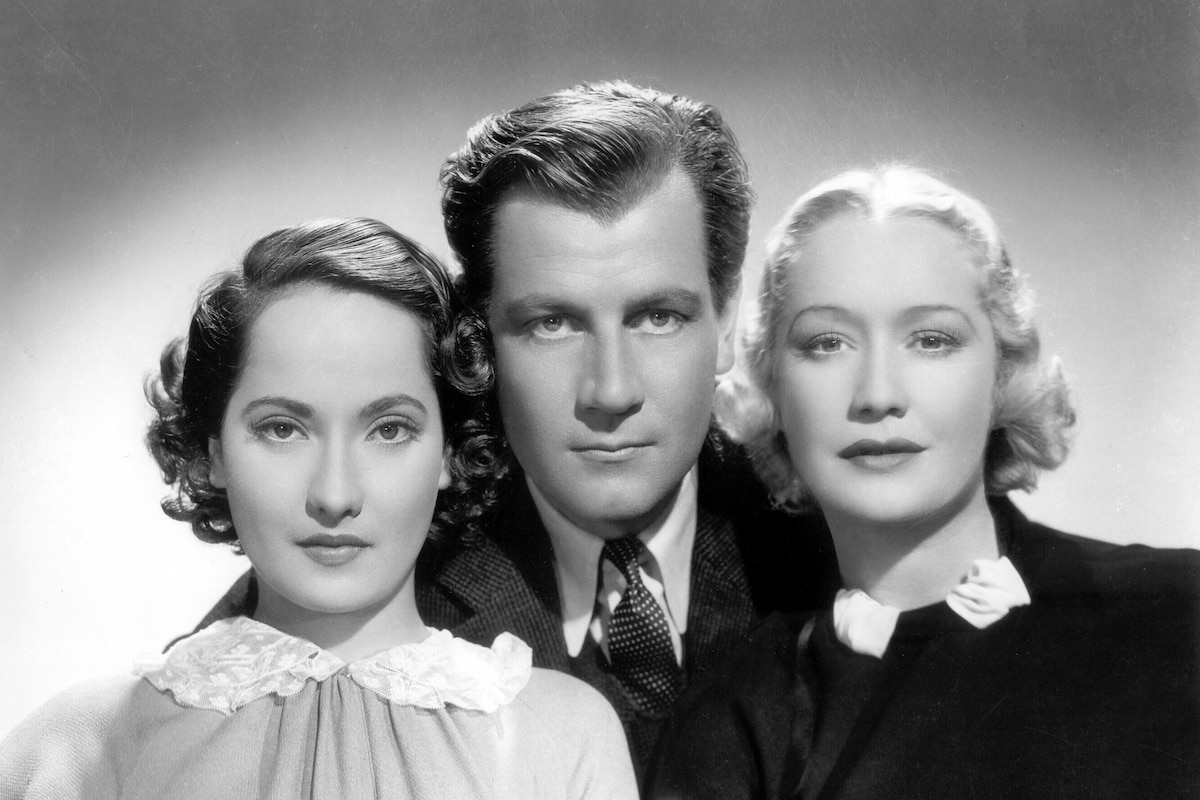
Merle Oberon teamed up with two other Samuel Goldwyn stars, Joel McCrea and Miriam
Hopkins, along with first-time Goldwyn director William Wyler to make the
first film to demonstrate the legendary "Goldwyn Touch," These
Three, in 1936. Although fans of The Children's Hour, the play
on which it was based, may be amazed at the sanitizing of the legendary
Broadway hit, the film version is in many ways more true to the spirit
of the original than its more faithful 1961 remake.
The idea for The Children's Hour had been suggested to fledgling
playwright Lillian Hellman by her longtime companion, Dashiell Hammett.
While reading an anthology of true-crime stories, Bad Companions, he
came across an account of two Scottish school teachers whose lives had been
ruined by the false accusation of lesbianism levied by one of their
students. Hellman turned the story into her first hit play, though when it
opened on Broadway she didn't know if she would be feted or arrested. At
the time, any mention of homosexuality on stage was illegal in New York
State. The play was such a success and so widely praised by critics that
the authorities overlooked its subject matter (the law would rarely be
enforced until it was repealed in the '60s).
But the Production Code Administration's ban on homosexuality as a film
topic was much stronger than any mere law. So strong, in fact, that
independent producer Sam Goldwyn was the only filmmaker to bid for the
rights. According to legend, when he was warned that he couldn't film the
play because it was about lesbians, he replied, "That's okay; we'll turn
them into Armenians." In truth, he was convinced to purchase the screen
rights when Hellman argued that the play was really about the power of a
lie. She even accepted his offer to write the screenplay, changing the lie
about the two school teachers being secret lovers into a rumor that one had
spent the night with the other's fiancΘ. Even so, the Production Code
Administration forbade Goldman to use the original title or even publicize
his purchase of the film rights. Hellman titled her screenplay The
Lie, and it wasn't until after shooting was completed that the story
department came up with the title These Three.
Goldwyn knew that he needed a director with a subtle touch to make the film
work. He was studying Frances Dee's work in The Gay Deception (1935) when
he realized he was more interested in the film's direction than her
performance. So he contacted director William Wyler and offered him the
film and a long-term contract. Wyler had started his career directing
low-budget westerns at his second cousin Carl Laemmle's studio, Universal,
but left in search of bigger projects. That was just what Goldwyn was
offering him, though Wyler cautiously asked for a three-year contract
rather than the five-year deal the producer had offered, just in case
things didn't work out.
At first, Wyler had cause for concern. Goldwyn had already cast the leads in
These Three with Oberon, Hopkins and McCrea. Of the three, Hopkins
was the only really strong actor, and she had a reputation for temperament.
Oberon -- though a recent Oscar® nominee for her first Goldwyn film,
The Dark Angel (1935) -- was considered more of a great beauty than a great
actress. And McCrea was a lightweight leading man. Wyler tried to
convince Goldwyn to cast Leslie Howard in the male lead, but the producer
was determined to build up his stable of contract stars. Unfortunately,
Goldwyn later told the leading man that Wyler didn't want him, which caused
problems on the set.
With his leads already cast for him, Wyler put most of his energies into
finding the perfect child actress to play Mary, the student whose lies
trigger the film's crises. He wanted the opposite of Shirley Temple, the
most popular child star of the time, and found it in Bonita Granville,
whose intense, complex performance brought her an Oscar® nomination for
Best Supporting Actress. During filming, Oberon feared that Wyler was
throwing the film to her and even convinced McCrea to complain to the
producer, but Goldwyn simply shouted, "I'm having more trouble with you
stars than Mussolini is with Utopia!"
This didn't mean that Goldwyn was giving Wyler a free hand. They fought on
the set constantly, though the director usually got his way. Wyler shot
Hopkins' big confession scene, in which she admits to being in love with
McCrea, from behind the actress, showing Oberon's reaction to her speech.
Goldwyn objected. After screening the film with Wyler and Goldwyn's
nine-year-old son, Sam, Goldwyn shrieked at the director for an hour,
claiming that the audience wouldn't understand the scene if they couldn't
see Hopkins' face. Finally, Wyler asked Sam if he understood what the
scene was about. The child explained it perfectly, to which Goldwyn
replied, "Since when are we making pictures for nine-year-olds?" But the
scene stayed as Wyler had shot it, and the critics loved it.
These Three brought Goldwyn the best reviews of his career. Though
he had had hits before, he had never enjoyed such a critical success.
Novelist Graham Greene, who reviewed films for England's the
Spectator, wrote "I have seldom been so moved by any fictional
film....After ten minutes or so of the usual screen sentiment, quaintness
and exaggeration, one began to watch the incredulous pleasure of nothing
less than life." With this film, critics began talking about "The Goldwyn
Touch," which his PR department described as "something that manifests
itself gradually in a picture; the characters are consistent; the
workmanship is honest; there are no tricks and short cuts; the intelligence
of the audience is never insulted." (in A. Scott Berg, Goldwyn: A
Biography). But though the producer tried to take credit for this
quality himself, most historians now feel "The Goldwyn Touch" was largely a
result of Wyler's perfectionism and taste.
Ironically, when Wyler directed a faithful screen version of The
Children's Hour in 1961, after the Production Code had been amended to
allow homosexuality as a screen subject, the film fell flat. One problem
was Hellman's limited participation in the film. Although she and Wyler
had maintained a close friendship since working on These Three,
scheduling conflicts had prevented her from doing more than a few quick
re-writes. More important, however, was the director's failure to adjust
to changing times. By the '60s, the child's accusations that her female
teachers were secret lovers just didn't seem as scandalous as they had in
the '30s. The lie had lost its power over time, and, despite the censors'
blue pencil, remained much more convincing in the original These
Three.
Producer: Sam Goldwyn
Director: William Wyler
Screenplay: Lillian Hellman. Based on her play The Children's Hour
Cinematography: Gregg Toland
Art Direction: Richard Day
Music: Alfred Newman
Cast: Miriam Hopkins (Martha Dobie), Merle Oberon (Karen Wright), Joel
McCrea (Dr. Joseph Cardin), Catherine Doucet (Mrs. Lily Mortar), Alma Kruger
(Mrs. Tilford), Bonita Granville, (Mary Tilford), Marcia Mae Jones (Rosalie
Wells), Margaret Hamilton (Agatha), Walter Brennan (Taxi Driver).
BW-93m.
by Frank Miller
These Three
by Frank Miller | December 17, 2002
SIGN UP FOR OUR NEWSLETTERS

CONNECT WITH TCM