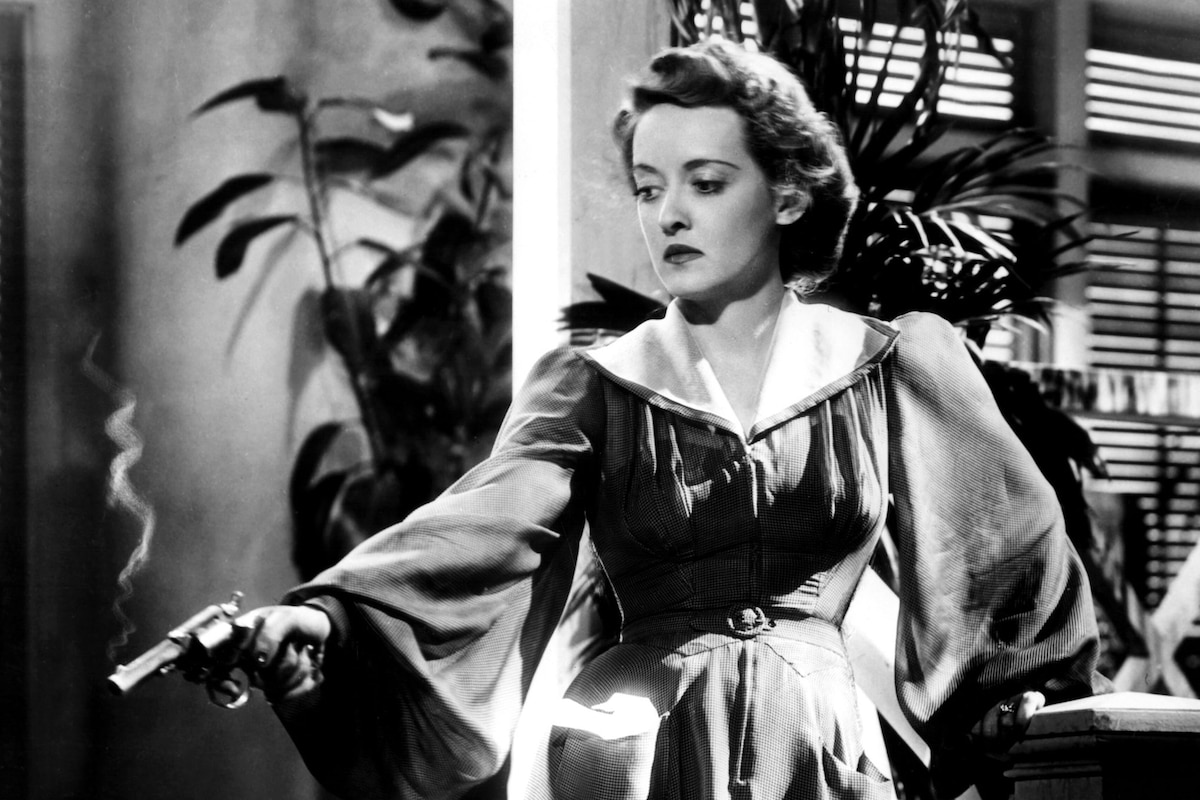
It is a sultry, sweltering, moonlit night on a Malayan rubber plantation. The camera pans across the native workers sleeping fitfully in their hammocks, through the silent, menacing darkness. Suddenly, a shot rings out. A ghostly tropical bird, startled, flies off its perch. A man stumbles down the steps of the veranda, followed by a woman who pumps several more shots into him and drops the gun. In two wordless minutes, director William Wyler grabs the audience and sets the mood of The Letter (1940), with one of the most stunning opening sequences ever.
Based on a short story and play by British author W. Somerset Maugham, The Letter is the story of Leslie Crosbie, who has killed her lover and claims self-defense. But an incriminating letter exists...
The legendary Jeanne Eagels starred in Paramount's silent film version shortly before her death in 1929. Bette Davis was thrilled when Warner Brothers purchased the rights for her. She was even more delighted when the studio borrowed William Wyler from Goldwyn to direct.
Wyler had guided Davis' Oscar-winning performance in Jezebel (1938), and the two had had a romantic relationship. That ended, but they still respected each other professionally. Davis would say that Wyler was one of the few directors she trusted completely, to whom she would subordinate her own instincts and judgment. That devotion was sorely tested in the climactic scene of The Letter, when Leslie admits to her husband that she still loves the man she killed. Davis felt that no woman could look at her husband when she admits such a thing. Wyler disagreed. Davis walked off the set. Later, she returned, and did it Wyler's way, but ever after, Davis insisted her way would have been better.
Cast as the lawyer who compromises his professional ethics to help Leslie was a British actor named James Stephenson. Jack Warner had suggested that Wyler use him in a film, but once Wyler cast Stephenson, Warner had second thoughts and felt the role was too important for an unknown. But Wyler stood firm, and Stephenson's performance earned him an Oscar nomination. Sadly, he had only a short time to enjoy the acclaim. Less than a year later, Stephenson died of a heart attack.
Wyler's visual storytelling is one of the most striking elements of The Letter. Like the opening, the confrontation between Leslie and her lover's Eurasian wife has virtually no dialogue and no music, only the eerie sounds of a wind chime, enhanced to menacing proportions. Yet Wyler also knows when to let dialogue carry a scene. A prison scene between Leslie and her lawyer - with virtuoso performances by Davis and Stephenson - is held on a single two-shot for eight minutes, broken only by a single reaction shot of Stephenson.
The Letter was nominated for seven Academy Awards, including Best Picture, Actress, and Director. It won none of them. But it is one of the finest examples of the craft of filmmaking within the studio system.
Director: William Wyler
Producer: Hal B. Wallis & Robert Lord
Screenplay: Howard Koch, based on the novel by W. Somerset Maugham
Editor: George Amy
Cinematography: Tony Gaudio
Art Direction: Carl Jules Weyl
Music: Max Steiner
Principal Cast: Bette Davis (Leslie Crosbie), Herbert Marshall (Robert Crosbie), James Stephenson (Howard Joyce), Frieda Inescort (Dorothy Joyce), Gale Sondergaard (Mrs. Hammond), Bruce Lester (John Withers), Sen Yung (On Chi Seng).
BW-96m. Closed captioning.
by Margarita Landazuri
