Unfolding with a strange, dreamlike logic, Morocco (1930), director Josef von
Sternberg's first American film, follows the beautiful Amy Jolly
(Marlene Dietrich) to the only possible destination for a love-burned,
down-on-her-luck cabaret singer: the arid African city of the title.
Wealthy Mons. Le Bessiere (Adolphe Menjou) spies the gorgeous Amy alone
on the ship's deck as it makes its way to that desert lair of thieves,
Foreign Legionnaires and various luckless souls. Le Bessiere is
immediately enthralled and offers to escort Amy around Morocco.
But Amy is a woman of great resourcefulness and talent, who quickly
adapts to Morocco's strange ways, as seen in her first musical
performance in a disreputable local bar populated by sophisticates and
riffraff alike.
Dressed in a man's tuxedo and dragging on a cigarette, Amy sings to the
enraptured crowd who respond instantly to her smoldering, androgynous
sensuality. As a saucy finale, Amy plants a kiss on a pretty
female member of the audience, titillating a handsome Foreign
Legionnaire in the audience, Tom Brown (Gary Cooper). The womanizing
Brown has pledged himself to service in the Foreign Legion with no ties to
any woman, but is soon fantasizing about desertion when he
meets Amy. Equally taken with Brown, Amy is forced to make a difficult decision,
between the wealth and stability of life with Le Bessiere who proposes
marriage, and her smoldering passion for Brown.
Morocco was von Sternberg's and Marlene Dietrich's
first American film after an unforgettable introduction to the
international film community with their collaboration on The Blue
Angel (1930). Lovingly photographed by her frequent collaborator von
Sternberg, Dietrich is ravishing in Morocco, often at the expense
of Cooper, who was angered at the attention the director lavished on
his leading lady while virtually ignoring him. Originally
the film had been titled Amy Jolly, The Woman of Marrakesh. But
Cooper, again fearing that too much of the picture's focus was being
placed on Dietrich, pressured the studio to change the title to
Morocco.
Though von Sternberg and Cooper developed a strong dislike for one
another during the making of Morocco, Cooper and Dietrich were
reportedly more amicable and their onscreen romance soon became an off-screen one as well. The combination of Dietrich's smoky exoticism and Cooper's all-American machismo somehow worked despite the incongruity and the pair would go on to appear as lovers once again in Desire
(1936), directed by Frank Borzage. Later in life, Dietrich was more candid about her co-star, remarking that "Cooper was neither intelligent nor cultured. Just like the other actors, he was chosen for his physique, which, after all, was more important than an active brain."
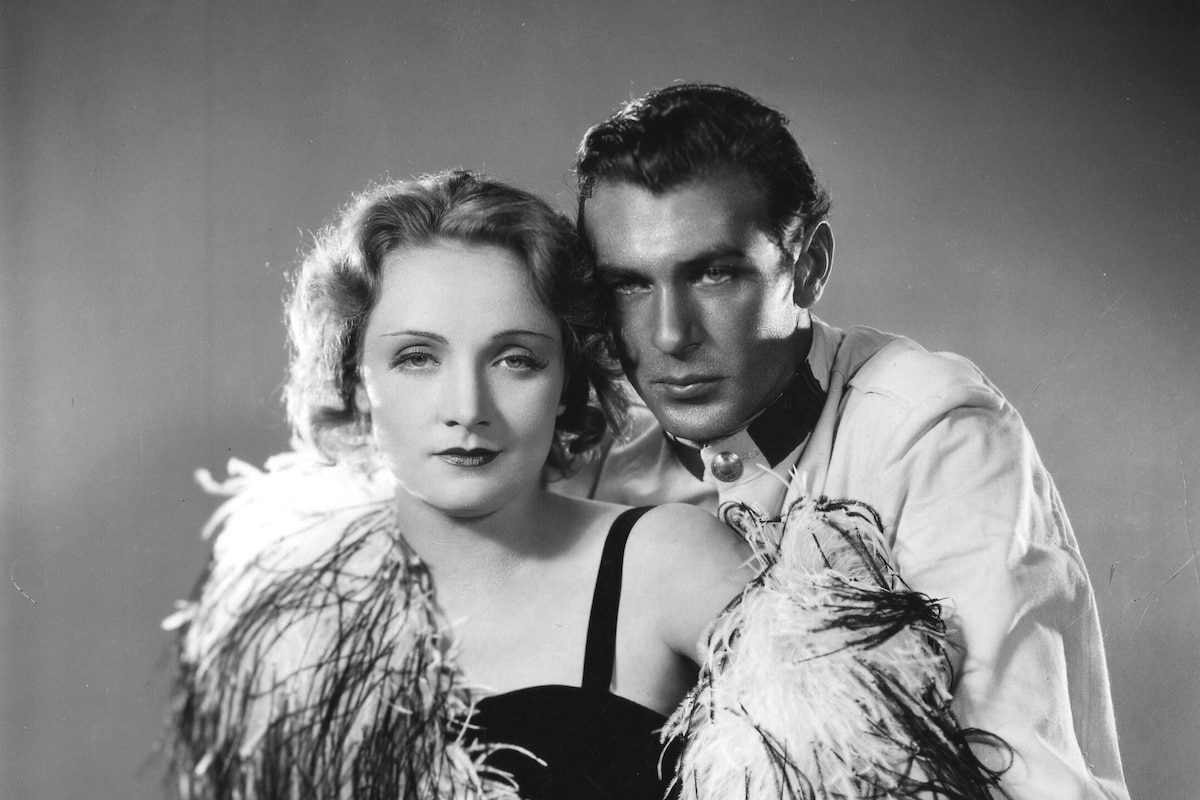
Von Sternberg, who made a total of seven films with Dietrich, controlled every aspect of his prized star's performance and appearance. He placed her on a strict diet, made sure her onscreen voice had the desired throaty, sexy timbre and even oversaw the plucking of her eyebrows to ensure the proper accent for her eyes. It was also the director who designed the ideal lighting for Dietrich. The actress recalled, "the light source created my mysterious-looking face with hollow cheeks, effected by putting the key light near the face and very high over it."
Von Sternberg was equally famous for continually correcting Dietrich's
heavily accented English. At one point during the production Dietrich
fainted from the intense heat and had to be carried from the set. While
lying on a stretcher, the workaholic actress asked von Sternberg if he
needed another "cloze-up." Ignoring her fatigue, he instantly
corrected her pronunciation.
Dietrich was von Sternberg's creation in many regards. Early on he saw
something in this ordinary girl born Maria Magdalena von Losch that
caused him to pluck her from the obscurity of small parts in German
films. He transformed her into an improbably gorgeous, mysterious dream-woman whose
sexual appeal was rarely matched in her films for other high profile directors like Ernst Lubitsch, Rene Clair, Raoul Walsh, Billy Wilder, Alfred Hitchcock, Fritz Lang and Orson Welles.
Cinematographer Lee Garmes, von Sternberg, art director Hans Dreier and
Dietrich were all nominated for Oscars for their work on
Morocco. And the film proved a spectacular success at the box
office as well, earning a phenomenal $2 million for Paramount Studios
and ensuring a place in film history for an unknown German actress
whose name soon became synonymous with movie glamour.
Director: Josef von Sternberg
Producer: Hector Turnbull
Screenplay: Jules Furthman, based on the novel Amy Jolly by
Benno Vigny
Cinematography: Lee Garmes, Lucien Ballard
Production Design: Hans Dreier
Music: Karl Hajos
Cast: Gary Cooper (Tom Brown), Marlene Dietrich (Amy Jolly), Adolphe
Menjou (Mons. Le Bessiere), Ullrich Haupt (Adjutant Caesar), Juliette
Compton (Anna Dolores), Francis McDonald (Cpl. Tatoche).
BW-91m. Closed captioning.
by Felicia Feaster
Morocco
by Felicia Feaster | December 12, 2002
SIGN UP FOR OUR NEWSLETTERS

CONNECT WITH TCM