Doris Day and her producer husband Martin Melcher tried to bring back the
classic MGM musical with Billy Rose's Jumbo, a lavish 1962 adaptation of the legendary
Broadway spectacle. If they didn't re-create the glorious box-office results
of the past, it certainly wasn't for lack of trying -- or achievement. The main problem was that Billy Rose's Jumbo was an entertainment from an earlier era and lacked appeal to contemporary audiences. Following the smashing success of West Side Story, with its
location-shot dance scenes and social commentary, Day's film seemed like a
throwback to an era that today is sadly missed.
In 1935, producer Billy Rose was already being publicized as the "Bantam
Barnum" when he got the idea for Jumbo during a visit to Europe,
where he saw two of the continent's famous indoor circuses. With a
generous investment from John Hay Whitney, he brought together a team of
showbiz experts: director George Abbott, dance director John Murray
Anderson, songwriters Richard Rodgers and Lorenz Hart, and playwrights Ben
Hecht and Charles MacArthur. They managed to coordinate over a dozen
circus acts, more than 1,000 animals, the Paul Whiteman Orchestra and comic
Jimmy Durante for an extravaganza about a romance between the son and daughter of
rival circus managers. Though it ran for 233 performances, followed by a
three-month engagement at the Texas State Fair, the show was too big to
turn a profit.
Throughout Jumbo's original run, Rose was besieged with claims that
the plot had been stolen from a variety of sources, though nobody could
make enough of a case to get even a token settlement out of him. When he
was negotiating the sale of film rights to MGM, however, Hecht, who was
angry at Rose for re-writing his script at the last minute, told studio
executives that he had, indeed, borrowed the plot from another play. As a
result, MGM dropped its offer from $200,000 to $50,000. Desperate to break
even on the show, Rose had to accept. Then the studio sat on the property
for almost three decades.
Day, who worked mostly at Warner Brothers and Universal, had had several
happy experiences working at MGM when she and her husband Melcher decided to make a
big musical there, possibly to compensate for her having lost the lead in
the film version of South Pacific to Mitzi Gaynor. Like Rose before them, they
assembled a team of experts to bring Billy Rose's Jumbo to the
screen. Director Charles Walters had started as a dancer and choreographer
before turning to directing with Good News in 1947 and Easter
Parade the following year. He and Day had teamed previously for
Please Don't Eat the Daisies. Melcher's co-producer was Joe
Pasternak, who had made Deanna Durbin a singing star at Universal in the
'30s, before coming to MGM, where he worked with such performers as Judy
Garland and Gene Kelly. In addition to producing Daisies for Day,
he had also produced her biggest dramatic triumph, Love Me or Leave
Me (1955). To keep the music up to MGM standards, they had associate producer
Roger Edens, who had helped shape Garland's singing career and supervised
the music on all of producer Arthur Freed's great musicals. And as second
unit director in charge of the musical numbers, they got Busby Berkeley to
come out of retirement for what would be his last film.
The original Jumbo had produced three hit songs: "The Most
Beautiful Girl in the World," "Little Girl Blue" and "My Romance." To
those and other songs from the original score, Day added another Rodgers and
Hart standard, "This Can't Be Love." The numbers were filmed impeccably,
with Berkeley staging an impressive array of circus stunts to accompany
Day's first song, "Over and Over Again," and Walters making the camera
dance with the performers as he had in his earlier films.
Although no singer, leading man Stephen Boyd had scored a hit as Messala,
the villain in Ben-Hur, and did an impressive job lip-synching to
James Joyce's vocals. But the film's cast was dominated by the presence of two
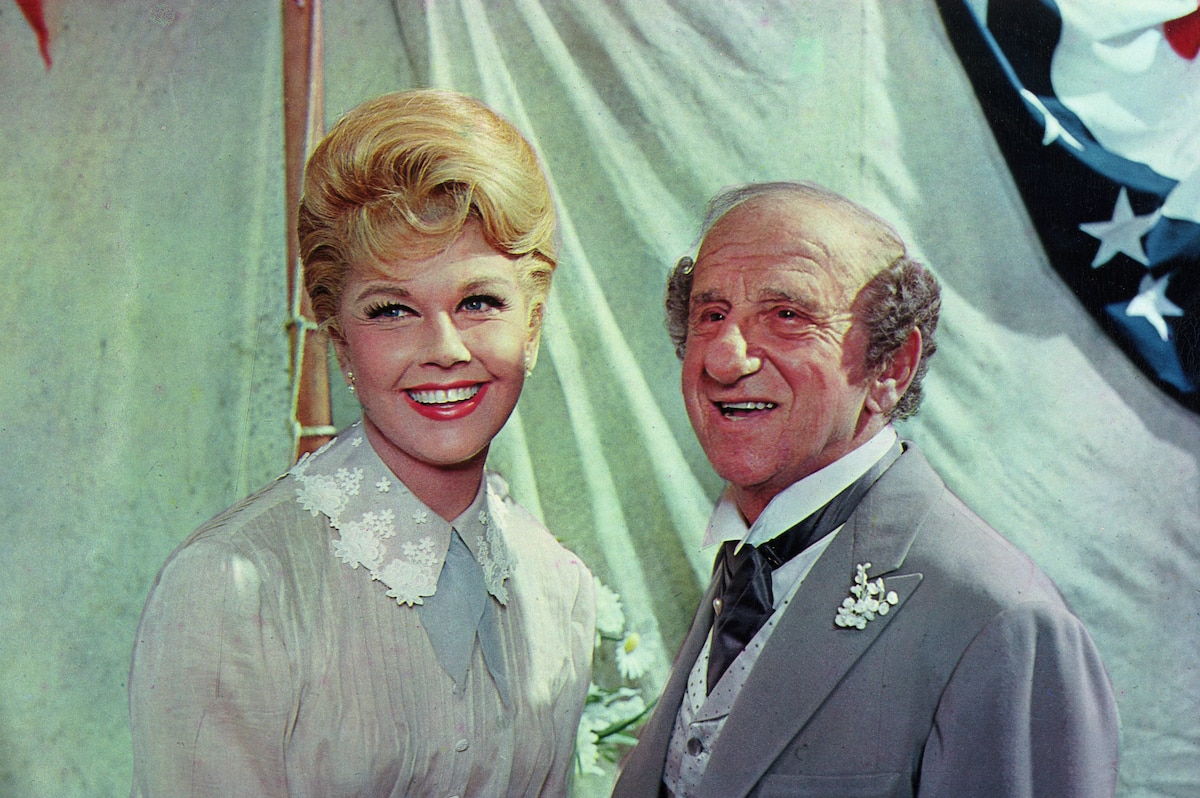
seasoned comic performers. To play Day's father, Durante, who played the
circus press agent on Broadway, returned to the screen after a ten-year
absence. Although the role was different, he got to re-create his most
famous line from the original. When he's stopped while trying to steal
back the circus' trademark pachyderm and asked, "What are you doing with
that elephant," Durante deadpans, "What elephant?"
To play Durante's lovelorn girlfriend, Martha Raye returned to the screen
after a 15-year absence during which she had become a top television star.
The circus routines gave Raye a chance to show off her still shapely legs,
while she also shared a lyrical duet with Day that reminded fans she was
one of the best singers in the business. Raye was so thrilled with the
role that she re-located to the West Coast, hoping her part would lead to
other film offers.
Unfortunately for all concerned, Billy Rose's Jumbo was far from a
giant at the box office. MGM gave it a big buildup, complete with an
opening engagement at the Radio City Music Hall, but fans and critics were
unimpressed. Only Raye, Durante and the elephant got decent reviews. It
took the Vietnam War and her tireless work for the USO to rejuvenate Raye's
career. But it was Day who suffered the most from the film's box-office
failure. She had been campaigning to star in the film versions of The
Unsinkable Molly Brown and The Sound of Music, but lost both
roles, to Debbie Reynolds and Julie Andrews respectively. The latter film
marked a resurgence in popularity for the film musical, but it came three
years too late to help Billy Rose's Jumbo at the box office.
Producer: Joe Pasternak, Martin Melcher
Director: Charles Walters
Screenplay: Sidney Sheldon
Based on a musical play by Ben Hecht and Charles MacArthur
Cinematography: William H. Daniels
Art Direction: George W. Davis, Preston Ames
Music: Richard Rodgers, George E. Stoll
Principal Cast: Doris Day (Kitty Wonder), Stephen Boyd (Sam Rawlins), Jimmy
Durante (Pop Wonder), Martha Raye (Lulu), Dean Jagger (John Noble), Grady
Sutton (Driver), Sydney the Elephant (Jumbo), Billy Barty (Joey).
C-124m. Letterboxed. Closed captioning.
by Frank Miller
Billy Rose's Jumbo
by Frank Miller | December 18, 2002
SIGN UP FOR OUR NEWSLETTERS

CONNECT WITH TCM