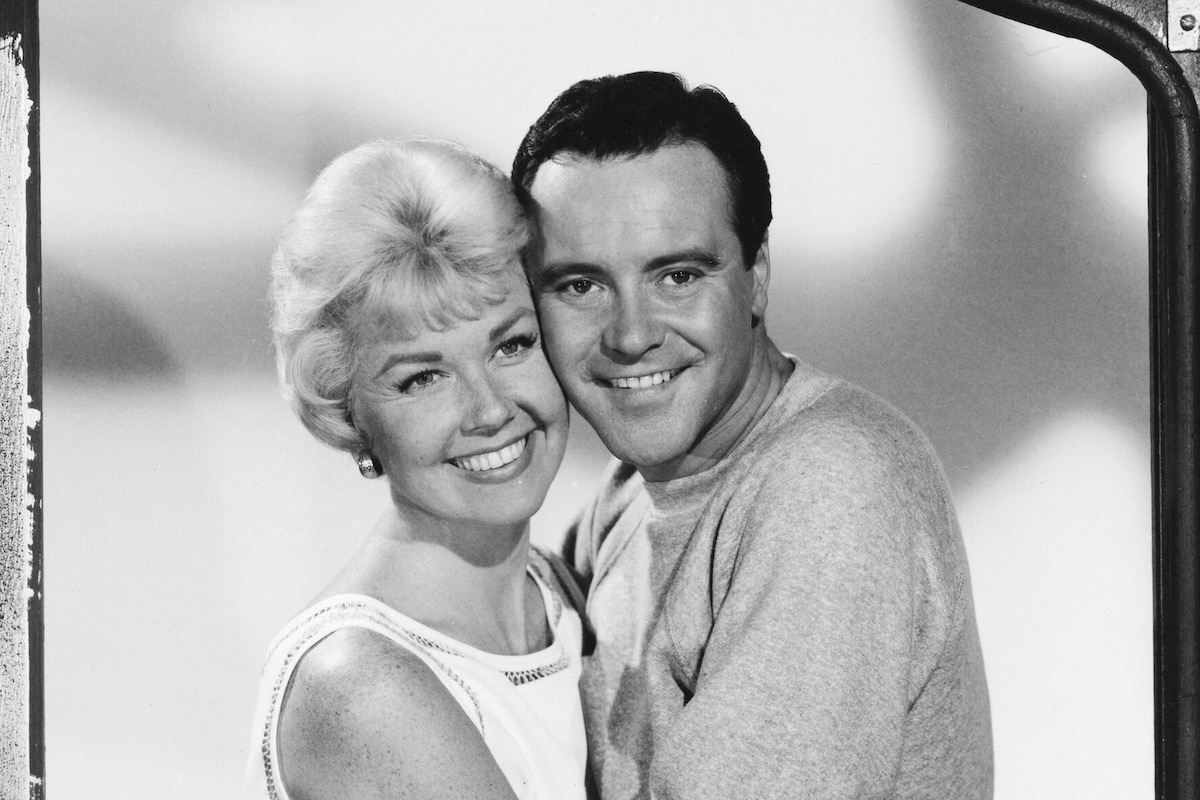
It Happened to Jane (1959) stars Doris Day as small town lobstery owner Jane Osgood, who finds herself up against a big city railroad tycoon. This Capra-esque comedy is a quintessential Doris Day film with
its sunny, nostalgic, and wholesome depiction of life in rural America.
By the time of the film's release, Day had become one of the most popular and highest paid female stars in Hollywood. The virginal
heroine in many of her films, she reflected an idealized version of the
American woman during the late '50s and early '60s. And she doesn't
depart from this persona in It Happened to Jane, where she plays
the perky girl-next-door whose drive for personal success is sometimes
greater than her desire to get married.
The film opens with Jane Osgood discovering that a shipment of her lobsters has been ruined
due to the negligence of the railroad owned by Harry Foster Malone (Ernie Kovacs). More importantly, her reputation as a reliable
businesswoman has been damaged so she and her lawyer, George (Jack Lemmon), decide to take Malone and the railroad to court. In her
campaign against the greedy tycoon, Jane appears on several real television shows of the day such as Youth Wants to Know and
I've Got a Secret. There are also cameos by such TV
personalities as Bess Myerson, Jayne Meadows, Garry Moore, Henry Morgan,
Betsy Palmer, and Gene Rayburn. Malone fights back of course, but before
long the whole country is rallying behind Jane, despite Malone's
attempts to block her. It was rumored that Harry Foster Malone's
character was modeled after the Charles Foster Kane character in
Citizen Kane (1941), which, of course, was based on newspaper
mogul William Randolph Hearst. Ernie Kovacs gained 40 lbs. for the role
and plays Malone with a growling meanness that provides a playful
contrast to Day's bubbling enthusiasm.
Lemmon described
working with Day as "a pleasure" in his biography by Don Widener and
recalled the film as "a charming picture, made when you could still do
charming films." Lemmon, Kovacs, and director Richard Quine all roomed
together in a 17th century house with oak-beamed ceilings during
production. At 3 o'clock every afternoon, Quine would let everyone
off for the day and many cast and crew members would go trout fishing in
a nearby stream. Lemmon would go back to his room, however, for piano
practice; he had an electric piano with headphones installed so that his
playing would not bother his housemates.
It Happened to
Jane had all the ingredients for a commercial hit but it was a box
office disappointment. Its 1961 re-release as Twinkle and Shine
didn't fare any better. In the biography Doris Day: Her Own Story
by A.E. Hotchner, Day recalled "it was pert and funny, but whether it
was the insipid title or something else, it just didn't make it.
However, I'm grateful to the film, for Jack and I became friends and we
saw each other socially over the ensuing years. Jack is a disarming and
charming man, and a gut actor with a natural sense of comedy - very
challenging to work with." Lemmon was equally impressed with his co-star
maintaining that "It Happened to Jane was a good, funny
movie....I felt Doris and I had very good chemistry together, and I
regret that we never made another film."
Producer/Director: Richard Quine
Screenplay: Norman
Katkov
Art Direction: Cary ODell
Cinematography: Charles
Lawton, Jr
Editing: Charles Nelson
Music: George
Duning
Cast: Doris Day (Jane Osgood), Jack Lemmon (George Denham),
Ernie Kovacs (Harry Foster Malone), Steve Forrest (Larry Hall), Teddy
Rooney (Billy Osgood),
C-98m. Letterboxed.
by Lacey Rice
It Happened to Jane
by Lacey Rice | December 18, 2002
SIGN UP FOR OUR NEWSLETTERS

CONNECT WITH TCM