Christensen was initially educated for a medical career at the University of Copenhagen, but was recruited for the musical stage when a renowned opera singer wandered by Christensen's home (circa 1899) and heard him singing loudly while shaving. The man encouraged Christensen to audition for a spot at the Opera Academy at the Danish Royal Theatre, which he successfully did. He first appeared on the stage in 1902 but his singing career was severely inhibited by stage fright. Since he had also studied acting at the Royal Theatre, he turned his attention to drama.
Christensen later told another tale in which his vocal talents were "discovered," but this anecdote sounds suspiciously like a modified version of the earlier tale. He claimed that in 1916, he traveled to the U.S. to sell the rights of his film Haevnens nat (released as Blind Justice in 1917). While relaxing in the bathtub at New York's Knickerbocker Hotel, Christensen once again unleashed his bass-baritone voice. The guest next door overheard Christensen's vocal stylings and came to his door, encouraging him to pursue a career in the opera. In this story, the nearby singer was legendary tenor Enrico Caruso. It should be noted that in another telling of this same anecdote, the action takes place in Paris, rather than New York, casting further doubt on the authenticity of the tall tale.
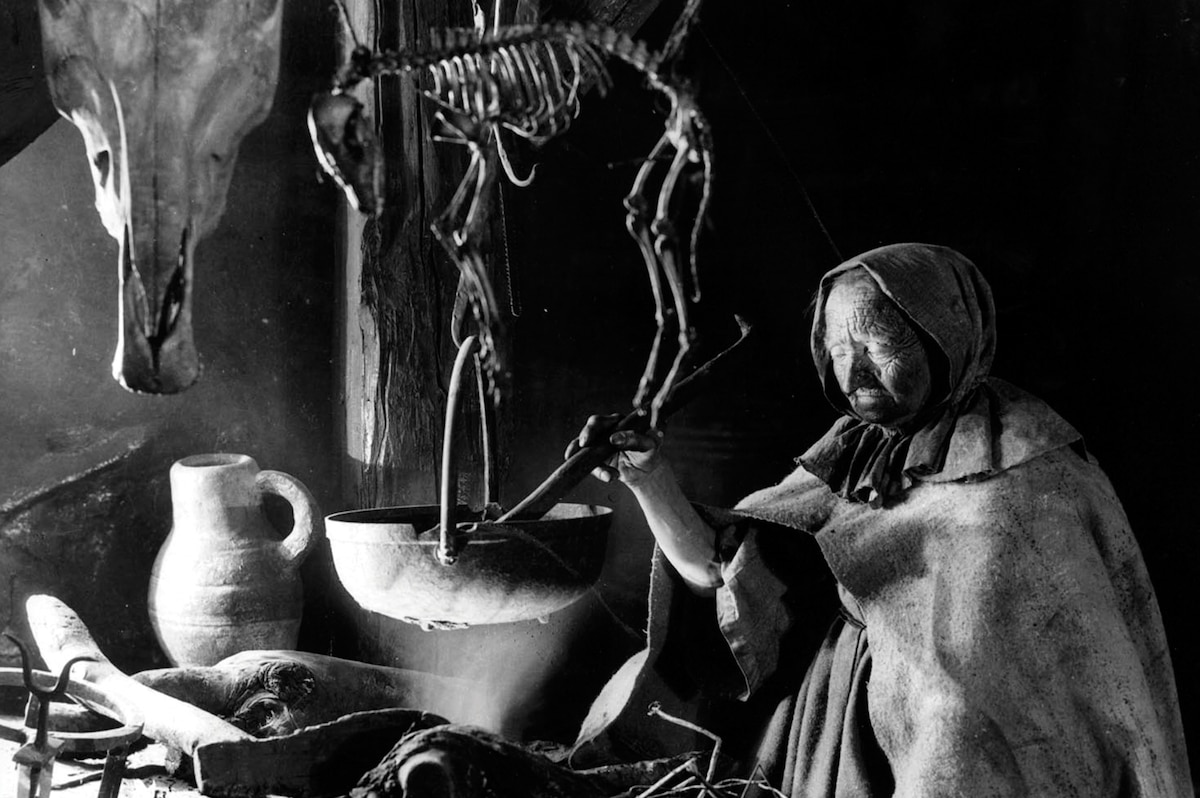
In spite of its efforts at historical authenticity, Haxan takes a very subjective approach to its subject. Although it is less apparent in the 1968 revised version of the film than the 1922 original, Christensen carefully foregrounded his voice as the film's director. His face appears in closeup at the beginning of the film. The opening credits of the 1922 edition are phrased in the first person: "For the photography I am grateful to Mr. Johan Ankerstjerne..." In one scene, a thumbscrew is demonstrated for the camera, but this is done outside of the historical context of the film. The titles say, "One of my actresses insisted on trying the thumbscrew when we shot these pictures." We then see the actress, speaking and laughing, as the device is tightened on her hands, presumably by Christensen himself. "I will not reveal the terrible confessions I forced from the young lady in less than a minute." And, in one of the most fascinating insertions of himself into the film, Christensen stars (under heavy makeup) as the devil and, in one brief double-exposure, as Christ. On the topic of the subjective film, Christensen later said, "Like every other artist, film artists must display in the future their own personality in their works. When we leave the theatre, we should know the person who has spoken to us from the screen."
The sequence in which the nuns run rampant in their convent was inspired by an actual event of 1634. The Ursuline nuns of the convent in Loudun, France were reportedly possessed by devils after the priest, Urbain Grandier, made a pact with the devil. This case was later the subject of a play by Alexandre Dumas the elder (Urbain Grandier [1850]), a novel by Aldous Huxley (The Devils of Loudun [1952]) and films by Ken Russell (The Devils [1971]) and Jerzy Kawalerowicz (Mother Joan of the Angels [1961]).
Haxan's world premiere was in Stockholm on September 18, 1922. It premiered in Denmark on November 7, 1922; and in Germany in June 1924.
Haxan didn't play in the U.S. until May 1929, at New York's Fifth Avenue Playhouse. At these initial screenings, it was accompanied by a newsreel, Liberty (1929, a Laurel and Hardy two-reel comedy), and Voices Across the Sea (1928, a celebrity-spotting talkie short promoting MGM's brightest stars). The film debuted in Los Angeles in March 1930. By this time, Christensen was living in the U.S., having landed a contract at MGM, where he directed a pair of expensive melodramas (The Devil's Circus [1926] and Mockery [1927]). He was later offered a contract at First National, where he made a quartet of light-hearted thrillers: The Hawk's Nest (1928), The Haunted House (1928), Seven Footprints to Satan (1929) and House of Horror (1929). Despite their titles, none of Christensen's American films approached the fantastic horrors of Haxan.
After leaving First National, Christensen returned to his native Denmark, where he made a handful of melodramas between 1939 and 1942. After the release of these films (and a 1941 re-release of Haxan), Christensen was granted a license to operate a movie theatre, which is how he spent the years prior to his death in 1959, at age 79.
When Haxan was given its 1941 re-release in Denmark, it was brought somewhat up to date by an eight-minute filmed introduction by Christensen (wearing an artist's smock, surrounded by camera equipment). It was after one of these Danish screenings that a twenty-three-year-old man was found roaming the streets of Horsens in a trance. A newspaper reported, "The young man, who has been discharged from hospital today, has declared that the reason for his state was that he had been to see Haxan last night, and had been so mesmerized by its unsettling scenes that he had gone into convulsions."
The poem read at the beginning of the film (see "Quote It") is an incantation that Burroughs often recited, with constant variation. It also appears in Burroughs and Balch's abstract sci-fi short Towers Open Fire (1963).
Years later, the indie filmmakers behind The Blair Witch Project (1999) would pay homage to Christensen's film by naming their production company Haxan Films.
Compiled by Bret Wood
In the Know (Haxan) - TRIVIA
by Bret Wood | December 16, 2007
SIGN UP FOR OUR NEWSLETTERS

CONNECT WITH TCM