One of the most unconventional films of the silent era, Benjamin Christensen's Haxan (1922) is a semi-documentary examination of witchcraft, and the unearthly and human horrors that permeate it. Christensen spent about two years researching and shooting Haxan, at great expense. But the quality of production is evident throughout the film, which resembles no other motion picture of its era.
Beginning as a cinematic textbook, Haxan uses medieval woodcuts and engravings to illustrate the early conceptions of satanic beings and the necromancers who worship them. To usher the Modern Age viewer into this realm of antiquated beliefs, Christensen uses charts and models (supplemented with an academic pointer) to show how people of the Middle Ages believed the universe was ordered, with the earth at the center of the universe, orbited by the moon, the sun, the stars, and surrounded by choirs of angels. In one deceptively quaint sequence, the torments of hell are depicted via a mechanical model, with tiny demons pumping the bellows, and dunking its human victims, while a toothy dragon chews one sinner in its jaws.
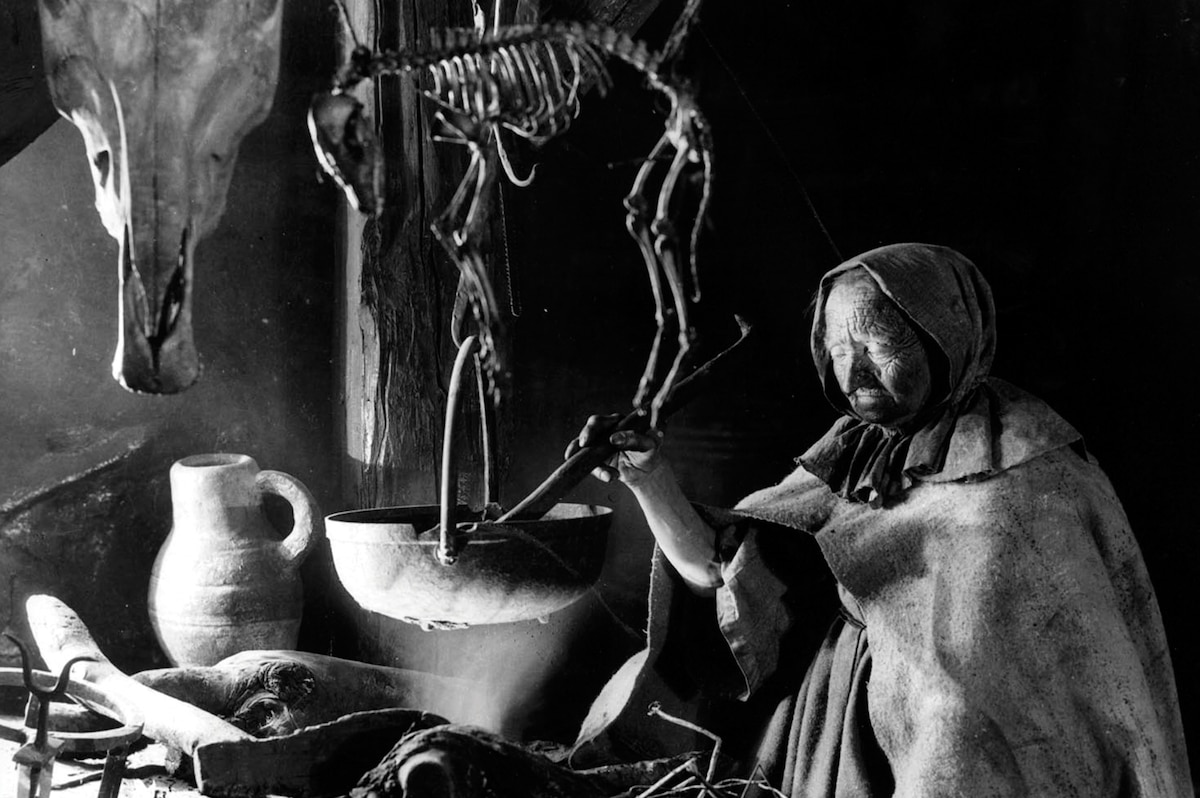
The film quickly delves into dramatizations of witchcraft, and history comes alive. At first, the episodes are somewhat quaint. A witch casts a spell on a spiteful man so that his mouth cannot be closed. Soon, the tales blossom into a hideous chamber of religious horrors. Peasant women concoct love potions from frogs, snakes, and the body parts of executed criminals. Friars are taunted by violent demons. Somnambulistic maidens leave their marriage beds to bow before their satanic master.
Unlike other films, in which demons, witches, monks, and nuns serve as clearly-defined symbols of good and evil, without even dirtying their hands, Haxan renders its characters as flesh, and allows them to indulge in the pleasures of sin at its most carnal. Shocking for any era, much less 1922, Haxan depicts a woman giving birth to demonic creatures, witches kissing the "arse" of Satan during a Sabbath frolic, nudity, vomiting, urination, and all sort of sacrilegious and sexual high jinks.
Once the phantasmagoric world of witchcraft is established, Haxan depicts the more earthly, more horrifying history of the persecution of witches. Because of the way the film is structured, the viewer is inclined to notice that the horrifying tales of witchcraft are those confessions obtained under the most cruel forms of torture. In one such confession, dozens of witches soar through the sky to attend a bacchanal presided over by Satan's grandmother. Those witches who have not yet committed enough crimes against religion are whipped savagely; a potion is brewed with the blood of unbaptized babies, and some of the unholy celebrants gleefully wipe their feet on a cross.
But is this horrifying story real? Or a fabrication designed by an accused witch to satiate her tormentors? As one closely watches Haxan, one realizes that the Inquisitors and holy men and women of the Catholic Church are not far removed from the Satanists they persecute. In one of the film's most deliciously subversive sequences, a young monk (Elith Pio) suffering from lustful thoughts asks a fellow monk to lash him with a whip. When the beating ends, the tearful penitent cries, "Oh, brother, why have you stopped?"
It seems members of religious orders are just as likely to fall prey to satanic forces as the uneducated peasant. In one sequence, the devil penetrates a convent, bludgeoning one nun with a club, who then stumbles through the chapel and stabs the communion host with a knife, before infecting the other nuns with tongue-lolling, eye-rolling, dancing abandon.
In its final act, Haxan uses modern science to "explain" witchcraft. Christensen reveals that it is not so different from the somewhat recently diagnosed mental illness known as hysteria. Somnambulism, kleptomania, and pyromania are all maladies that might have once been attributed to demonic possession.
From the vantage of the 21st Century, we see another set of misogynistic values at play here, in the form of this scientifically-defined psychosis that is intrinsically feminine. The label of "hysteric" was often used to dismiss rebellious female behavior and sometimes relegate its sufferers to institutions, against their will.
Director: Benjamin Christensen
Screenplay: Benjamin Christensen
Cinematography: Johan Ankerstjerne
Film Editing: Edla Hansen
Art Direction: Richard Louw
Music: Launy Grondahl
Cast: Maren Pedersen (Heksen/The Witch), Clara Pontoppidan (Nonne/Nun), Elith Pio (Heksedommer/Witch Judge), Oscar Stribolt (Graabroder/Doctor), Tora Teje (Modern Hysteric), John Andersen (Chief Inquisitor).
BW-104m.
by Bret Wood
The Gist (Haxan) - THE GIST
by Bret Wood | December 16, 2007
SIGN UP FOR OUR NEWSLETTERS

CONNECT WITH TCM