"...several sequences stoop to juvenile theatrics, and the determined sexual inversion (whereby most women become freakish 'characters', and men loose-limbed sex objects) comes to look disconcertingly like a misogynist binge. But in conception the film remains highly original, and it does deliver enough of the goods to sail effortlessly away with the title of Britain's first official punk movie..."
TimeOut
"One of the most original, bold and exciting features to have come out of Britain this decade...could duplicate the cultural impact that Easy Rider [1969] had upon the young generation of approximately 10 years ago."
- Variety
"Although Jarman handles the film's militant women, fetishized violence, and punk rhetoric with an iconic brashness somewhat reminiscent of Frank Tashlin, Jubilee is ultimately too whimsically wordy and fastidiously stylish to be truly effective. Evocative sequences like Jordan's grotesque striptease production number of "Rule Britannia" are diminished by Jarman's including such episodes as that in which Jesus Christ is groped at a disco orgy, which compares unfavorably to even the most inept blasphemies of John Waters's Multiple Maniacs [1970] or Alejandro Jodorowsky's The Holy Mountain [1973]."
- J. Hoberman & Jonathan Rosenbaum, Midnight Movies
"Perhaps the suggestion that they could never escape the system is what pissed off punks about the film back in 1978: Jubilee suggests that punk is complicit, even a willing participant, in its own commodification...For all the controversy--and perhaps because of it--Jubilee has remained something of a cult favorite for the last 25 years. Other punk films (like Temple's The Great Rock 'n' Roll Swindle [1980]) have long disappeared. And now we can see that Jarman's vision of punk's commodification and England's future was nothing short of prescient."
- Todd R. Ramlow, PopMatters
"Jubilee is the most important British film of the late '70s....And although it strikes parallels with the earlier A Clockwork Orange [1971], Jubilee is impulsive where that film is measured, raw where it is stylized, and unrestrained where Kubrick is exacting. What's more, in a lethargic and conservative industry that had been defeated by tax and underfunding, Jubilee was the only British film of its time advancing an unabashed social critique...Jubilee, however, seems less like Jarman's vision than one of a punk cinema collective: it could have feasibly been made by Paul Morrissey on an Andy Warhol sabbatical...Similarly, the film has echoes of John Waters, Russ Meyer, and, fittingly for Jarman (who designed The Devils [1971]), Ken Russell. As such, it is quite a unique experience."
- Julian Upton, Bright Lights Film Journal
"Its blunt attitude to violence has confused many critics who seem to have missed the point: irony and cynical humor as a means of diagnosing the malaise of contemporary Britain, its paradoxes and puritanism. That there are flaws in the film it's hard to deny - mainly in terms of its theatrical stage of the story and its attempt to invert gender roles - but it is also difficult to deny the film's aesthetic innovation which still remains very impressive...Witty, raw and imaginative Jubilee might not provide answers to the burning questions of British society, but it will certainly provide an accurate and often darkly funny description of them."
- Spiros Gangas, Edinburgh University Film Society
"One way you know that a movie sucks is when it requires you to go read a history book in order to understand it. "Jubilee," which is some kind of punk-inspired treatise on the ills of 1970s British society, is just such a movie...Apparently, the film's only supposed redeeming quality is that Adam Ant is in it. Frankly, I don't know that there was ever a time where having Adam Ant in your movie was really a sign of quality."
Mr. Cranky (www.mrcranky.com)
"A clever satire on the so-called 'glorious past' combined with a bleak look at the future which pulls no punches in its depiction of a once-great country gone horribly wrong...It's not the most pleasant of viewing, but it's observant and knowing."
- Channel 4 Film (www.channel4.com)
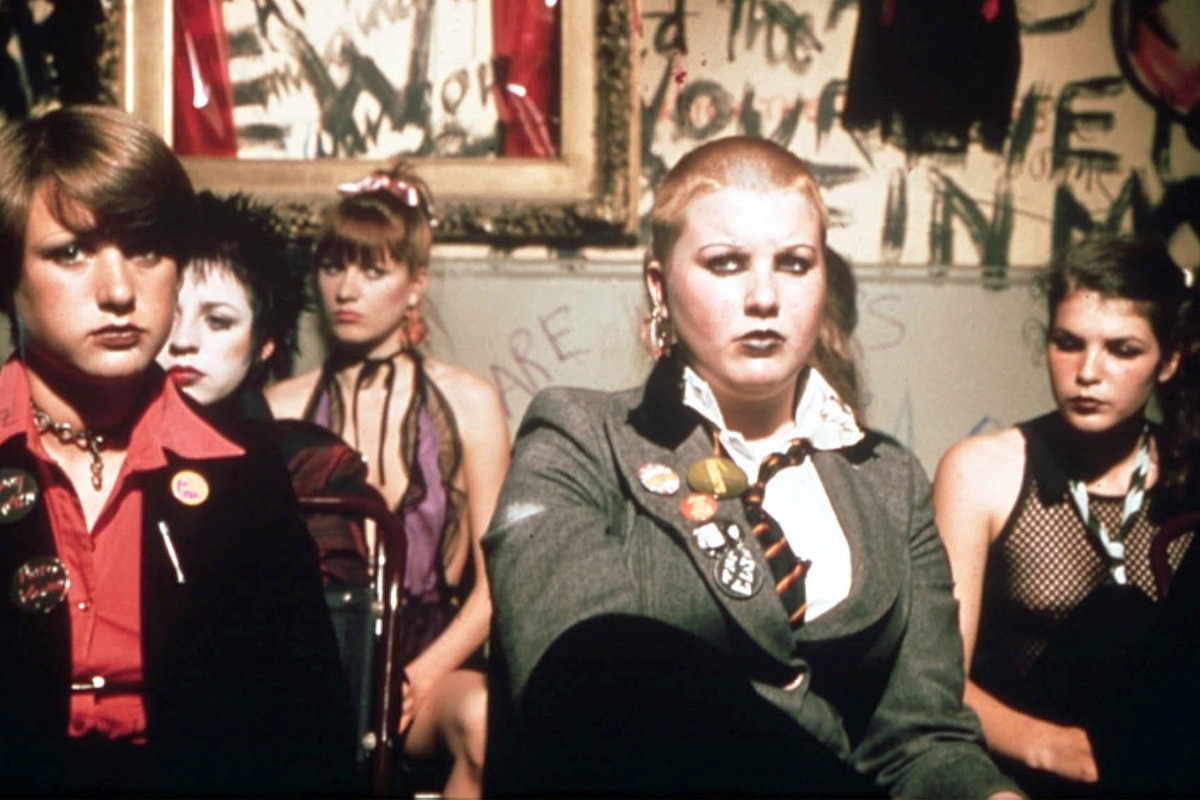
"Jarman's sophomore film "Jubilee", is a Molotov Cocktail of celluloid - a film that practically dares you to watch it...Basically, a giant filmed "F*ck You" to Margaret Thatcher, the royal family and the times in general. Jarman's visual flair becomes even more apparent. His technique as a filmmaker, garish colors and costumes, unreal settings, another Eno score on a shoestring budget defies logic. It looks and is to this day amazing. The theme of the decline of British society one which he would often revisit, explodes in every frame. In short, the film is punk."
- Thomas Bennett, Film Threat
"The now legendary soundtrack remains one of the film's biggest selling points, but its chaotic spirit also endeared the film itself to several generations of university students and underground movie fanatics. All others might want to start somewhere else, as this is not the most easily accessible film in the art house canon; the shifts in time and rambling monologues can be daunting to the inexperienced, and those who find Kenneth Anger too heady will no doubt run screaming during the first ten minutes."
- Nathaniel Thompson, Mondo Digital
"Under the direction of Derek Jarman, who also penned the script, this is no self-aggrandizing cash-in in the style of Malcolm McLaren's Great Rock 'n' Roll Swindle, but takes the punk movement seriously, so seriously in fact that it tends to lose the way at times, with a disjointed presentation verging on the incoherent while it mercilessly exposes punk's flaws. Where it does score is in its gritty imagery, and if the music takes second place to that, then it's spirited in other ways. The shock value is there, of course, because without the desire to be subversive and controversial, it's doubtful that anyone would have taken much notice...but now Jubilee, once so sly, modern and of the moment, looks like a antique, an item of nostalgia, and perhaps worst of all, an art movie."
- Graeme Clark, The Spinning Image
"The film is decidedly anarchic, in keeping with late-70s British punk, and depicts a scenario of societal rot, in which the guiding throne is uninvolved. Jubilee precedes the Margaret Thatcher renaissance, and functions as a call-to-question, a statement of disinterest in the threatening use of violence...The film stands as an exemplar of its origin era, both undeniably bold and alienating."
- Rumsey Taylor, Not Coming to a Theatre Near You (www.notcoming.com/)
Compiled by Jeff Stafford
Yea or Nay (Jubilee) - CRITIC REVIEWS OF "JUBILEE"
by Jeff Stafford | October 22, 2007
SIGN UP FOR OUR NEWSLETTERS

CONNECT WITH TCM