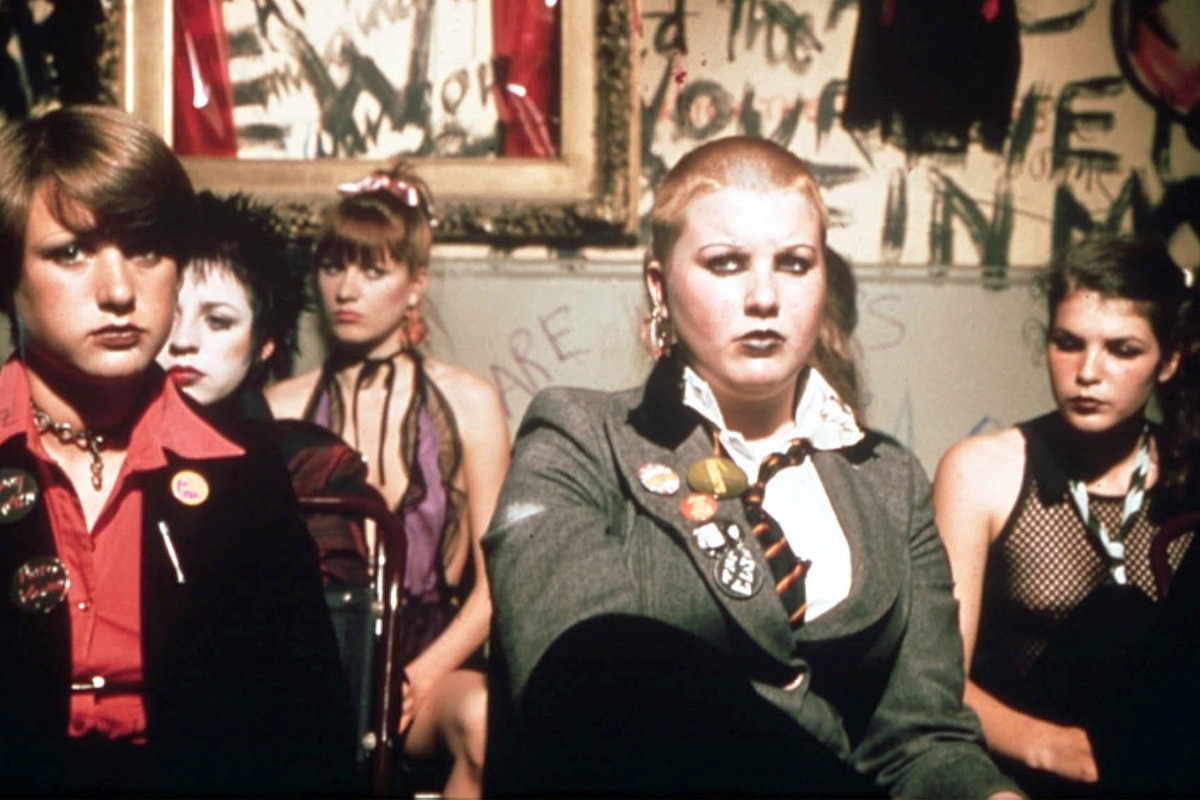
One of the few films to emerge from Britain's punk rock movement of the mid-seventies that succinctly expressed the anger and anarchic spirit of the times, Jubilee (1977) is possibly director Derek Jarman's most accessible film though its irreverent mixture of history, fantasy and agitprop shot, guerilla-style, on the back streets of London is not for everyone. The loosely structured film has a framing device that is set in the year 1578 as Queen Elizabeth I ponders the future of her country. Along with her court magician, Dr. John Dee, and lady-in-waiting, she is transported to contemporary England by the angel Ariel. There she finds a mirror image of herself as Bod, the leader of an outlaw band of deviants, who struggles for dominance in a post-Margaret Thatcher wasteland controlled by the fascist media mogul Borgia Ginz. In Jarman's apocalyptic vision, murder, muggings and widespread lawlessness are the norm, Westminster Cathedral has become a decadent discotheque and Buckingham Palace has been converted into Borgia Ginz's recording studio. All of it reflects the disillusionment and outrage of an artist reacting against a government in decline, rendered impotent by economic recession, ultra-conservative policies and an ongoing war with the IRA.
It has been said that the punk movement began as an art-school aesthetic expressed through the fashions and clothes created by Malcolm McLaren and Vivienne Westwood in their clothing store in the King's Road, Chelsea. Jarman became fascinated with the emerging scene and originally wanted to make a super-8 film that captured the milieu around his friend Jordan who worked at the King's Road store. "Punk...from the start raised questions about sexual codes," Jarman stated. "It is often argued that punk opened a space which allowed women in - with its debunking of 'male' technique and expertise, its critique of rock naturalism, its anti-glamour."
Howard Malin and James Whaley, who had produced Jarman's first feature length feature Sebastiane (1976), a gay love story with Latin dialogue based on the final days of the Catholic martyr, St. Sebastian, encouraged Jarman to instead make a movie that capitalized on the burgeoning punk movement. Jarman had, in fact, already filmed the Sex Pistols performing at a 1976 Valentine's Day party (the footage, one of the earliest surviving records of the band, later appeared in Julien Temple's The Great Rock 'n' Roll Swindle, 1980) and became excited about fashioning a narrative that was fueled by his political and artistic interests and partially inspired by his current interest in Valerie Solanas's Scum Manifesto, William Burroughs's The Wild Boys and Erich Fromm's The Fear of Freedom.
Jarman would later say "With Jubilee the progressive merging of film and my reality was complete. The source of the film was often autobiographical, the locations were the streets and warehouses in which I had lived during the previous ten years. The film was cast from among and made by friends." This eclectic group included two key participants from The Rocky Horror Picture Show (1975) - the show's creator, Richard O'Brien, and Little Nell (aka Nell Campbell) who played Columbia; Toyah Willcox, a classically trained actress from the National Theatre; Ian Charleson, who would receive international acclaim for his role as real-life runner Eric Liddell in Chariots of Fire (1981); Jenny Runacre, the versatile art-house star of such films as Pier Paolo Pasolini's The Canterbury Tales (1972) and Michelangelo Antonioni's The Passenger (1975); cinematographer Peter Middleton who filmed Sebastiane; costume designer Christopher Hobbs who would go on to work on other Jarman films as well as Todd Haynes's Velvet Goldmine (1998); composer Brian Eno, a former member of the band Roxy Music who is internationally renowned for his ambient music albums. Jarman also convinced musician Wayne County to play the part of Lounge Lizard and offered small parts to The Slits (as a street gang) and a young unknown, Adam Ant, who had just entered the music scene.
In the biography Derek Jarman, author Tony Peake wrote that "The production was based at Butler's Wharf. There was some distant location work...but otherwise the film was shot entirely in London, principally around Southwark, Rotherhithe and Victoria Docks. All along the river, the property developers were as active as ever, and throughout 1977 the empty warehouses continued to go up in flames. The apocalyptic desolation of the area, fringed as it was with 'rotting estates, closed shops and boarded windows,' mirrored to perfection the desolation Jarman was dissecting, while at the same time allowing him to rescue on celluloid that which the developers were intent on destroying. In this way - and most fittingly, given that punk shared a similar attitude - Jubilee stands as yet another example of the way Jarman liked to rehabilitate what would otherwise be discarded."
Originally Jarman had hoped that he would finish Jubilee in time to release it during the year of the Queen's Silver Jubilee but it didn't actually have its theatrical premiere until February 1978 at London's Gate 2 cinema. The reaction to the film was decidedly mixed by critics and audiences alike. There were numerous walkouts at the premiere with some people shouting, "This isn't punk!" at the screen. Others were offended by the film's numerous depictions of sex and violence while some were simply baffled by Jarman's off-kilter style with its low-budget aesthetics and artistic pretentions. Vivienne Westwood, the punk fashion designer, proclaimed it "the most boring and therefore most disgusting film I had ever seen." But there were numerous admirers as well. Variety called Jubilee "one of the most original, bold, and exciting features to have come out of Britain this decade."
Derek Jarman had the last word on the matter when he wrote in his autobiography, Dancing Ledge: "Afterwards the film turned prophetic. Dr. Dee's vision came true - the streets burned in Brixton and Toxteth, Adam [Ant] was on Top of the Pops and signed up with Margaret Thatcher to sing at the Falklands Ball. They all sign up in one way or another."
Producer: Howard Malin, James Whaley
Director: Derek Jarman
Screenplay: Derek Jarman
Cinematography: Peter Middleton
Film Editing: Nick Barnard
Art Direction: Mordecai Schreiber
Music: Brain Eno
Cast: Jenny Runacre (Queen Elizabeth I), Nell Campbell (Crabs), Toyah Willcox (Mad), Jordan (Amyl Nitrite), Hermine Demoriane (Chaos), Ian Charleson (Angel).
C-100m. Letterboxed.
by Jeff Stafford
SOURCES:
Derek Jarman by Tony Peake
Derek Jarman by Rowland Wyner
Derek Jarman: Dreams of England by Michael O'Pray
Midnight Movies by J. Hoberman and Jonathan Rosenbaum
The Criterion Collection DVD liner notes
IMDB
The Gist (Jubilee) - THE GIST
by Jeff Stafford | October 22, 2007
SIGN UP FOR OUR NEWSLETTERS

CONNECT WITH TCM