Targets (1968) marks the confident and self-assured solo feature debut of director Peter Bogdanovich, and it also marks the bittersweet swan song of one of the screen's most recognizable horror actors, Boris Karloff.
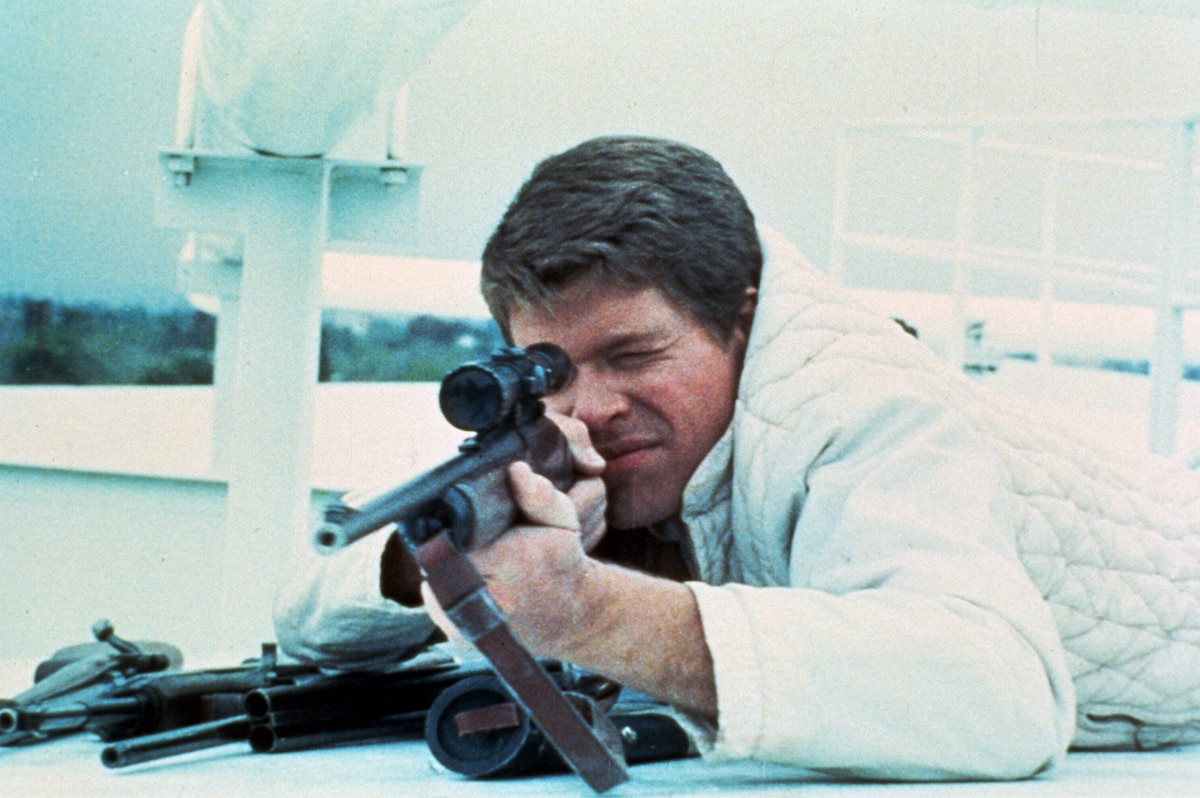
The film relates two separate stories, intercutting between them until the final moments in which they collide. The opening credits are displayed over footage from Roger Corman's The Terror (1963), and the viewer sees that this is the latest effort of elder horror-movie star Byron Orlok (Boris Karloff), being viewed in a studio screening room. Orlok is ready to retire from the business, feeling that his brand of Victorian boogieman has become passé in a world of modern, random violence. Young director Sammy Michaels (Bogdanovich) tries to persuade Orlok to act in his newest film, which he promises will be a change-of-pace. Orlok, Michaels, and Orlok's secretary Jenny (Nancy Hsueh) are standing outside the screening room on Sunset Blvd. in Hollywood, while across the street a young man named Bobby Thompson (Tim O'Kelly) is at a gun shop, trying out a potential purchase he places Orlok in the crosshairs of a new rifle. Thompson buys the rifle and adds it to a startlingly massive arsenal that he keeps in the trunk of his car. Thompson is unemployed and lives with his parents and new wife in a typical Los Angeles suburban ranch house. The atmosphere of the house is one of repression and disenchantment; the father (James Brown) is the probable target of Bobby's resentment, although the real reasons remain vague and unspecified. [SPOILER ALERT] While Orlok deals with the impending premiere of his new film at the drive-in theater, Bobby calmly kills members of his family and goes out to randomly pick off victims with his collection of guns.
Peter Bogdanovich started as a writer and film critic in the early 1960s he conducted important, exhaustive interviews with such directors as John Ford and Orson Welles, and programmed several of the earliest film retrospectives and brought new attention to such overlooked directors as Howard Hawks and Allan Dwan. Then Bogdanovich gained hands-on experience in the informal "Roger Corman school" of filmmaking, particularly with his work on The Wild Angels (1966); he scouted locations, did a major re-write on the script, directed the 2nd-unit work, and did some sound and cutting work. Corman next handed Bogdanovich a more thankless job: he had him shoot a few days worth of new footage of Mamie Van Doren and other aspiring starlets to cut into footage from a Russian sci-fi import Roger had acquired, Planeta Bur (1962) - the result was Voyage to the Planet of Prehistoric Women (1968). Following this assignment, Corman put forth a modest proposal: It seems that horror king Boris Karloff owed Roger two days of shooting, worth $15,000. Corman suggested that for his first solo feature film, Bogdanovich shoot twenty minutes of Karloff in the two days allotted, use twenty minutes of stock footage from Corman's earlier picture The Terror (1962), and shoot forty minutes of additional footage without Karloff, resulting in an 80-minute feature. Bogdanovich would be given a budget of $125,000 and a 15-day shooting schedule.
Bogdanovich wrote the story for Targets with his first wife, production designer Polly Platt. In his chapter on the film from Midnight Marquee Actors Series: Boris Karloff, Mark A. Miller writes that "in its original version, Karloff would play an old horror actor who had hated being typecast all his life. Bitter that his career path has not been more like Cary Grant's, 'he goes into his room [and] pushes a secret button, and there's his dressing room,' according to Bogdanovich. 'He puts on a handsome mask, and he goes out and strangles women in supermarkets. I wanted that, because the floor of a supermarket is great for dollying.'" Fortunately, cooler heads prevailed, and the decision was quickly made to have Karloff essentially play himself in the film, rather than a villain.
Bogdanovich has said (in the Targets DVD commentary) that the idea that Karloff should be an actor in the story came originally from a joke: "I was going to begin the picture with The Terror, the lights were going to go up, Roger Corman was going to be sitting next to Karloff, and he was going to turn to Roger and say, 'that's the worst movie I've ever seen.'" Bogdanovich drew many of the details of the sniper story from the then-recent 1966 case of Charles Whitman, an ex-marine who killed his wife and mother before climbing the Tower at the University of Texas in Austin and shooting innocent passersby before being killed by police.
Just prior to filming Targets, Bogdanovich had a story conference with director Sam Fuller, who made several changes and suggestions which were incorporated into the script, including the climax. (When Fuller refused screen credit for his contribution, Bogdanovich named the young director he played in the film "Sammy Michaels" a tribute to Samuel Michael Fuller). The film stayed on budget but went a week over schedule. The two days with Karloff expanded to five, and of the remaining 18 days, 12 of those were taken up in filming at the Reseda Drive-in Theatre in Los Angeles.
While preparing Targets, Bogdanovich had seen the debut of the now-classic animated TV special How the Grinch Stole Christmas (1966), which was narrated by Karloff he asked himself, "How can I do a movie with Boris Karloff and not have him tell a story in it?" One of the most memorable scenes in the film was devised as a result, as Karloff/Orlok rehearses in his hotel room for an upcoming radio broadcast and tells the story "Appointment in Samarra." Karloff insisted on filming the sequence in an uninterrupted take, without cue cards. He received an ovation from the crew after the scene was completed.
Bogdanovich certainly felt himself prepared by 1967 to direct a feature. In addition to his hands-on training under Corman, he was probably more bolstered by his years of interviewing the great directors of the past he put to use many bits of advice from the likes of Hawks ("Always cut on movement, then the audience won't see the cut") and Hitchcock ("Never use establishing shots to establish. Only use them when you want a dramatic effect").
Filming on Targets was completed in April of 1967, but following a long editing period and a sale to Paramount Pictures (which gave Corman a tidy profit on his investment), the film sat on the shelf for a time and did not see general release until August of 1968. In the interim, the country had been subjected to the assassinations of Martin Luther King, Jr. and Robert Kennedy. Consequently, Paramount nervously added a brief prologue a text scroll about gun control.
Targets has gained its well-deserved reputation over the passage of time; upon initial release it was ignored at the box-office although it earned good notices from the few publications that bothered to review it. Variety called it "A good programmer, within low budget limitations" and says "Peter Bogdanovich has made a film of much suspense and implicit violence....Aware of the virtue of implied violence, Bogdanovich conveys moments of shock, terror, suspense and fear."
In a perfect world, Targets would have been Boris Karloff's last movie appearance. But life is seldom so tidy, and workhorse Karloff went on to act in five more movies: in England he shot The Crimson Cult (1970) with Christopher Lee, and then he returned to Los Angeles after accepting an offer to act in no less than four movies, all shot back-to-back. These movies were financed by a Mexican producer, Luis Enrique Vergara, who employed American B-Movie mainstay Jack Hill (Spider Baby, 1968) to fashion four different screenplays in such a way that all of Karloff's scenes could be shot in one three-week period.
Boris Karloff died in February of 1969, six months after the release of Targets, and his dialogue as "Orlok" the great horror actor became more poignant: "I feel like a dinosaur. Oh, I know how people think of me these days old-fashioned, outmoded. You know what they call my films today? Camp. High camp." Peter Bogdanovich's first feature could never be called "camp;" it has always felt fresh, and it can also claim to be one of the few cult films of the 1960s to have a continuing relevance since shooting sprees perpetrated by young Whitman/Thompson-types continue to crop up, unfortunately, with alarming frequency.
Producer: Peter Bogdanovich
Associate Producer: Daniel Selznick
Director: Peter Bogdanovich
Screenplay: Peter Bogdanovich, story by Polly Platt and Peter Bogdanovich
Cinematography: Laszlo Kovacs
Film Editing: Peter Bogdanovich
Production Design: Polly Platt
Makeup: Scott Hamilton
Sound Editor: Verna Fields
Cast: Tim O'Kelly (Bobby Thompson), Boris Karloff (Byron Orlok), Arthur Peterson (Ed Loughlin), Monty Landis (Marshall Smith), Nancy Hsueh (Jenny), Peter Bogdanovich (Sammy Michaels), James Brown (Robert Thompson, Sr.), Mary Jackson (Charlotte Thompson), Tanya Morgan (Ilene Thompson).
C-90m.
by John M. Miller
Targets
by John M. Miller | October 22, 2007
SIGN UP FOR OUR NEWSLETTERS

CONNECT WITH TCM