Based on the true story of Dr. Samuel Mudd, the Maryland physician sentenced to life in prison for his alleged involvement in the assassination of President Abraham Lincoln in 1865, The Prisoner of Shark Island (1936) combines history with histrionics in an exciting production expertly directed by John Ford. Remarkably, Ford had already directed over eighty films in Hollywood since starting his career in 1917, including, the year before this film, the acclaimed Irish rebel drama The Informer, for which Ford won the Oscar® for Best Director. Though The Prisoner of Shark Island has often fallen somewhat under the radar in the hall of fame of John Ford's achievements, its star is rising as film scholars rediscover the stark and powerful imagery and intriguing political nuances found in the production.
The Prisoner of Shark Island was made for Twentieth Century-Fox under the aegis of producer Darryl F. Zanuck, the self-made and incredibly successful Hollywood writer-producer who had cut his teeth in silent films, including a stint with Mack Sennett. He co-created the successful Rin Tin Tin canine adventures for Warner Bros., and became head of production for the studio at age twenty-three. Frustrated with his inability to rise higher in the Warner Bros. management hierarchy, Zanuck left his comfortable berth at the studio in the early 1930s in order to form his own 20th Century Pictures, which he later merged with the Fox Studio in 1935. After a string of producing successes including Les Miserables and The Call of the Wild (both 1935), Zanuck teamed with the tough-minded director Ford for The Prisoner of Shark Island, the first of many illustrious Zanuck-Ford collaborations (Young Mr. Lincoln (1939), Tobacco Road (1941), The Grapes of Wrath (1940), How Green Was My Valley (1941), among others) that thrived on the feisty relationship between the two expert and opinionated moviemakers.
The Prisoner of Shark Island was penned by screenwriter Nunnally Johnson, a Georgia-born, former New York City newspaperman who transitioned into the movies in the early 1930s. Whether or not Johnson's Southern background influenced his particular retelling of Dr. Mudd's unusual story is still up for discussion. In fact, the entire extent of the involvement of Dr. Mudd in the Lincoln assassination is, to this day, an open book. Up until a few years ago, when the Supreme Court declined to hear the appeal of Dr. Mudd's conviction (because the case was filed past deadline), the surviving members of the Mudd family, including his grandson who passed away in 2002, repeatedly petitioned for Dr. Mudd's conviction to be expunged from the records. Even though he had been pardoned by President Andrew Johnson in 1869 after some of the events chronicled in The Prisoner of Shark Island, Mudd's relatives felt that he had been wrongly sentenced during the trial of the assassins.
As it was, Mudd narrowly avoided execution by hanging, the punishment meted out to four of the conspirators (Mary Surratt, David Herold, George Atzerodt, Lewis Payne) with the other four (Mudd, Arnold Spangler, Samuel Arnold, Michael O'Laughlen) sent to Florida's sweltering Fort Jefferson Dry Tortugas prison compound for the rest of their lives. The actual assassin of President Lincoln, the dashing, daring and possibly demented actor John Wilkes Booth, had of course been shot and killed--against orders, by a lunatic soldier--after a two-week long pursuit through the Washington D.C.-area woods and swamps. Saddened and enraged by the death of Lincoln, the country (especially the North) demanded swift justice, hustling the accused into a hasty military trial where the customary rules of evidence weren't strictly upheld and passion and grief may have stepped in where cooler heads were not to be found. Nevertheless, despite the fact that Dr. Mudd repeatedly claimed he did not know the identity of the two men who knocked on his door in the dark of night, one of them in great pain from a broken leg, and who left the next day after paying him for his services, in truth Mudd was being less than candid.
He later admitted, and research has shown, that he did in fact know John Wilkes Booth, who had visited him at his farm on a horse-buying excursion, and whom he had also socialized with in Washington D.C. well before the events of April 1865. Although there does not seem to be evidence that Mudd conspired in any way in Lincoln's assassination, he may have been marginally involved in an earlier plot to kidnap the President, also orchestrated by Booth. During his trial, Dr. Samuel Mudd was surely being disingenuous when he claimed no recognition of the assassins as they stopped by his house, though of course Booth clearly hadn't planned on breaking his leg in his leap to the Ford's Theatre stage (thereby requiring medical assistance), and would not have sought out his acquaintance Dr. Mudd had the unforeseen injury not occurred. Indisputable evidence notwithstanding, the fact that Mudd had aided the assassins by giving directions to the pair as they prepared to leave his house was enough to seal his fate in the eyes of the military court.
In The Prisoner of Shark Island, Dr. Mudd is clearly seen as a victim, an innocent man caught up in the frenzy for justice brought on by Lincoln's murder, a viewpoint that can be understood from several angles; not the least of them is the fact that an innocent man trying to escape from a brutal prison packs more dramatic punch than a justly-implicated man doing the same. Despite the sympathy for Mudd the man, the death of the President is shown as every bit the tragedy it was for the nation. The actual assassination of President Lincoln is faithfully recreated to great dramatic effect with the frequent Lincoln portrayer Frank McGlynn briefly seen as the martyred leader.
The cast of The Prisoner of Shark Island is first-rate. Warner Baxter, silent screen matinee idol, Best Actor Academy Award winner for his work in In Old Arizona (1928, as the Cisco Kid), and the Broadway producer who urged young Ruby Keeler to stardom in 42nd Street (1933), had one of his best roles as Dr. Mudd. After breaking into films he made over fifty movie appearances in the 1920s, and continued his career--including his Oscar® win--up until his death in 1951. Baxter is intense, sympathetic and haunted as Mudd, though his early attempts at a Maryland Southern accent did not meet with Darryl Zanuck's approval. After viewing dailies, the producer stormed onto the set to confront director Ford about Baxter's performance. After Ford threatened to quit if Zanuck interfered, the producer barked back at the pugnacious director "I throw fellas off this set. They don't quit on me." Ford had met his match and a productive professional relationship was born.
Actress Gloria Stuart (who would have her biggest smash hit as Rose, the elderly survivor in 1997's Titanic) played Dr. Mudd's wife. In her second film directed by John Ford (1932's Air Mail was the first), the lovely Miss Stuart realized that Ford was a minimalist director when it came to actors. In her autobiography she relates how he would place the actors, plot their movements, and call for a rehearsal. After one scene he asked her for a "little more reaction," the most direction she ever recalled getting from him. Regardless of her technique, Stuart's performance as the wife of the imprisoned doctor is heartbreaking and realistic, given the extreme circumstances of their separation. Unfortunately, good roles such as Peggy Mudd were rare for Stuart who could have been a major star in Hollywood if she had been given better opportunities.
Perhaps the most striking performance, other than Warner Baxter's, in The Prisoner of Shark Island is that of John Carradine, who plays the wild-eyed prison guard Sgt. Rankin. Though he had appeared in over twenty-five films since starting his movie career in 1930, Carradine had still not found his breakout role. He originally auditioned for the role of Lincoln, but after a contentious screen test where Carradine and director Ford didn't get along, Ford instead asked the actor to read the part of the sadistic Yankee guard. Though Carradine balked at Ford's request to play Rankin as a fanatical half-wit, he tried to placate Ford yet also toss in his own interpretation of the sergeant, to Ford's disapproval. Certain that he had blown the audition, Carradine stalked off the set, only to be informed by the other actor in the scene that the part was his. That other actor was John Ford's brother Francis Ford, who appears as Corporal O' Toole in the film.
John Carradine's distinctive performance as the cruel Sgt. Rankin, who eventually comes to respect Mudd after the doctor saves the prison colony from a yellow fever epidemic, was uniformly praised for its often disturbing physical nature; some of it was due to Ford's decision, and that of his cinematographer, the talented Bert Glennon, to shoot Carradine with a strong face light, causing the actor to squint maliciously in key scenes. A number of effective close-ups, memorably vicious action sequences and Carradine's frightening gaunt visage earned the actor much praise and a contract with 20th Century-Fox, both worth their weight in gold. Carradine later explained that even though Rankin was on the surface a villain, the audience could empathize with him since his cruelty was a manifestation of his extreme love for Abraham Lincoln and his hatred of anyone connected with the death of his beloved leader. John Carradine would eventually make a dozen movies with John Ford.
The rest of the supporting cast was impressive as well, including Harry Carey, Sr., a huge star of early westerns (many directed by Ford) who had been a close friend and associate of the director for many years until their friendship faltered in the early 1920s, reportedly over Carey's marriage to his leading lady, whom Ford also fancied. It wasn't until Ford cast his former pal as the prison commandant in The Prisoner of Shark Island that their friendship was mended.
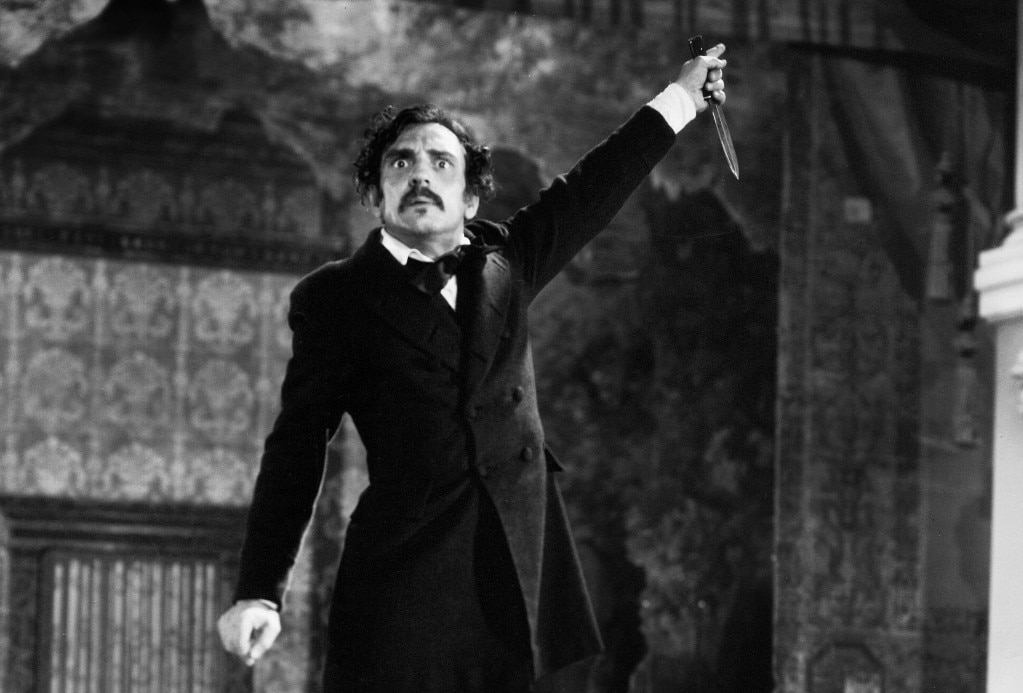
Veteran screen actor Francis McDonald played the small but crucial role of assassin John Wilkes Booth, one of nearly three hundred and fifty movie and TV roles, many in westerns, the Kentucky-born thespian made over his career which started in 1913. The important part of Buck Milford, Dr. Mudd's former slave who is assigned as one of his prison guards and aids Mudd in his attempted escape, was played by Ernest Whitman in an earnest and moving performance. Despite arguable depictions of slavery and some uncomfortable remnants of Hollywood's less-than-ideal attitude towards race, Whitman's Buck is powerful, courageous and one of the high points of the film. Actor O.P. Heggie, who plays the prison doctor who succumbs to yellow fever, died just two weeks after finishing his role in the film.
While critics were overall impressed with The Prisoner of Shark Island, some complained that they'd seen it all before, notably in movies about the Dreyfus affair and his wrongful imprisonment on Devil's Island. The fact that this was an infamous chapter in American history didn't sway some of the critics, though many were pleased to see these colorful real life characters brought to the screen. Most agreed however that John Ford's direction was superb, a more-than-merely-capable combination of grim and moody courtroom and prison scenes, along with heart-pounding action sequences, including the failed prison escape, hungry shark attacks, and prison rebellions, that moved the fascinating story along. While truth isn't always stranger than fiction, it actually is in The Prisoner of Shark Island, a story of a still-contentious and always-fascinating event in United States history. With John Ford at the helm, it might even be enough to send some audience members back to the library to learn the real story behind his intriguing movie.
Producer: Nunnally Johnson, Darryl F. Zanuck
Director: John Ford
Screenplay: Nunnally Johnson
Cinematography: Bert Glennon
Film Editing: Jack Murray
Art Direction: William Darling
Music: R.H. Bassett, Hugo Friedhofer
Cast: Warner Baxter (Dr. Samuel Mudd), Gloria Stuart (Mrs. Peggy Mudd), Claude Gillingwater (Col. Jeremiah Milford Dyer), Arthur Byron (Mr. Erickson), O.P. Heggie (Dr. MacIntyre), Harry Carey (Commandant of Ft. Jefferson).
BW-96m.
by Lisa Mateas
The Prisoner of Shark Island
by Lisa Mateas | October 10, 2007
SIGN UP FOR OUR NEWSLETTERS

CONNECT WITH TCM