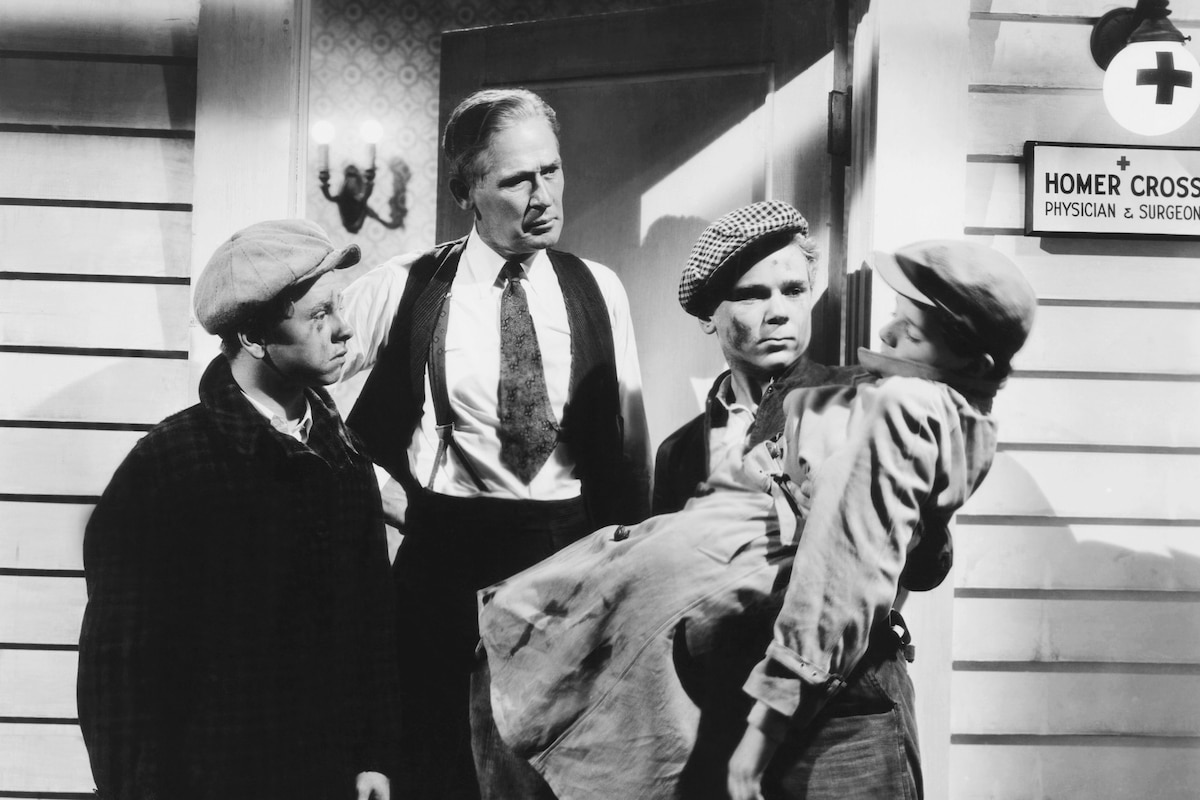
MGM made a rare foray into the slums for The Devil Is a Sissy (1936), a tale of the unlikely friendships forged when a lonely British boy moves into a low-rent neighborhood with his divorced father. Street crime and juvenile delinquency were more the province of studios like Warner Bros. in 1936, but prompted by the stage success of Dead End, which independent producer Sam Goldwyn would film in 1937, studio head Louis B. Mayer decided to showcase his roster of juvenile players in this surprisingly gritty comedy-drama. The film also marked a transition in the studio's star roster, with more idealized young actors like Freddie Bartholomew and Jackie Cooper finding themselves upstaged by the earthy young Mickey Rooney, who would soon become one of MGM's top stars.
MGM announced plans for The Devil Is a Sissy in an article in The Hollywood Reporter of October 31, 1935, just six days after Sidney Kingsley's slum-set play Dead End opened to rave reviews on Broadway. Storywriter Rowland Brown started out as the picture's director, but studio veteran W.S. Van Dyke II was brought in to assist him from the start. Within days he had taken over as sole director, with most of Brown's footage scrapped. This marked the fourth time Brown, famous for his arguments with studio heads and producers, would be fired as a director. From that point, he would confine himself to writing, moving to Warner Bros. to create the story for Angels with Dirty Faces (1938), a vehicle for the real Dead End Kids, the original stars of the Broadway play. After a brief foray to Broadway as playwright and producer, he would retire from show business
By contrast, Van Dyke was the perfect studio player. He worked quickly and efficiently, earning the nickname "One Shot." But he also stood up for what he believed in and had fought to cast William Powell and Myrna Loy in The Thin Man (1934), the film that made them stars and a major screen team. Moreover, he was a perfect choice for the film, as he related to younger actors on a personal level. On weekends, he and his wife frequently invited neighborhood children and MGM's younger stars to pool parties at his house, where he was often at the center of the juvenile horseplay.
Early Retirement was the fate that almost befell one of stars of The Devil Is a Sissy. Jackie Cooper had been a mainstay at MGM as a child. But as he entered his teen years, the good looking young man was having trouble maintaining his box office popularity, particularly since the studio insisted on casting him in tear-jerkers similar to his biggest studio triumph, The Champ (1931). That strategy proved to be unsuccessful for the 15-year-old actor's career. After completing The Devil Is a Sissy, he and his mother were summoned to Louis B. Mayer's office and informed that the studio had decided to drop his option. At the time, he was earning $2,000 a week, which was more than he was worth at that point. Mayer then offered him a new contract at only $250 a week, informing him that the studio would keep him in bit parts until he got through his "awkward years." When they turned him down, Mayer had the young actor blacklisted for a year. In the meantime Cooper proved he was indeed a gifted actor in a number of B movies for other studios, often receiving the top billing. By 1941 he had worked his way back to MGM appearing as Judy Garland's love interest in Ziegfeld Girl (1941). With his recent successes in Seventeen (1940) and The Return of Frank James (1940), the studio wound up paying him $5,000 a week.
Cooper's departure after The Devil Is a Sissy, however, would hardly leave MGM at a loss for young male stars. That film had been planned less as a showcase for him than for young Bartholomew, a British actor who had scored a hit as the younger version of David Copperfield (1935). Only twelve when he co-starred with Cooper, he would continue as a top juvenile star until he really did fall prey to the awkward years of adolescence. After a few unsuccessful attempts at more adult roles, he moved into advertising.
Although The Devil Is a Sissy was intended to build Bartholomew's star status, the film provided a bigger career boost for third-billed Mickey Rooney. As the son of a death row inmate, he had a powerful scene in which he learns of his father's death. As a result, he stole the picture from his co-stars, showing the almost limitless talent that would eventually make him the movies' top box office star from 1939 to 1941.
Producer: Frank Davis
Director: W.S. Van Dyke II
Writer: John Lee Mahin, Richard Schayer
Based on a story by Rowland Brown
Cinematographer: Harold Rosson, George Schneiderman
Art Director: Cedric Gibbons
Score: Herbert Stothart
CAST: Freddie Bartholomew (Claude), Jackie Cooper ("Buck" Murphy), Mickey Rooney ("Gig" Stevens), Ian Hunter (Jay Pierce), Katharine Alexander (Hilda Pierce), Gene Lockhart (Mr. Murphy), Jonathan Hale (Judge Holmes), Etienne Girardot (Principal), Frank Puglia ("Grandma").
BW-92m.
by Frank Miller
The Devil is a Sissy
by Frank Miller | September 26, 2007
SIGN UP FOR OUR NEWSLETTERS

CONNECT WITH TCM