The first image in Decoy (1946), after opening credits placed
over a smoking gun and strongbox, is that of the dirtiest sink
imaginable. A pair of equally dirty hands wash themselves shakily
before we pan up to a shard of a mirror to see the disheveled face of a
man we'll soon know as Dr. Craig (Herbert Rudley). In a daze, he
wanders out of this service station restroom and onto the highway,
where a roadsign tells us he's 75 miles from San Francisco. He tries to
hitch a ride. Finally a car stops. The doctor says not a word all the way
to the city. He arrives at a hotel, makes his way up to a woman's room
and pulls out a gun, closing the door behind him...
The rest of Decoy lives up to this terrifically compelling opening
sequence. In flashback, told to cop Joe Portugal (Sheldon Leonard) by
Margot Shelby (Jean Gillie), the woman in that hotel room, we are
treated to a lurid story of greed, double-crossing and wanton murder.
Margot's boyfriend Frank Olins (Robert Armstrong, of King Kong
[1933] fame) is about to be sent to the gas chamber, but the $400,000 he
stole is still buried somewhere and only he knows where. Margot has
an only-in-the-movies plan, however. If she can get Frank's body to a
crooked doctor within an hour of the execution, a special drug can be
administered which will revive him; then Frank can retrieve the money.
While the drug-induced revival works out, in a "mad-doctor" sequence
which even has the revived Frank exclaiming "I'm alive! I'm alive!", the
ensuing drama gets a bit more complicated and way more violent.
Suffice it to say that Margot will not let anyone get in her way to recover
the loot: not Frank, not the doctor, not Frank's henchman Jim Vincent
(Frank Norris), not cop Joe Portugal.
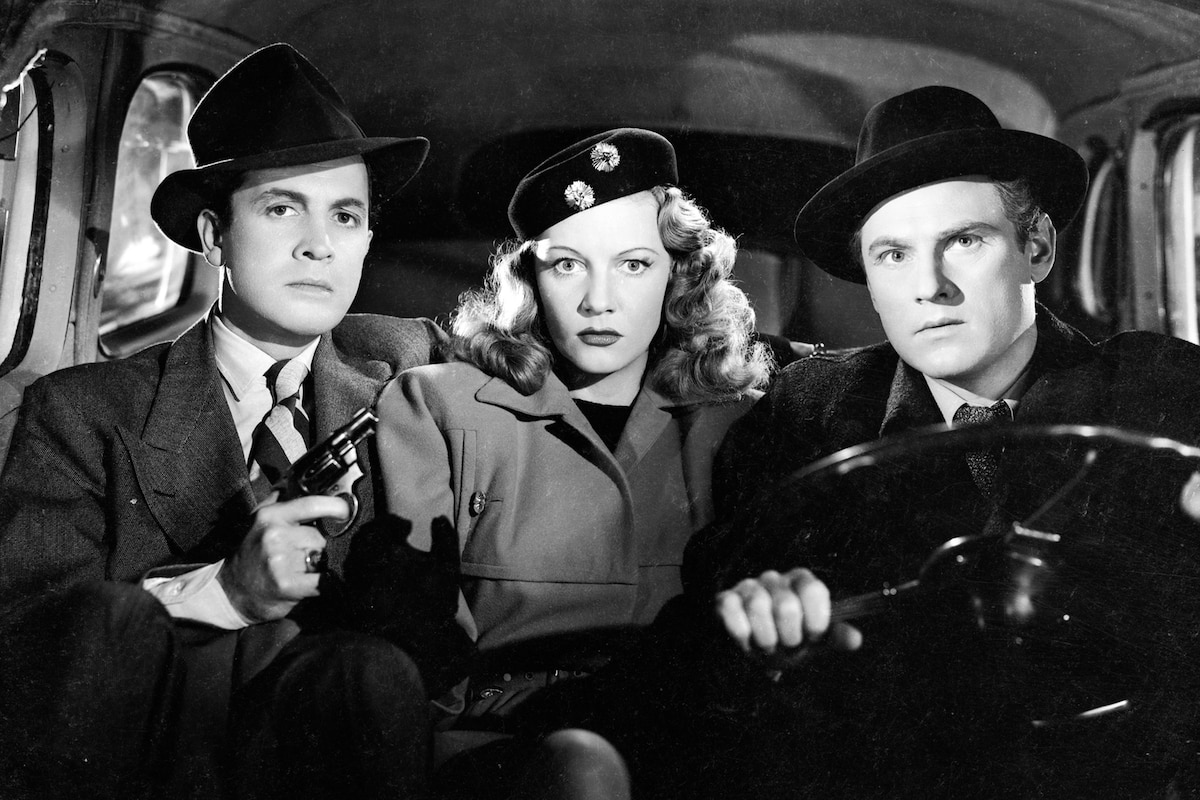
Decoy is unified in its delightfully cheap, pulpy, Monogram
style, though in truth it looks pretty good for a poverty row studio like
Monogram. Sheldon Leonard is probably the most recognizable face
here, and while it's fun to watch him slap people around and take Jean
Gillie's breathtaking final putdown, Decoy is far and away
Gillie's baby.
A British actress who was married to Decoy's director Jack
Bernhard at the time, Gillie had appeared in a number of British films
but had yet to conquer Hollywood. She and Bernhard broke up soon
after making this film, and her career never went anywhere despite
good notices. She acted in one more picture and a good one at that,
The Macomber Affair (1947), before dying of pneumonia in 1949
at only 33 years of age. Had she lived, she would very likely have
developed a significant career, for in Decoy she is absolutely
sensational. In black gloves, a low-cut tight-fitting dress, and glittering
diamonds around her neck, Gillie is the epitome of a femme fatale,
beautiful and mean literally to her dying breath. Watching her play -
and eliminate - man after man on her quest to get the money is a sight
to behold.
Like Margot, Decoy is lean and mean, a tough little obscurity
which can now be discovered by movie lovers thanks to Warner Home
Entertainment, which has included it in the Film Noir Classic
Collection, Vol. 4. The only flaw on the DVD is the fact that the
nastiest moment in the movie is missing. Margot kills a man in one
scene by running him over, and in the original release, she drives over
his body a second and third time. That sequence was purportedly seen
at American Cinematheque screenings in the early 2000s but is missing
from this transfer; film historian and reviewer Glenn Erickson, on his
commentary track, speculates that the sequence must have been edited
out for television airings in the 1950s and 60s and that one of those prints
was used for the DVD.
In the commentary Erickson interviews Stanley Rubin, who is credited
with Decoy's story. Rubin was interested in how far greed could
take a person and originally wrote Decoy as a radio piece, later
selling it to Monogram. (Writer/actor Nedrick Young wrote the finished
screenplay.) It's an excellent conversation, fun to listen to and full of
compelling information about the movie, those associated with it, and
other elements of Rubin's career. (Rubin also did a commentary track in
2006 for the DVD of Macao [1952] which is more interesting than
that film itself!) Rubin says that Jean Gillie raised the level of
Decoy by the force of her own talent, which seems true, and
Erickson clearly knows his stuff. He also pops up in the 5-minute
featurette on the making of Decoy, which is the only other
extra. Other talking heads in this well-edited piece include Rubin, Molly
Haskell and even Dick Cavett.
2007 is the fourth year in a row that Warner Brothers has released a
multi-disc set of classic film noir, and this time around they have
packaged ten titles instead of the usual five. A pair of movies can be
found on each disc, and DVDs are available individually or in the
complete set. Decoy shares a disc with Andre de Toth's
first-rate Crime Wave (1954) and is one of the best reasons to pick
up this entire collection. Very highly recommended!
For more information about Decoy, visit Warner Video. To order
Decoy, go to
TCM
Shopping.
by Jeremy Arnold
Decoy - A Rarely Seen 1946 Film Noir Gem on DVD
by Jeremy Arnold | August 27, 2007
SIGN UP FOR OUR NEWSLETTERS

CONNECT WITH TCM