What the hell does Blade Runner (1982) have that The Apple (1980) didn't have first, two years earlier? The obvious Christian allegory, the studly but dull crypto-Fascist hero whose rite of passage comes via a bloody beating that mirrors Christ's passion, the unpersuasively retrofitted vintage automobiles kitted out with "futuristic" chrome appliqués and bubble domes, the flying cars, the overuse of see-through plastic as a fashion accessory and the neon-splashed, rain-soaked Dystopia in which old world brick and mortar tenements are offered in counterpoint to cold Bauhaus architecture were all in place before Ridley Scott had even signed his contract. So why is Blade Runner heralded as a sci-fi classic and The Apple branded (to quote one of its kinder detractors) "lovably incoherent"? Part of the answer is that no one has ever gone to bat for The Apple, while Blade Runner has had an endless stream of defenders since its initially unfavorable reaction twenty-five years ago. A box office dud at the time of its November 1980 theatrical release and shown only sporadically in the early days of cable television, The Apple quickly lapsed into relative obscurity, decried as a bomb by more people than had ever seen it. The other half of the answer is that it's really bad!
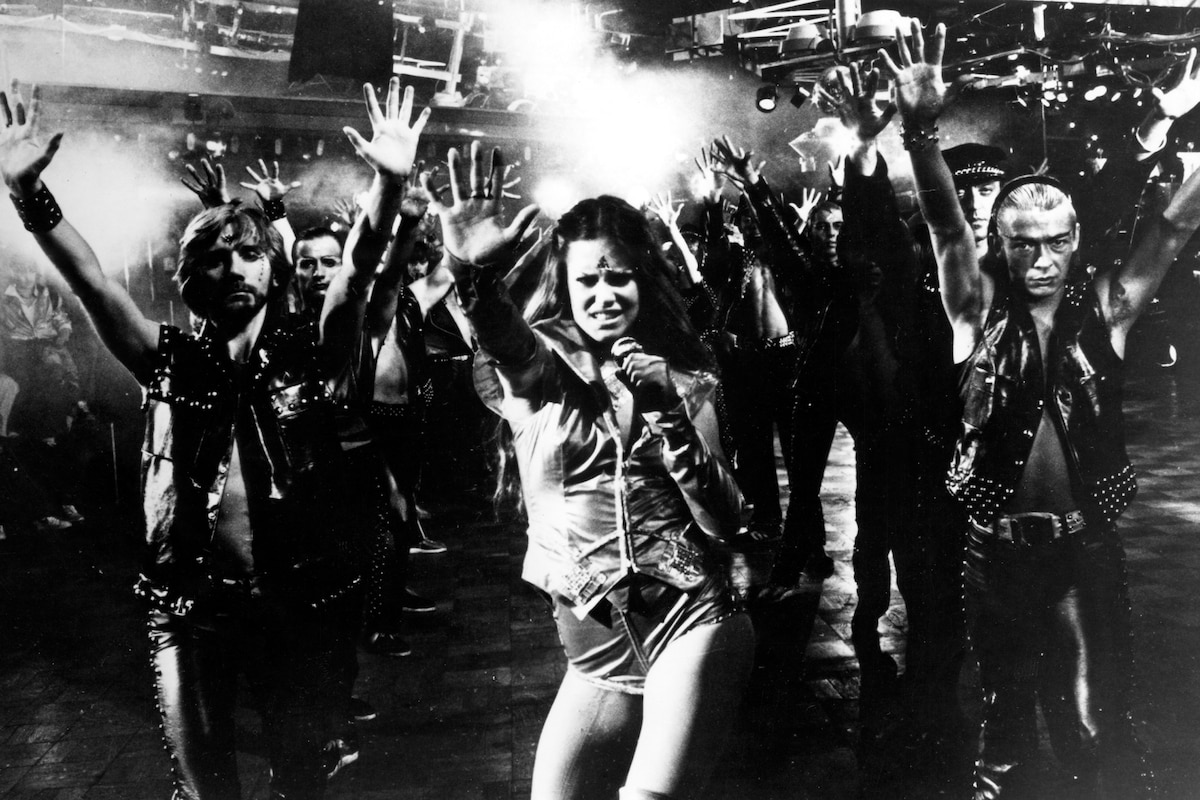
For a movie made by an Israeli, The Apple plays like a Christian scare film and even sets one production number in Hell, where vampires, zombies and wolf-snouted slaves fawn and scratch over the naked bodies of the story's surrogate Adam and Eve as they are seduced by Satan himself (the suitably serpentine Vladek Sheybal). Evil in The Apple (influenced as much by the Book of Genesis as The Rocky Horror Picture Show, 1975) is aligned with electronic music, glitter make-up, lawyers and homosexuality, all of which get in the way of the "normal" relationship of four-square hero Alphie (the pseudonymous "George Gilmour," whose English carries more than a hint of Germanic bluntness) with virginal heroine Bibi (Catherine Mary Stewart). While Alphie resists the siren call of sin, Bibi falls (so like a woman) and the only time Alphie wavers is when he is drugged and mounted against his will by a flirty Negress (Grace Kennedy). The majority of the film's villains are effeminate if not downright flaming and at one point Alphie is introduced to a stable of "girls" who are clearly men in drag. There's a Mein Kampf quality to Alphie's struggle and eventual martyrdom; that he ultimately allies himself with a troupe of aging counter culture types doesn't ameliorate the Final Solution aftertaste that The Apple leaves you with, as God (veteran British actor Joss Ackland) cleanses the earth of "pollution" in a Rapture-like mass exodus of the faithful. It would be a happy ending if Alphie weren't such an unappealing homophobic knob whose "pure" music weren't such torture to listen to.
Beyond the thematic and subliminal bizarreness and the thievery from better films (Bob Fosse's All That Jazz (1979) comes instantly to mind), The Apple remains solid guilty pleasure entertainment. While few of the songs are memorable, the film clips along energetically and its maladroit futuristics are fun in the way of Italian science fiction movies post-The Road Warrior (1982). The candied chromatics of cinematographer David Gurfinkel (who would go on to shoot Delta Force (1986) and several of Cannon's "ninja" programmers) have aged well and editor Alain Jakubowicz (who later cut Tobe Hooper's Invaders from Mars (1986) remake and The Texas Chainsaw Massacre 2 (1986) for Cannon) keeps the scenes from overstaying their welcome. If The Apple's leading man and leading lady leave something to be desired, bad guy Vladek Sheybal (a former James Bond villain and a reliable exotic in British films since the early 1960s) is always fun to watch (even when participating in painfully clubfooted dance numbers), as is singer Grace Kennedy (in bad-girl-with-a-heart-of-gold mode), whose two solos are by themselves worth the price of admission to The Apple...provided one hasn't paid too much to see it.
Producers: Menahem Golan, Yoram Globus
Director: Menahem Golan
Screenplay: Coby Recht, Iris Recht and Menahem Golan
Cinematography: David Gurfinkel
Film Editing: Alain Jakubowicz
Music: Coby Recht
Cast: George Gilmour (Alphie), Catherine Mary Stewart (Bibi), Vladek Sheybal (Mr. Boogalow), Joss Ackland (Hippie Leader/Mr. Topps), Allan Love (Dandi), Grace Kennedy (Pandi), Ray Shell (Shake), Miriam Margolyes (Landlady), Leslie Meadows (Ashley), Derek Deadman (Bulldog), George S. Clinton (Joe Pittman), Francesca Poston (Vampire/Boogalow Receptionist).
C-90m.
by Richard Harland Smith
The Gist (The Apple) - THE GIST
by Richard Harland Smith | August 24, 2007
SIGN UP FOR OUR NEWSLETTERS

CONNECT WITH TCM