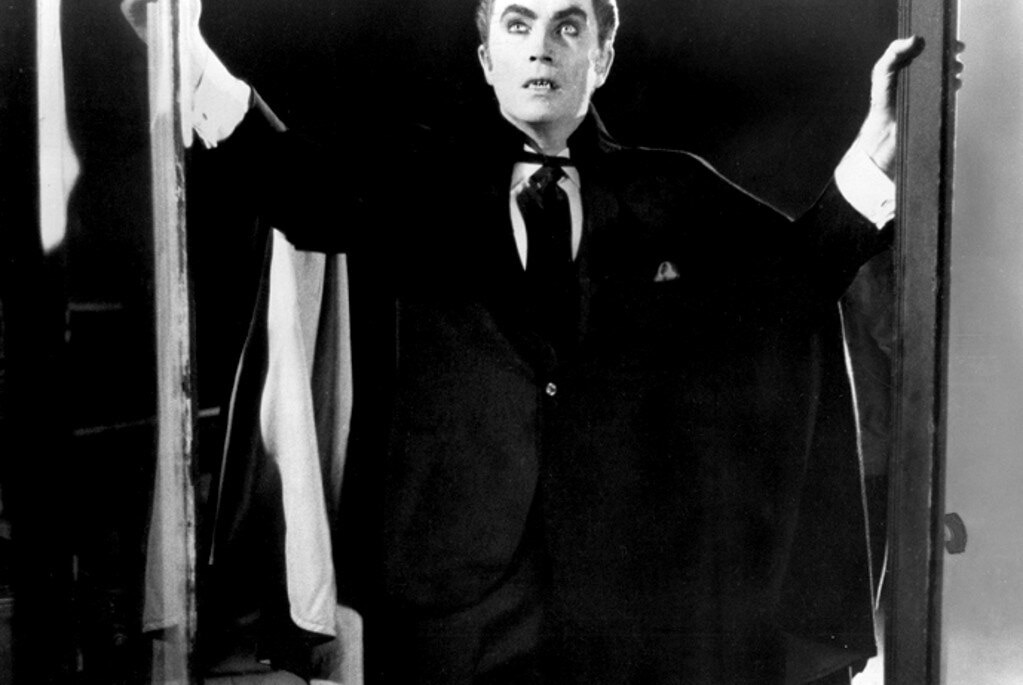
Robert Quarry, the star of Count Yorga, Vampire, has been a film actor since 1943 when he scored his first bit part in Alfred Hitchcock's Shadow of a Doubt. He has also appeared in various episodes of such television series as The Millionaire [1955], Mike Hammer [1958], Sea Hunt [1959], Perry Mason [1965], and The Rockford Files [1977-79].
Count Yorga, Vampire was Quarry's first major starring role and the film's surprise popularity encouraged producers James Nicholson and Samuel Z. Arkoff to offer him a contract and groom him as a new horror star to rival their current heir to the throne, Vincent Price. After the two Yorga films, Quarry would co-star with Price in Dr. Phibes Rises Again [1972] and Madhouse [1974] but he soon discovered that being typecast as a horror star had its limitations. "...I remember when it started happening to me, it really pretty much ended everything," Quarry admitted in an interview with Anthony Petkovich. "They didn't develop me as a property at AIP. They just let me go down the drain...Sam [Arkoff] didn't know what to do. He knew how to buy movies, but that's about it."
It was Robert Quarry's association with actor George Macready (Paths of Glory [1957], The Big Clock[1948]) that led to his involvement with Count Yorga, Vampire. Their collaboration was a huge success with Robert and Michael in key roles and George Macready as the voiceover narrator. The trio reteamed for The Return of Count Yorga. This time George Macready had a cameo (it was his last film, he died in July of 1973), Michael focused solely on producing and Quarry repeated his signature role.
Despite Quarry's immense success as Count Yorga, it was the Macreadys and director/screenwriter Bob Kelljan who reaped the profits. In an interview with Psychotronic Video, Quarry admitted, "Bob [Kelljan] and Michael [Macready] got their $2 million cut from the film. And they were so grateful to me that they sent me a bonus check. I only made $1249 for the whole thing. We shot it over three or four weeks, and I charged them $5 more than minimum. Well, they sent me a check for $350 out of their $2 million...a check which I was going to tear up, I was so angry about the whole thing. But then I thought, 'Well, $350...I can take four people out to the best restaurant in town.' So I gave a dinner party on my $350 bonus. I was going to frame it and write under it, 'Their gratitude knew a lot of bounds.'"
Between Count Yorga, Vampire and its sequel, Quarry made Deathmaster [1972], in which he played a vampire who becomes the Charles Manson-like cult leader of a hippie commune. The film was directed by former actor turned director Ray Danton but was not a success due to a poor script and erratic direction.
One thing that Robert Quarry noticed about Count Yorga, Vampire was its popularity with Afro-American audiences. "I'd be in some restaurant," he said, "and the black waitress would go, 'Is you Count Yorga?' I was never Robert Quarry...I was always 'Count Yorga.'"
Bob Kelljan, the director/writer of both Yorga films, went on to helm Scream Blacula Scream (1973), starring William Marshall and Pam Grier, right after The Return of Count Yorga. He also directed two other drive-in exploitation classics, Act of Vengeance [1974, aka Rape Squad] and Black Oak Conspiracy [1977], and TV episodes of such cult favorites as Wonder Woman, Starsky and Hutch and Charlie's Angels.
Roger Perry, who plays the Van Helsing counterpart to Quarry's Dracula imitation in both Yorga films, was better known as a television actor. He was briefly married to Laugh-In star Jo Anne Worley.
The most famous actor to emerge from the Yorga films and break into mainstream Hollywood cinema is Michael Murphy, who plays the ill-fated Paul. He would become a regular ensemble player in director Robert Altman's films, beginning with Countdown [1968] all the way up to Tanner on Tanner (2004) for the Sundance Channel. He also made memorable impressions in The Front [1976] co-starring Woody Allen and the latter's Manhattan [1979], Paul Mazursky's An Unmarried Woman [1978], Peter Weir's The Year of Living Dangerously [1982], Oliver Stone's Salvador [1986], Batman Returns [1992] as the Mayor, and Away from Her [2006].
Edward Walsh, who plays the Igor-like Brudah in both Yorga films was at one time a part of the New York music scene and appears as himself in the short Exploding Plastic Inevitable [1967] which spotlights the seminal '60s group, The Velvet Underground. He would later carve out a character actor career in television and movies. His final film credits before his death in 1997 were Another 48 Hours [1990] and Walter Hill's Johnny Handsome [1989].
None of the main actresses who starred in Count Yorga, Vampire had very extensive film careers. D. J. Anderson who plays Donna, also starred in Werewolves on Wheels [1971] but her last screen credit was in 1993 for a bit role in the USA TV movie, Woman on the Run: The Lawrencia Bembenek Story. Count Yorga, Vampire was the last film credit for Judy Lang who plays the vampirized Erica; she also starred in The Psycho Lover [1970] and Roger Corman's The Trip [1967].
Indications that Count Yorga, Vampire was originally intended to be a soft core sex/horror film appear to be confirmed by the conspicuous appearance of exploitation actresses Julie Conners as Cleo, Marsha Jordan as Donna's mother and Deborah Darnell. Ms. Conners has appeared in Narcotics: Pit of Despair [1967], Ray Dennis Steckler's Body Fever [1969], and The Curious Female [1970]. Deborah Darnell appeared in Pink Garter Gang [1971] but Marsha Jordan is the real veteran with more than 43 film credits for such "Adults only" features as Dr. Sex [1964], From Woman to Woman to Woman [1968], Infrasexum [1969], Her Odd Tastes [1969] and Breast Orgy [1972]. Often referred to as the "Queen of Soft Core" in the '60s, Jordan grew up in a Catholic convent and worked for awhile as a flight attendant for Delta.
Robert Quarry later remarked on some of his live appearances at promotional tours for the Yorga films in Psychotronic Video: "Some really sick fans would show up at my guest appearances...really sick...When I went out on tour girls and women would crowd in on me to get my autograph, get right up to me, and just pee right down the front of my clothes. They'd be so beside themselves that they'd actually wet themselves. I never understood it...I'll also never forget this one theatre in St. Louis. The place was packed....and I sort of halfway turned my back, and I felt a kind of pressure. And then the whole back of me was wet. As it turned out, some guy had masturbated behind me and shamelessly came on my clothes...My favorite story, though, was when I was in Chicago...here was this little, slight, skinny guy. So I put my arm on his shoulder and he said, 'Smile.' So I turned to him with a smile and he turned to me and smiled and do you know that he filed every one of his teeth down into fangs? All of them! I'm sure the picture came out with him smiling at me with his mouth full of sharpened fangs and me looking down at him in horror with my jaw just dropping. And I thought, 'Two years from now, this kid's going to be the Vampire Killer of Chicago and they're going to find the picture of me...with my arm around him."
by Jeff Stafford
SOURCES:
Psychotronic Video Number 33, "Robert Quarry Count Yorga Rises Again!," Interview by Anthony Petkovich
Video Watchdog No. 116, Count Yorga, Vampire & The Return of Count Yorga reviews by Richard Harland Smith
Cinefantastique Winter 1971, film review by John R. Duvoli
Hollywood Gothique, "Count Yorga Speaks" by Steve Biodrowski, hollywoodgothique.bravejournal.com/
IMDB
In the Know (Count Yorga, Vampire) - TRIVIA
by Jeff Stafford | August 24, 2007
SIGN UP FOR OUR NEWSLETTERS

CONNECT WITH TCM