The genesis of Blood on Satan's Claw began with twenty-two-year-old Cambridge graduate Robert Wynne-Simmons who told interviewer David Taylor in Shock; The Essential Guide to Exploitation Cinema, "I was just out of University and looking to find work in the film industry. So I didn't have any track record at all and I wrote the obligatory hundred letters. It was on the first of January that I got a reply...from a producer called Chris Neame, who was working, I think, for Tony Tenser at Tigon. He'd been collecting on behalf of the other producers there were about four people involved here a number of potential scripts from which to make a film."
Wynne-Simmons quickly learned how soon Tigon wanted to put the picture in production: "They'd done a deal with Pinewood in advance, to get a low rate from the studio. It was booked for April 1 which sort of seemed vaguely appropriate! The letter said we've got thirty possible outlines that we've been presented with and we notice that you've done some writing I'd written some plays and things at university do you have anything to offer us? Before I'd really got my head together, I rang them up and said yes, there was something really exciting coming and they said could they have it by next Thursday!"
The studio was interested in making a horror film that mimicked the structure of Dr. Terror's House of Horrors (1965) and Torture Garden (1967), two successful horror anthologies made by Amicus Productions. The screenwriter's challenge was to write three or four stories linked by a common theme.
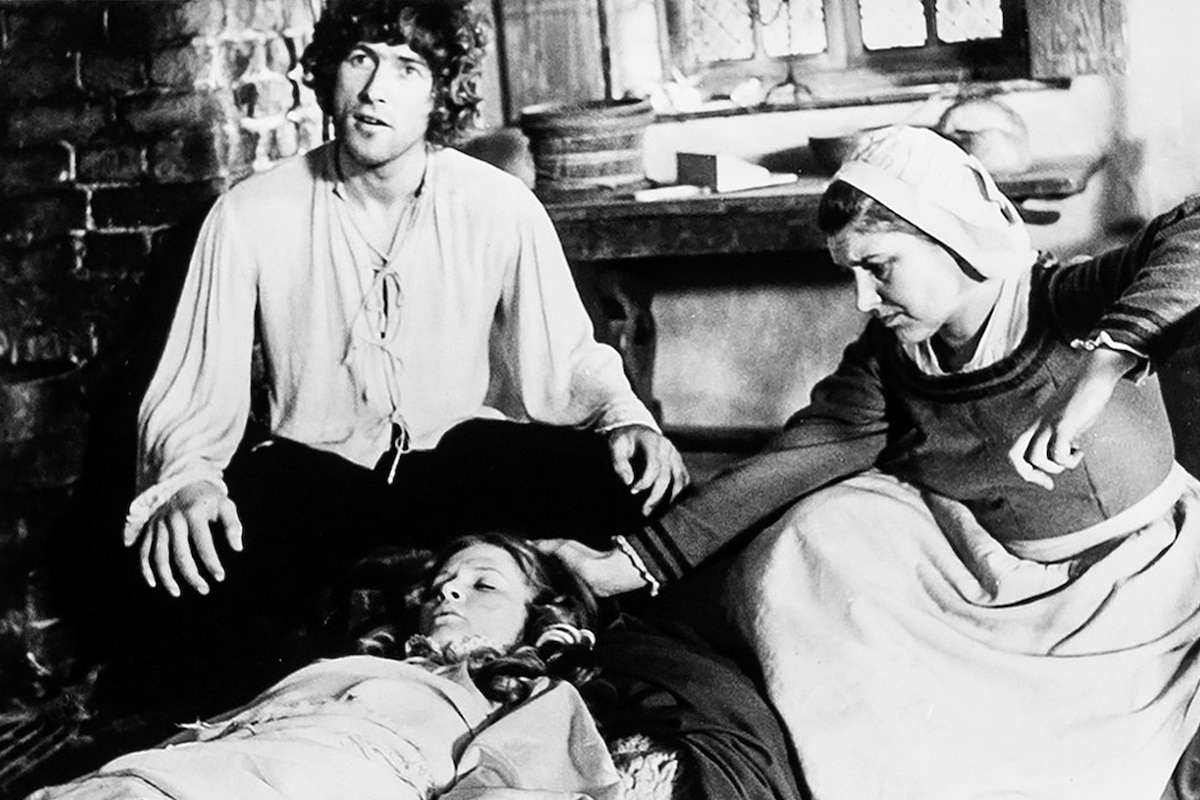
Wynne-Simmons revisited some of the unpublished short stories he had written as an undergraduate and adapted two of them for his first pass at a screenplay. "The first episode had to do with Simon Williams and Tamara Ustinov, and the whole idea of her going mad and being forced by the unpleasant aunt into the spare bedroom, where something nasty was lurking....Then there was another story about a group of schoolchildren who found something nasty in a field."
Wynne-Simmons's screenplay clearly reflected his generation's unrest and disenchantment with the period, drawing inspiration from the true-life crimes of the Charles Manson family and Mary Bell, an eleven-year-old murderess who earned front page headlines in England in 1968.
Initially the demon who appears in the village and motivates the events that occur was not intended to be Satan nor was there any intention to make the villagers Devil worshippers or members of a witch coven. "It was deliberately ambiguous...Essentially it was a God-Devil...The idea was that a God who demanded an unpleasant sacrificial type of worship was coming alive again. Also, there was this sort of feeling that evil though this creature might be, it was somehow more 'alive' than the Patrick Wymark character, whose viewpoint was essentially a dead one."
The Tigon producers were not completely satisfied with the first draft of the screenplay which was set during the early Victorian era and had a scene of "The Judge arriving aboard a steam train, which was meant to be an image of him steamrolling the whole movement," according to Wynne Simmons. Instead, Tigon wanted to capitalize on the recent success of Michael Reeves's Witchfinder General aka The Conqueror Worm and set the movie in the 17th century during the time of the witchhunts.
The financier/distributors also weren't happy with the ambiguity in the script and the finale which was not the dramatic showdown between good and evil they envisioned. Wynne-Simmons confessed that "In the original script, the last scene was probably more destructive than it was in the eventual film. Patrick Wymark had militiamen with him who actually gunned people down. There was a mass grave dug and that was their end. So it was really a very, very destructive thing. Rough justice, where he just obliterated this crowd of people."
Despite the changes Wynne-Simmons had to make to the screenplay of Blood on Satan's Claw, he was never quite able to transform the character of The Judge into the film's hero, even with him welding a cross-like sword in the finale. "...the person who is wielding the cross is usually the 'Van Helsing' [the hero of "Dracula"] force of good, and it was very difficult to reconcile the character of The Judge with the forces of good! This would have reduced his 'ethnic cleansing' to the minimum, sort of make him halfway acceptable."
The original script was titled "The Devil's Skin" but Tigon wanted something else and during filming the movie was known as "The Devil's Touch" but was released as Satan's Skin and then retitled and re-released as Blood on Satan's Claw. At least all of these titles were better than the suggestion of Tony Tenser who owned Tigon; he wanted to call the film "The Ghouls Are Amongst Us."
While Wynne-Simmons was busy with script revisions, Tigon began casting about for a director and showed some interest in Piers Haggard, a young director who had just completed his first feature film, Wedding Night (1969), which was screened for the Tigon executives (but not released theatrically until after Blood on Satan's Claw).
Two of the producers, Peter Andrews and Malcolm Heyworth, were suitably impressed with Wedding Night and offered Haggard Blood on Satan's Claw though he is still puzzled about why they chose him. "I don't think I'd ever been to a horror film," he stated. "I was very arty. I'd worked at the National Theatre and in television, doing series like Callan and various BBC plays...So I couldn't have done a Hammer horror film...well, in the way that would have been accepted."
Haggard realized that the film's success would depend on a convincing sense of place and time as well as four or five dramatically powerful sequences which Wynne-Simmons's screenplay had strategically placed throughout the narrative. It was also his desire to make a "folk horror tale," one that tapped into the darkness of local legends in the rural English countryside.
Research was conducted on iconography of the Devil, based on drawings from the time period when Blood on Satan's Claw was set, in order to create a cinematic representation of Satan.
The aspect of Wynne-Simmons's screenplay that immediately struck Haggard was the rural setting and the lyrical, poetic approach to the subject matter. "I was isolated until I went to university at seventeen," Haggard said, "and those are the formative years. Your imagination is formed at that time. I had an absolutely passionate feeling for the countryside in a very Wordsworthian sense: the light on the bank, the feeling of beech trees in spring, so pale and green; the light on the river or the river at night; walking down the lane with no lights, guiding yourself by looking up at the stars. A very strong and vivid sense of country life."
One of the first things that Haggard did after being hired to direct Blood on Satan's Claw was convince the producers that the script would work better as one story and not three and they eventually agreed. Wynne-Simmons then had to stitch the three stories together in a more cohesive fashion but due to the rushed production schedule never really resolved some of the problems and continuity holes in the screenplay. For example, the character of Isobel Banham is dropped from the story after her face is clawed by the insane Rosalind Barton, never to be seen again.
Another continuity error that actually worked to the film's advantage in the opinion of some is the disappearance of The Judge from the middle section of the film. In stitching together the three stories, Wynne-Simmons was never able to solve how to reintroduce The Judge into the story before his climactic appearance at the end. However, his return, when the village is almost completely engulfed in evil, makes a more unexpected and ambiguous finale.
Marc Wilkinson, a composer for London's National Theatre who was hired to write the score for Blood on Satan's Claw, based his music on other orchestral works which depicted the Devil in musical form and used a thirteen note descending pattern in the score.
Although Tigon executives insisted that Blood on Satan's Claw be filmed at Pinewood Studios to avoid the additional expense of location shooting, Haggard held out until they agreed to let him shoot the bulk of the movie at Bix Bottom, "a small valley midway between the towns of Nettlebed and Henley-on-Thames in the Chiltern hills. The name Bix was a holdout from the days when the valley was used as a base for the Roman army specifically the Roman century B IX," according to David Taylor.
Haggard has fond memories of producer Tony Tenser who gave him a first-rate education in controlling film budgets, production costs, promotion ideas and monitoring box office intake.
Because of the limited budget, Haggard assembled a cast of mostly unknown actors who were working in television and theatre with the exception of well known character actor Patrick Wymark who had previously appeared, playing Cromwell, in Witchfinder General. The only other actor audiences might have recognized was Linda Hayden who had attracted some notoriety for her role as the teenage nymphet in Baby Love (1968) and for her appearance opposite Christopher Lee in Taste the Blood of Dracula (1970).
Among actors and film crews Wymark was known as a heavy drinker and co-star Simon Williams recalled one incident that caused him some anxiety when Wymark returned from lunch drunk. "There was a scene where he had to thump me one. Tamara had gone insane and I'd gone a bit hysterical, and he had to slap me to get me to pull myself together...He did actually hurt me quite a lot."
The director, cast and crew were amused by the fact that screenwriter Wynne-Simmons had the look of a young, earnest scholar and was shy which was such a contrast to the person they had imagined as the screenwriter of this disturbing, horrific tale.
The opening scene of the fields being plowed by Barry Andrews was also the very first scene that was filmed for the movie.
Haggard credits a lot of the film's effectiveness to cinematographer Dick Bush who had recently left the BBC to work in feature films. "Dick Bush...taught me something that I've used ever since. He said, "You're shooting these wide shots in the woods, so you must have a dark foreground. Particularly in a horror film, where who knows what might be lurking in the foreground.' It taught me that it was terribly important to identify the highlight in each frame."
Linda Hayden recalled that she cut her foot badly on the first day of shooting and had to be rushed to the closest local hospital for stitches. Her unexpected appearance, in costume and makeup, made quite an impression on the other patients there who were mostly senior citizens.
The famous Devil's skin removal scene where Michele Dotrice is strapped to a table and a patch of fur is surgically removed from her thigh was inspired by Wynne-Simmons's memory of an operation performed on him at home on the kitchen table by a doctor when he was young.
Costar Simon Williams recalled that he had some reservations about working for Tigon at the time: "The whole thing had quite an "iffy" feel about it. Rumours were going about Tigon and we were all cashing our cheques quite quickly." Tigon would soon shut down production for good in 1972 after the release of Neither the Sea Nor the Sand.
Williams also remembered filming the scene where he is attacked by the furry hand. "They had a little insert shot of my hand reaching for the dagger and I was doing a lot of business of inching my fingers forward and twitching them. Piers said, 'Cut! Cut! Cut! Simon, don't overact with your fingers.'
One of the most powerful sequences in Blood on Satan's Claw - the rape/murder of Cathy Vespers was unplanned and spontaneous. "I didn't have the idea of Wendy Padbury [Cathy] being beaten with May blossom, "recalled Haggard, "until the morning of the shoot...I was trying to devise some rituals that might seem meaningful for ignorant and superstitious people. It was an inversion of the stations of the cross in the Catholic Church. Likewise, the chant was written on the spot."
Tamara Ustinov recalled in David Taylor's account of the film's production that "when they did the rape scene with Wendy Padbury, I remember she got very upset. I think Piers had said, "Look, you've got to make this really realistic"......I think that maybe it all went a bit far. But looking at what's done now, that's nothing...compared to what films are like now."
After viewing the film British censor John Trevelyan cautioned Haggard, saying "The thing is, Piers, it's sex and violence. You can have sex. That's alright. Violence is alright. But sex and violence...this is what we have to think carefully about." He then suggested that Haggard remove 6-8 seconds from the rape scene which he did although screenwriter Wynne-Simmons later commented: "The result of the censor's intervention was to make the scene more censorable, in my mind. Because what you then have is a scene with a rape which is largely played out on the faces of the people watching it."
Wynne-Simmons recalls that for the final scene in the film where The Judge confronts the Devil executive producer Tony Tenser demonstrated how he wanted the scene to be played by imitating Satan and hopping around on one leg.
Haggard noted in the DVD commentary of the film that Blood on Satan's Claw was blessed with good weather for most of the exterior shooting and didn't have to rely on day for night scenes which he feels rarely works in movies.
by Jeff Stafford
SOURCES:
"Don't Overact With Your Fingers!: The Making of Blood on Satan's Claw" by David Taylor from Shock; The Essential Guide to Exploitation Cinema edited by Stefan Jaworzyn
The Blood on Satan's Claw DVD commentary by Piers Haggard, Robert Wynn-Simmons, & Linda Hayden
IMDB
Insider Info (Blood on Satan's Claw) - BEHIND THE SCENE
by Jeff Stafford | March 24, 2008
SIGN UP FOR OUR NEWSLETTERS

CONNECT WITH TCM