Few films are as mocked as the 1972 schlockfest Night of the Lepus. One need only mention the premise (attack of the giant bunnies!) and the derision sets in on its own. It's a wonder the whole genre of horror didn't just curl up and die in embarrassment. Legions of film critics, genre fans, and innocent bystanders have set up their tents in the let's-make-fun-of-the-dumb-bunny-monsters camp, sharing the assumption that it was the choice of menace that doomed this exercise. How could killer rabbits ever be scary? But if it is self-evidently obvious that rabbits make for a poor choice of monster, how could this be? What would motivate a motion-picture institution run by responsible adults to invest in a thing like this? What were they thinking?
For the majority of Americans, rabbits exist only as cuddly pets. It is hard for many of us to envision the cute widdle wabbits as pests, but that is indeed what they are. Consider the case of Australia, where rabbits were introduced in the mid-19th century by a British officer as a lark. He thought they were fun to look at, and a joy to shoot, so he imported a mere twenty four wild rabbits and let them loose. Within ten years, the offshoots of those original 24 numbered in the millions. And they destroyed the environment. The rabbit scourge exterminated one out of every eight mammalian species on the continent, and left untold devastation to the farmlands. It was nothing short of a natural apocalypse. In desperation, the Australian government in the 1950s introduced myxomatosis and other viral plagues to curb the rabbit population. This was initially successful, but natural selection created myxomatosis-proof rabbits that survived the disease... which brings us to the world of science-fiction.
In 1964, Australian satirist Russell Braddon wrote a wickedly funny work of speculative fantasy about the continued efforts of the Australian authorities to bio-engineer a more effective strain of myxomatosis to combat the rabbit's growing natural resistance. In the book, the new Super-Myx fails to kill the pests, but only makes them savage and carnivorous. However, it turns out that Super-Myx is fatal to humans, and so the power-mad Aussie Prime Minister seizes on the properties of his new biological weapon to conquer the world and establish a fascist Australian empire. As he builds his totalitarian state, the infected rabbits mutate into increasingly deadly monsters that ultimately bring his reign of terror to an end-and wipe out all human civilization to boot.
The Year of the Angry Rabbit is a riotous novel, a sort of literary Dr. Strangelove (1964) for the age of Rachel Carson. The killer rabbits figure only in a small part of the story, which reads more like a history of Nazi Germany as told by Oscar Wilde.
A decade later found Hollywood rapidly overrun by monster animals and Nature-vs-Man parables. And so it came to pass that producer A.C. Lyles would oversee a filmic adaptation of Braddon's novel. It was an anomaly, an aberration. Lyles had never done sci-fi before, and would never again.
Lyles made his name manufacturing small-scale Westerns of an old-fashioned stripe, the sort of homespun oater that the followers of Sergio Leone destroyed. He trudged on regardless (although his recent work on Deadwood shows that Lyle could, if sufficiently prodded, move with the times). He assembled a team of fellow Westerners to write and star in this monster flick, which would be shot at Old Tucson, the location favored by so many period Westerns. Night of the Lepus was horror in name only-it looked, walked, and quacked like an old-school Western.
Lyle's screenwriters Gene R. Kearney and Don Holliday threw out everything that made the book witty, clever, original, and entertaining. All that was left was killer rabbits. In Braddon's story, the rabbits were not just violent and bloodthirsty; they were also plague-carriers. In omitting that viral aspect, the movie would be obliged to depict its bunnies as physically threatening. This would be difficult in the best of circumstances, but the effects crew (Escape from the Planet of the Apes' [1971] Howard A. Anderson Company) proved themselves incapable of the task.
Night of the Lepus was Don Holliday's only screenplay credit; he also edited the 1944 Disney animated short The Three Caballeros (1944). Gene R. Kearney, on the other hand, had many screenplay credits to his name, including the intriguing 1967 Curtis Harrington thriller Games, modeled on the French film classic Diabolique (1955), and TV series episodes for Night Gallery, Lou Grant and Kojak.
The script paid a brief homage to its source in an opening sequence set in Australia, but few readers of Braddon's book would recognize Night of the Lepus as being at all connected. It would be as if a filmmaker set out to make a movie of The Bible but chose to use only the genealogical "begat" sequences from Genesis and skipped everything else.
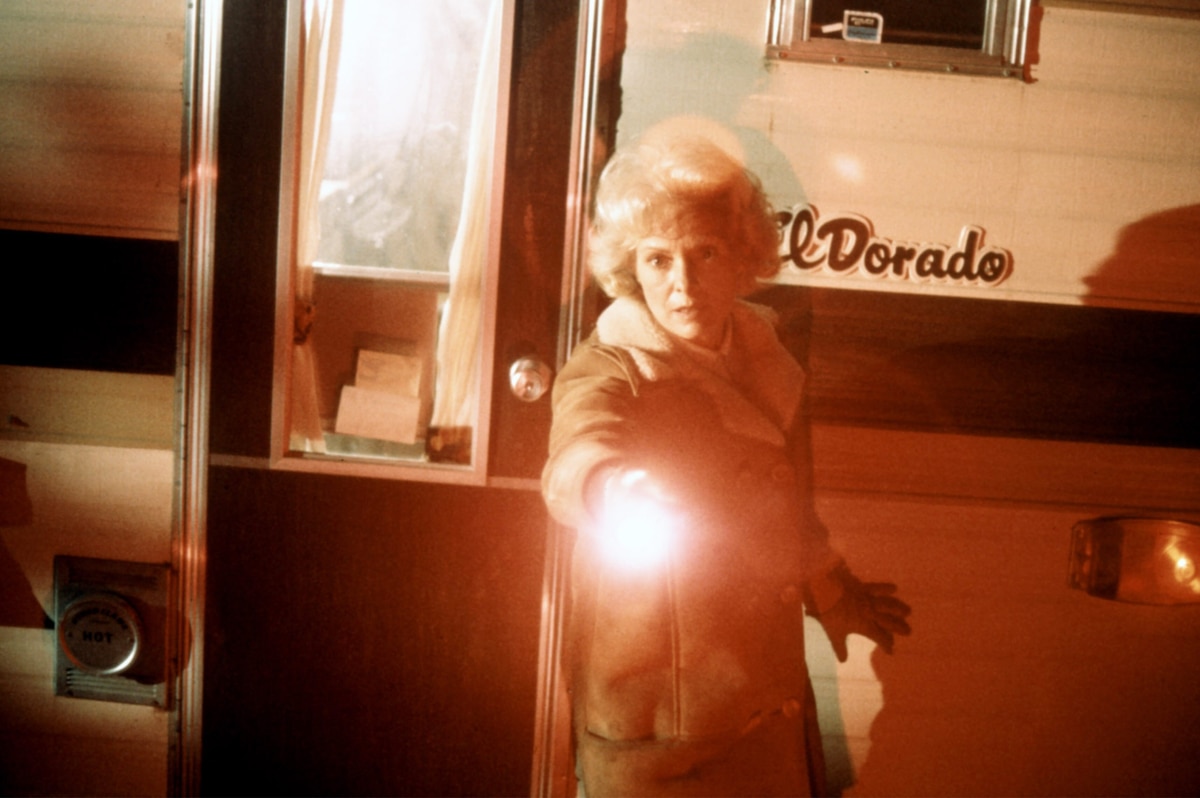
When asked how she could have agreed to participate in such a debacle, Janet Leigh explained that the screenplay read well and that, on the page, Lepus seemed to fall happily in line with other horror flicks like Willard (1971) and Frogs (1972). "No one twisted my arm and said I had to do it," she said, "It didn't dawn on anyone until-it took about four or five days before we realized we didn't have the ideal director."
Leigh has been terrorized more effectively on the screen in such landmark films as Alfred Hitchcock's Psycho (1960) and the Fred Zinnemann film noir thriller Act of Violence (1948). She was also threatened by murderer Robert Ryan in The Naked Spur (1953), stripped and humiliated by Mexican thugs led by Mercedes McCambridge in Touch of Evil (1958) and tangentially involved in a political assassination plot in John Frankenheimer's chilling The Manchurian Candidate (1962). After Night of the Lepus, Leigh attempted one more horror film, John Carpenter's The Fog (1980), co-starring her daughter Jamie Lee Curtis. It was a much more positive experience.
Making rabbits threatening is a significant challenge, but not an entirely insurmountable one in the right hands. Plenty of movies have managed to create menaces out of seemingly innocuous things: babies and children are rendered scary in the likes of Village of the Damned (1960), The Exorcist (1973), and The Omen (1976). When Alfred Hitchcock crafted The Birds (1963), he selected ordinary wrens and seagulls as his monsters, not more realistically dangerous birds of prey. The makers of Long Weekend (1978) have as their primary screen threat a manatee-one of Nature's most docile of animals-and not just any manatee, but a dead one. You can't get much more unthreatening than that-unless maybe you're making The Monolith Monsters (1957), about killer rocks. Inanimate, immobile rocks. Or Charisma (1976), about a killer tree. Again, it doesn't even move. These are all effective works of suspense, classics in their own right. What makes these other movies so powerful, though, is the careful creation of a suspenseful atmosphere, and the ratcheting up of drama between the human characters. Babies and rocks and trees are not in themselves scary, but careful filmmaking can make them seem so.
In Night of the Lepus, the mutation appears to ripple through the wild rabbit population almost overnight, even before the effects of the experimental serum make themselves evident in the lab. This is one of several implausibilities in the movie such as real rabbits have no vocal chords. So even an army of giant mutant rabbits would make almost no sound. The filmmakers dub in a strange warbling sound regardless.
William F. Claxton, the director assigned to Night of the Lepus, was mainly known for his Westerns, some of them for Mr. Lyles, and all of them the kind of thing where simply having a cowboy on a horse passed for sufficient entertainment to an undemanding audience. In place of a spooky atmosphere, he sets Night of the Lepus in the sunny expanses of an Arizona desert, populated by cowboys and gold mines and other refugees from old-school horse operas. Claxton never even bothers with any of the cinematic tricks that could artificially manufacture an ominous mood out of thin air-canted camera angles, dark shadows, eerie music... he seems confident that the rabbits will all by themselves do the job.
Other films that Claxton has directed include the juvenile delinquent drama Young and Dangerous (1957) starring Mark Damon, Rockabilly Baby (1957), the soap opera Desire in the Dust (1960) with Raymond Burr, Martha Hyer and Joan Bennett, and the religious drama I'll Give My Life (1960) starring Ray Collins and Angie Dickinson. He has also helmed many episodes for such TV series as Yancy Derringer, The Twilight Zone, Gunsmoke, Little House on the Prairie and Bonanza. He died in 1996.
Rory Calhoun was then best known as the star, producer, director, and writer of The Texan, one of the numerous Western TV series that clogged the airwaves in the mid-20th century. Another such program was The Rifleman, former home of actor Paul Fix. DeForest Kelley had guest-starred on Bonanza, Gunsmoke, and just about any other Western series you care to mention. Of course, he is now best remembered for his role as the chief physician on the Starship Enterprise. In a curious coincidence, his role had originally been filled by Paul Fix in the pilot episode of Star Trek. Scenes in which Kelley and Fix play alongside each other give some sci-fi buffs one of the few moments of pleasure to be found in the dreary Night of the Lepus.
by David Kalat
Sources:
Russell Braddon, The Year of the Angry Rabbit, William Heinemann Ltd., 1964.
Tom Weaver, Interview with Janet Leigh, Return of the B Science Fiction and Horror Heroes, McFarland Press, 2000.
Night of the Lepus press kit, MGM, 1972.
Night of the Lepus publicity kit, MGM, 1972.
In the Know (Night of the Lepus) - TRIVIA
by David Kalat | March 05, 2008
SIGN UP FOR OUR NEWSLETTERS

CONNECT WITH TCM