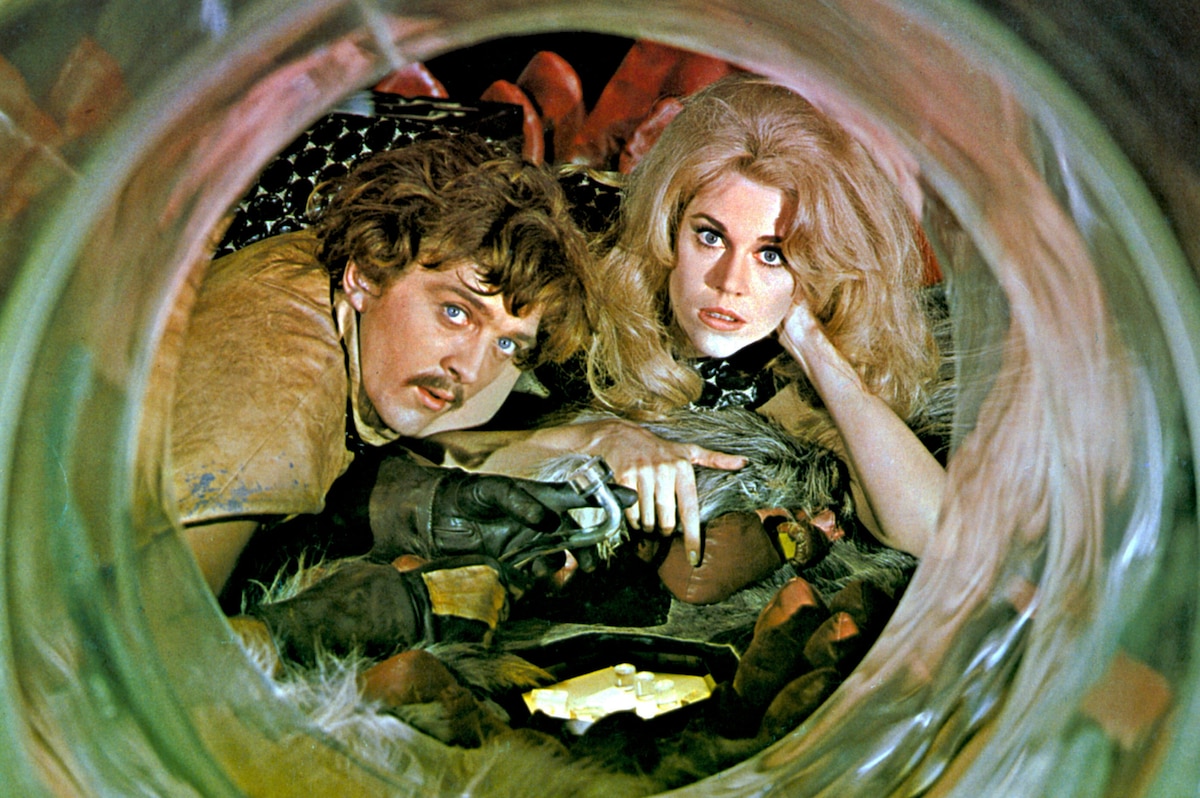
"Comic-strip buffs, science-fiction fans and admirers of the human mammae will get a run for their money in Barbarella, and will probably provide Barbarella with enough money for a run. Other moviegoers need take no notice. The only break-throughs in this husband-and-wife collaboration of Actress Jane Fonda and Director Roger Vadim are made by Miss Fonda's shapely torso through an assortment of body stockings. These are ripped and ravaged by among other things a team of sharp-toothed mechanical dolls, a flight of budgerigars and a machine designed to kill its victims with sexual pleasure. ...[Fonda] meets some topflight actors who are all too lost in space Marcel Marceau as the wizardly Professor Ping, Claude Dauphin as the President of Earth, Ugo Tognazzi as a friendly inhabitant of Planet Lytheon. Her only really amusing encounter is with David Hemmings, an inept leader of the Lytheon underground who has a hankering to try the old earthling technique of sexual intercourse."
TIME, October 21, 1968.
"While other men dream about the perfect society of creativity and equality, Vadim prefers to imagine a world in which everyone goes to bed without strain or conscience and fields are replaced by forests of naked girls, as though all nature had been choreographed by the Folies-Bergere. In this universe of yummy decadence, Jane Fonda is violated and tormented by everything from fornicating pianos that pleasure her to death to snapping dolls with sharp teeth that nibble her legs. On the face of it, all this nonsense is pretty thin stuff for a film. But Vadim carries it all off with such humor, style and detachment that Barbarella becomes something of an intergalactic put-on, all satire and supersonic camp. ...Vadim has always crammed a good deal of fantasy into his films. Now he has taken his inner life as his whole subject and turned out his best work to date."
Paul D. Zimmerman, Newsweek, October 21, 1968.
"Despite a certain amount of production dash and polish and a few silly-funny lines of dialog, Barbarella isn't much of a film. ...The Dino De Laurentiis production is flawed with a cast that is not particularly adept at comedy, a flat script, and direction which can't get this beached whale afloat. Jane Fonda stars in the title role, and comes across as an ice-cold, antiseptic, wide-eyed girl who just can't say no. Fonda's abilities are stretched to the breaking point along with her clothes. In key supporting roles, John Phillip Law is inept as a simp angel while Anita Pallenberg, as the lesbian queen, fares better because of a well defined character. Made at De Laurentiis' Rome studios, film can't really be called overproduced, considering the slapdash special effects, grainy process and poor caliber of the props, though put together on a massive scale so as to appear of spectacle proportions."
Variety, January 1, 1968.
"The décor and effects in Roger Vadim's erotic comic strip are disappointing, but Jane Fonda has the skittish naughtiness of a teen-age voluptuary. She's the fresh, bouncy American girl triumphing by her innocence over a lewd, sadistic world of the future. David Hemmings shows unexpected comic talent as an absent-minded revolutionary."
Pauline Kael, The New Yorker.
"This piece of interplanetary titillation is based on Jean-Claude Forest's risqué French comic strip which achieved international notoriety in the early sixties. The tone of the film is set by its opening sequence, a free fall striptease by Fonda in the title role, in which director Vadim clearly demonstrates that his aim was to make his (then) wife an international sex star in the mold of his previous wives (Brigitte Bardot and Annette Stroyberg). But, if the resulting adolescent voyeurism has all the passion of a masturbatory fantasy and suggests a deep-seated hostility to women on Vadim's part, Fonda's wide-eyed innocence remains appealing. The film's most revealing failing is its lack of narrative drive, necessitated by Vadim's need to stop the action and present his scantily clad wife for the audience to ogle. ...The script (c-authored by Southern) has a humorous and cutting edge to it that no other Vadim film possesses. This is supported by Renoir's ravishing cinematography and a number of gloriously decadent sets of designer Mario Garbuglia, which are remarkably faithful to Forest's drawings. The result is a confectionary delight that surprisingly survives its cynical centre..."
Phil Hardy, The Encyclopedia of Science Fiction Movies.
"Barbarella suffers substantially in the transition from print to film. Impersonated with wide-eyed adaptability by a delightful Jane Fonda, Forest's sexually emancipated space woman becomes less independent and erotically acquisitive than the original, though gaining a sense of humour with which her creator never imbued her....Vadim's version of Forest is always an inadequate one, its designs occasionally reminding one of the original but lacking its free fantasy and spring-tight composition. Fonda, whether writhing in a free-fall striptease under the credits, cuddling lasciviously on furs or twitching in agony as mechanical dolls nibble at her thighs is unfailingly delectable, but this is not enough to rescue the film from tedium.."
John Baxter, Science Fiction in the Cinema.
"Roger Vadim's vulgar valentine to his then-wife Jane Fonda is a sort of kitsch Candide, with its "superinnocent" heroine, now in space-age fetish garb, bravely navigating through a decadent future society. Actually, Terry Southern's novel Candy, a comic inversion of the Voltaire, is a more obvious influence. Southern, who adapted Barbarella for the screen from a famous French comic strip, specialized in satires of modern mores and the so-called sexual revolution. Vadim, on the other hand, constructed ponderous, sleazy showcases for his various child brides (including Bardot). Barbarella, for all its gaudy, colorful sets, looks like it was shot in the bowels of the Playboy mansion especially our heroine's space ship, with its fur-lined walls that reek of '60s softcore chic.
Gary Morris, brightlightsfilm.com.
"Cinematically, an imaginative adaptation of the French cartoon strip by Jean-Claude Forest. Barbarella is a wide-eyed innocent in 40,000 A.D. with bulging bosom and an incompetency for sex. Roger Vadim directed with an eye for psychedelic detail and treats matters neither seriously nor inanely, allowing the viewer to indulge himself. The set design is often incredible and the incidents unforgettable. Silly, absurd, funny, outrageous, utterly visual...the ridiculousness won't stop. John Phillip Law, Milo O'Shea, David Hemmings and Ugo Tognazzi are among the oddly garbed grotesqueries."
John Stanley, The Creature Features Movie Guide
"Vadim kicks off his adaptation of Jean-Claude Forest's 'adult' comic strip by stripping Fonda starkers. From there on it's typically vacuous titillation... But Terry Southern's dialogue occasionally sparkles, and the imaginative designs, as shot by Claude Renoir, look really splendid."
Tom Milne, TimeOut Film Guide.
Compiled by John M. Miller
Yea or Nay (Barbarella) - CRITIC REVIEWS OF "BARBARELLA"
by John M. Miller | January 07, 2008
SIGN UP FOR OUR NEWSLETTERS

CONNECT WITH TCM