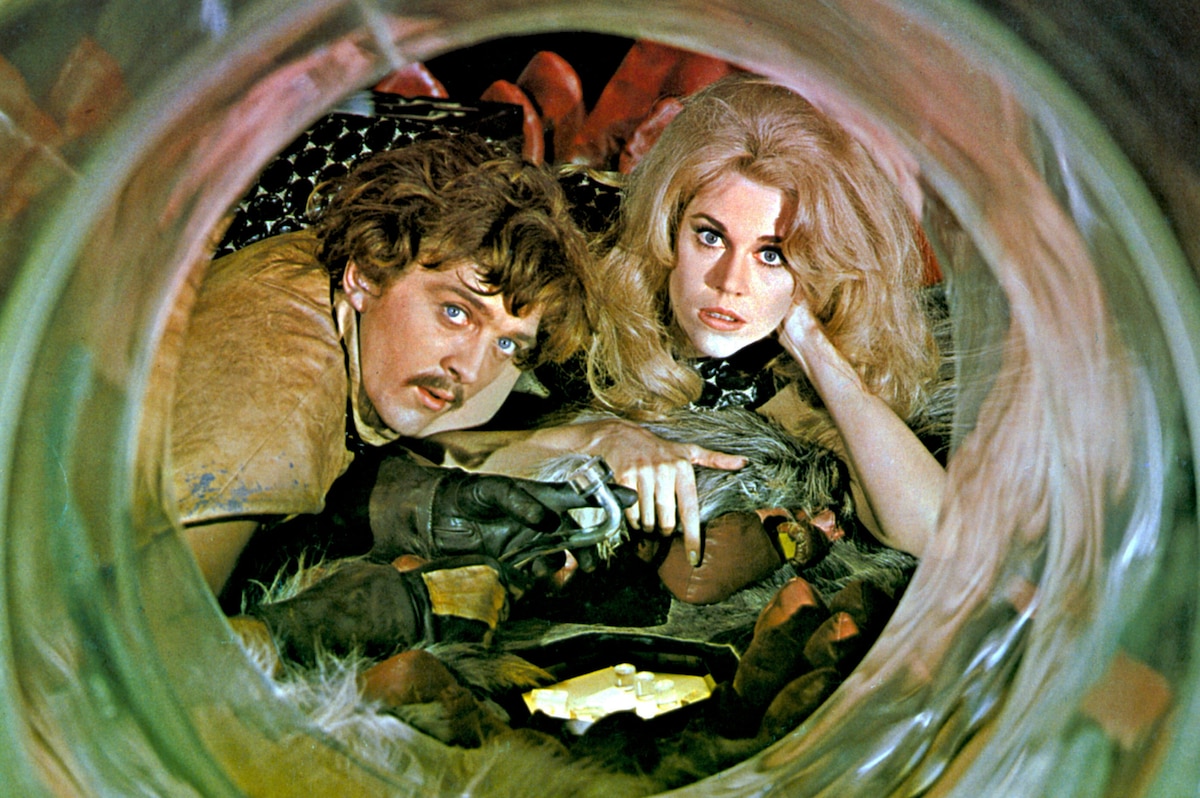
During the planning stages for Barbarella, Jane Fonda was in Baton Rouge, Louisiana working on Otto Preminger's Hurry Sundown (1967). Her husband Roger Vadim was only able to visit for a week or so, but as Fonda relates in her autobiography My Life So Far, "...during his brief stay, while sitting around the motel pool, he saw the lean, tanned, blue-eyed John Phillip Law emerge from the water like a piece of sculpture and he decided then and there that he was the one to play Barbarella's Pygar, the blind angel who recovers his will to fly after he and Barbarella make love."
Barbarella creator Jean-Claude Forest worked eight months on the film, closely participating in the production design. "I was completely involved," Forest recalled in a 1985 interview. "At that time, I didn't care about my strip, what really interested me was the movie business. The Italian artists were incredible; they could build anything in an extremely short time. I saw all the daily rushes, an incredible amount of film. The choices that were made for the final cut from those images were not the ones I would have liked, but I was not the director. It wasn't my affair."
In her autobiography, Jane Fonda describes one of the biggest challenges facing the special effects department: how to film the scenes in which Pygar the blind angel flies while carrying Barbarella in his arms. Fonda details the setup: "A huge rotating steel pole stuck out horizontally from a cycloramic gray screen. The pole had large hooks and screws at the end, on which two metal corsets were attached. One corset had been made to fit John Phillip Law and one was for me, and they were skintight because our costumes had to fit over the metal and not look bulky. We got all suited up, first the cold metal corsets, then the costumes, and then John's wings were strapped onto his back with wires running from the wings to a remote-control machine. Than a crane hoisted us up and we stood on the platform while John was hooked up to the end of the pole. Then my metal corset was screwed to the front of his, putting me into a position that made it look as though he were carrying me."
So far so good...however, the studio technicians overlooked an important detail. Fonda continues: "After we had been suited up, hoisted up, and screwed up, the moment of truth arrived. The crane, which until then had been supporting us, was moved away, leaving us suspended in air. With the weight of our bodies jamming our hipbones and crotches into the metal corset. It was sheer, utter agony. And with all that, we had to remember our dialogue, look dreamy, and occasionally be funny. The muted sounds of misery I could hear from John (who was bearing the added weight of his wings) told me that his pain was worse than mine, and mine was nearly unbearable. No one had taken our poor crotches into consideration! John was convinced his sex life would be brought to a premature demise."
The flying effect that came out of this painful rigging was due to a new process of front projection (as opposed to the standard rear projection commonly used in the industry), in which a previously-filmed background of clouds and terrain would move behind the stationary actors. The background images were projected, in a split-beam fashion, onto an unusually sensitive motion picture screen; beam-splitting meant that the projected image was at precisely the same angle as the camera, so that the actors would not cast a shadow on the screen. Because of this technology, as Fonda later remembered, "...you couldn't even see what was being projected on the screen until the film had been developed...Lots of things had to work properly at the same time: The steel pole had to rotate in sync with the moving sky, the remote-control specialist had to make Pygar's wings flap in the same way. And the projection onto the gray screen had to function properly. This all took days and days to rig up, while John and I hung there, our private parts growing progressively numb."
"I will never forget the first day we finally had rushes to look at. Everyone was excited and anxious, since flying without the help of wires had never been done before and so much depended on the believability of the flying scenes. ...The light in the screening room dimmed, the film began to roll and ...Oh my God...we were flying backward! It was too funny not to laugh: The one most obvious thing, what direction the clouds and landscape were moving, had been overlooked. But what was also apparent was that once they got us in sync with the background, it would work."
Fonda also later claimed that her husband took to drinking on the set: "Partway through the filming of Barbarella he started drinking at lunch, and we'd never know what to expect after that. He wasn't falling down, but his words would slur and his decisions about how to shoot scenes often seemed ill-considered."
Vadim wasn't the only one with insecurities to deal with on the set. Incredibly, Fonda was second-guessing the state of her body at the time: "There I was, a young woman who hated her body and suffered from terrible bulimia, playing a scantily clad sometimes naked sexual heroine. Every morning I was sure that Vadim would wake up and realize he had made a terrible mistake 'Oh my God! She's not Bardot!'"
by John M. Miller
SOURCES:
My Life So Far by Jane Fonda
Memoirs of the Devil by Roger Vadim
The Fondas: A Hollywood Dynasty by Peter Collier
Bardot, Deneuve, Fonda by Roger Vadim
Psychotronic Magazine Number Twelve Interview with John Phillip Law by Michael Murphy
Insider Info (Barbarella) - BEHIND THE SCENES
by John M. Miller | January 13, 2008
SIGN UP FOR OUR NEWSLETTERS

CONNECT WITH TCM