One of the favored plot devices for generations of satirists is the Candide-like protagonist: a wide-eyed innocent who, through a series of misadventures is able to naively comment on a variety of satirical targets. In the late 1950s/ early 1960s, two well-known American satirists independently created female protagonists to comment on the "sexual revolution" and other mores of the day: in the pages of Playboy magazine, cartoonist Harvey Kurtzman's Little Annie Fanny often found herself both disrobed and in the midst of a contemporary political or social controversy; meanwhile author and screenwriter Terry Southern's 1958 novel Candy, featuring a similar sexual adventuress, was published in America in 1963, just ahead of his great success in co-writing Dr. Strangelove (1964) with Stanley Kubrick.
In 1967, Terry Southern, then much-in-demand, was recruited to write the screenplay for Barbarella (1968), a film based on a five-year-old French comic strip by cartoonist Jean-Claude Forest. Southern altered the heroine's persona to be a bit more like Candy, while the plot and incidents in the script all came from Forest's first book collection of Barbarella strips (published in 1964 and translated into 12 languages).
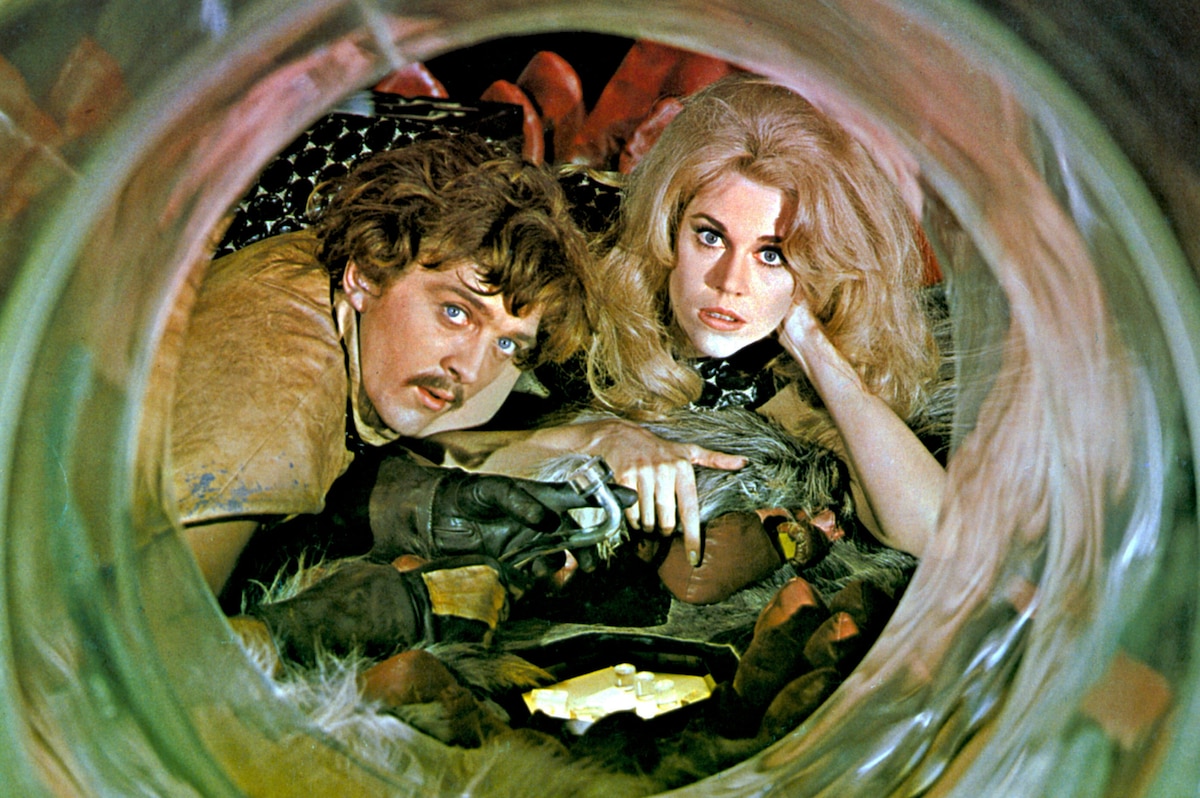
In the year 40,000, Barbarella (Jane Fonda) is a solo space aviatrix and adventurer. She is called upon by the President of the Republic of Earth (Claude Dauphin) to locate Durand-Durand (Milo O'Shea), because the renegade scientist has invented a weapon called a Positronic Ray with which he plans to overtake the Universe. Barbarella searches for the city of SoGo, and has many strange encounters along the way, including a run-in with children armed with cannibalistic dolls, bedding down with a fur-covered huntsman (Ugo Tognazzi), and crossing ice fields in a sled powered by stingrays. In a desolate slave encampment called the Labyrinth, Barbarella meets a blind angel called Pygar (John Phillip Law) and his mentor, the kindly Professor Ping (Marcel Marceau). Barbarella restores Pygar's confidence by making love to him, and Pygar carries her aloft to SoGo. There, Barbarella encounters The Great Tyrant (Anita Pallenberg), the Black Queen ruler of SoGo. Barbarella mixes among the people of SoGo, and with the help of the rebel Dildano (David Hemmings) she exposes the plot of Durand-Durand to overthrow The Great Tyrant as his first step in controlling the Universe.
Barbarella was a bone-fide International production, financed by Italian mega-producer Dino De Laurentiis, directed by Roger Vadim of France, and featuring an English-speaking cast from around the globe. This cast was an eclectic, inspired gathering of iconic actors and personalities with strong 1960s cachet: David Hemmings (Blow-Up [1966]); model, actress and jet-setter Anita Pallenberg, who was romantically involved with Brian Jones and Keith Richards of The Rolling Stones at different times; world-famous mime Marcel Marceau; and John Phillip Law, a favorite for his roles in eccentric international productions (Danger: Diabolik [1968]) and mainstream oddities (Skidoo [1968]). The lynchpin of Barbarella, however, is Jane Fonda. She is in virtually every scene, and her wide-eyed-yet-knowing performance is the one winning constant in an otherwise uneven production. Yet, when Fonda first received the offer of the role, she tossed it away.
Director Roger Vadim and actress Jane Fonda had been married since 1965; it was the third marriage for the director, whose first wife, Brigitte Bardot, was catapulted to stardom in his film ...And God Created Woman (1956). Vadim and Fonda were living in Malibu, California in 1966 when Jane received a letter from famous Italian producer De Laurentiis to come to Rome and star in a film based on a comic strip. Fonda wadded up the letter and threw it in the wastebasket. As Vadim relates in his book Bardot, Deneuve, Fonda, "The film in question would be based on a French comic strip I knew well. The heroine was named Barbarella. Dino's first choices had been Brigitte Bardot and Sophia Loren, who had both refused. They had the same reaction as Jane: 'A comic strip character? He can't be serious.'" But Vadim became enthusiastic about the idea himself: "I explained to Jane that cinema was evolving and that the time was approaching when science fiction and galactic-style comedies like Barbarella would be important. She wasn't really convinced, but she realized that I had a passion for the project..." In her autobiography, My Life So Far, Jane Fonda wrote that "...Vadim was adamant that science fiction films would be the wave of the future, that this could be a terrific sci-fi comedy, that I should do it, and that he should direct." De Laurentiis asked Vadim to direct the project, effectively sealing the deal in obtaining Fonda for the role.
Vadim and Fonda moved to Rome and rented a large and ancient house on the outskirts of the city; Fonda later called it "...part castle, part dungeon. There was a tower next to our bedroom that dated from the second century before Christ. At night we regularly heard scuffling and mewing coming from there. One evening during a dinner party in the cavernous living room below, there was a loud noise, some plaster fell from the ceiling, and an owl fell onto Gore Vidal's plate. It turns out that a family of large owls had been making the racket in the tower."
Filming on Barbarella began in August of 1967. Fonda described the shooting method for the famous opening-credit striptease: "The set of the space cabin, instead of sitting like a normal room that you could walk in and out of, was turned upward so that it faced the ceiling of the enormous sound stage. A pane of thick glass was laid across the opening of the set, and the camera was hung from the rafters directly above it. I would have to climb up a ladder and onto the glass, so that from the camera's point of view the space cabin was behind me and I appeared to be suspended in space." Then Fonda slowly removed her spacesuit while a wind machine blew her hair as though it were swirling around her in free fall. "I was terrified that the glass would break [and] terrified of rolling around like that in the altogether... Vadim promised that the letters in the film credits would be placed judiciously to cover what needed to be covered and they were."
Barbarella's final credits list five writers in addition to Southern, Vadim, and Forest, giving an indication of the story difficulties encountered during production. Jane Fonda later said that "...the script hadn't been worked out sufficiently in advance. Often I would have to pretend to be sick so that the film's insurance would cover the cost of a shutdown for a day or two while Vadim, Terry Southern, and others figured out the script problems."
Fonda may not have grasped the satirical edge of the film initially. As Vadim wrote in his autobiography, "She accepted the part because I was enthusiastic about the project, but she disliked the central character for her lack of principle, her shameless exploitation of her sexuality, and her irrelevance to contemporary social and political realities. In fact Barbarella, for all its extravagant fantasy, contains a good deal of ruthless satire on the problems of our times. But humour is not one of Jane's strong points unless it is stated explicitly."
For years Fonda was either disdainful of Barbarella or more often ignored its existence. In recent years, however, she has come around to its appeal and to her performance in particular. In her 2005 autobiography, she wrote, "I never dreamed the film would become a cult classic and, in some circles, the picture Vadim and I would be best known for. It has taken me many decades to arrive at a place where I can understand why this is so and even share the enjoyment of the film's unique charms. ...By today's standards Barbarella seems slow, ...but I think the jerry-built quality of the effects and the offbeat, camp humor give it a unique charm."
Today Barbarella is probably the film that most mainstream moviegoers point to as the prime example of a "psychedelic" fantasy film. The sight of the blind angel Pygar carrying the resourceful Barbarella aloft has become one of the iconic images of 60s cinema. Vadim's opus may have become kitsch, camp, and dated immediately upon release, but no doubt that was mostly by design. The striking visuals (uneven as they are) and Jane Fonda's casually appealing performance carry the day, and give just enough weight to this bit of psychedelic fluff to keep it from floating away.
Producer: Dino De Laurentiis
Director: Roger Vadim
Screenplay: Terry Southern, Roger Vadim, Vittorio Bonicelli, Clement Biddle Wood, Brian Degas, Tudor Gates, Jean-Claude Forest, based on the comic strip by Jean-Claude Forest.
Music: Michel Magne
Song Performances: The Glitterhouse
Cinematography: Claude Renoir
Editing: Victoria Mercanton
Production Design: Mario Garbuglia
Costume Design: Jacques Fonteray, Paco Rabanne
Special Effects: August Lohman, Gerard Cogan
Title Designer: Maurice Binder
Cast: Jane Fonda (Barbarella), John Phillip Law (Pygar), Anita Pallenberg (The Great Tyrant), Milo O'Shea (Durand-Durand), Marcel Marceau (Professor Ping), Claude Dauphin (President of Earth), Veronique Vendell (Captain Moon), David Hemmings (Dildano).
C-98m.
by John M. Miller
The Gist (Barbarella) - THE GIST
by John M. Miller | January 13, 2008
SIGN UP FOR OUR NEWSLETTERS

CONNECT WITH TCM