The Busher (1919, Famous Players-Lasky), a five-reel comedy-drama, stars
Charles Ray, who then was at the zenith of his popularity playing country rubes
who, during the course of the story, rise above their gullibility while winning the
respect of their peers and the love of the heroine. Ray offers an appealing
performance as Ben Harding, the "baseball pride of Brownsville," a star hurler who,
when he pitches, has "got more curves than a stovepipe." The scenario follows his
plight after he is called to the major leagues and is (temporarily) transformed by big
city life from rube to dandy.
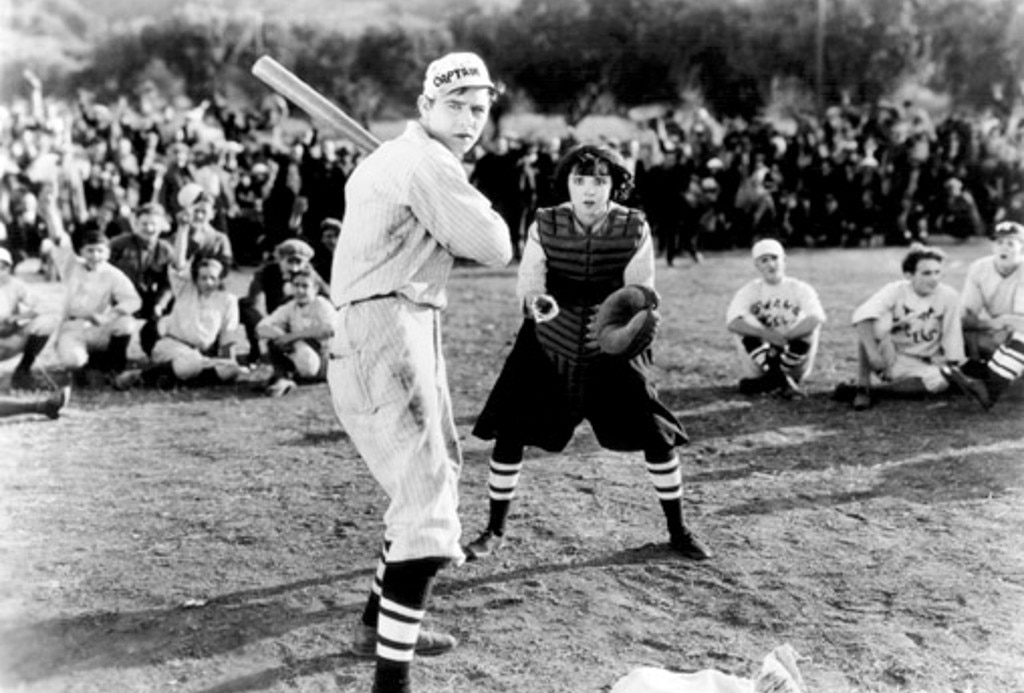
Two other silent screen legends play key roles in The Busher. Colleen
Moore, destined to become one of the top late-silent-era box office draws, plays
Mazie Palmer, Harding's small-town girl. John Gilbert, another mid-to-late 1920s
screen hero famed for his co-starring roles (and off-camera love affair) with Greta
Garbo, plays Jim Blair, a spoiled rich kid who attempts to buy Mazie's affection.
Producer: Thomas H. Ince
Director: Jerome Storm
Screenplay: R. Cecil Smith, based on a story by Earle Snell
Cinematography: Chester A. Lyons
Cast: Charles Ray (Ben Harding), Colleen Moore (Mazie Palmer), John Gilbert (Jim
Blair), Jay Morley (Billy Palmer), Otto Hoffman (Deacon Nasby).
BW-50m.
Hearts and Diamonds (1914, Vitagraph) is a representative early baseball
comedy. The star is John Bunny, a corpulent comic actor who predated Charlie
Chaplin, Buster Keaton, and Harold Lloyd as the cinema's foremost silent comedian.
Bunny, who resembles a giant teddy bear, plays the Widower Tupper, who starts
his own ball team to impress the wealthy, baseball-loving Miss Rachel Whipple
(Flora Finch, Bunny's frequent co-star). Watching Bunny garbed in a baseball
uniform and attempting to make like Ty Cobb is the equivalent of W.C. Fields
endeavoring to toss a 50-yard-long touchdown pass.
Hearts and Diamonds lampoons real-life major league baseball heroes as
Tupper is inspired to create his own team after meeting one Matty Christheson, "the
famous pitcher"-and an obvious take-off on Christy Mathewson.
Director: George D. Baker
Screenplay: Eugene Mullin
Cast: John Bunny (Widower Tupper), Flora Finch (Miss Rachel Whipple), Matty
Christheson (himself), Ethel Corcoran (Tupper's daughter), Arthur Cozine (The
daughter's boyfriend).
BW-33m.
Happy Days (1926, Weiss Bros.) features characters from Martin Branner's
famous comic strip Winnie Winkle the Breadwinner, which debuted in 1920. Unlike
most period strips that centered on unmarried women and romantic entanglements,
the early Winnie Winkle storylines focused on the title character's simple life as a
working woman who toils to support her aging parents. Baseball-wise, the spotlight
in Happy Days is on Winnie's adopted brother Perry; he plays "in the mangy
baseball league," whose participants come in all sizes, shapes, and colors.
Needless to say, the featured contest is not a heated pitching duel between, say,
Sandy Koufax and Bob Gibson.
Director: Arvid E. Gillstrom
Screenplay: Martin Branner
Cast: Billy Butts, Ethelyn Gibson (Winnie Winkle).
BW-14m.
Felix Saves the Day (1922, M. J. Winkler), an early Felix the Cat cartoon
produced and directed by animation pioneers Pat Sullivan and Otto Messmer, offers
a primer in early animation techniques. It chiefly features animated images, as
Willie Brown's "Nifty Nine" practice for the big game at the Polo Grounds against an
all-black team and Felix pitches-and catches balls with his tail-before tussling
with a policeman. However, the animation is cleverly combined with still
photography, and live-action shots of real fans crowded into a ballpark are
juxtaposed to those of the animated characters on the ballfield.
Producer: Pat Sullivan
Director: Otto Messmer
BW-7m.
Casey at the Bat is an early example of sound-on-film and features DeWolf
Hopper, former Broadway matinee idol and husband of gossip columnist/actress
Hedda Hopper. Thayer's poem initially was printed in the San Francisco Examiner
on August 13, 1888. The following year, Hopper first performed Casey at Wallacks
Theatre, at Broadway and 13th Street in New York City, while acting with the
McCaull Opera Company in Prince Methusalem. In the audience were New York
Giants and Chicago White Stockings players. Over the next 45 years, the actor
publicly recited Casey at the Bat perhaps 10,000 times. Happily, there is a
filmed record of Hopper performing the poem. In 1922, he offered a florid recitation
of Casey in a DeForest Phonofilm, which utilized the experimental sound-on-film
technology developed by Theodore Case and Lee DeForest. The result is a
fascinating-and unintentionally funny-curio.
Producer/Director: Lee De Forest
Screenplay: Ernest Lawrence Thayer
Cast: DeWolf Hopper Sr.
by Rob Edelman, author of Great Baseball Films and Baseball on the
Web
Silent Baseball Part 2
by Rob Edelman | August 17, 2007
SIGN UP FOR OUR NEWSLETTERS

CONNECT WITH TCM