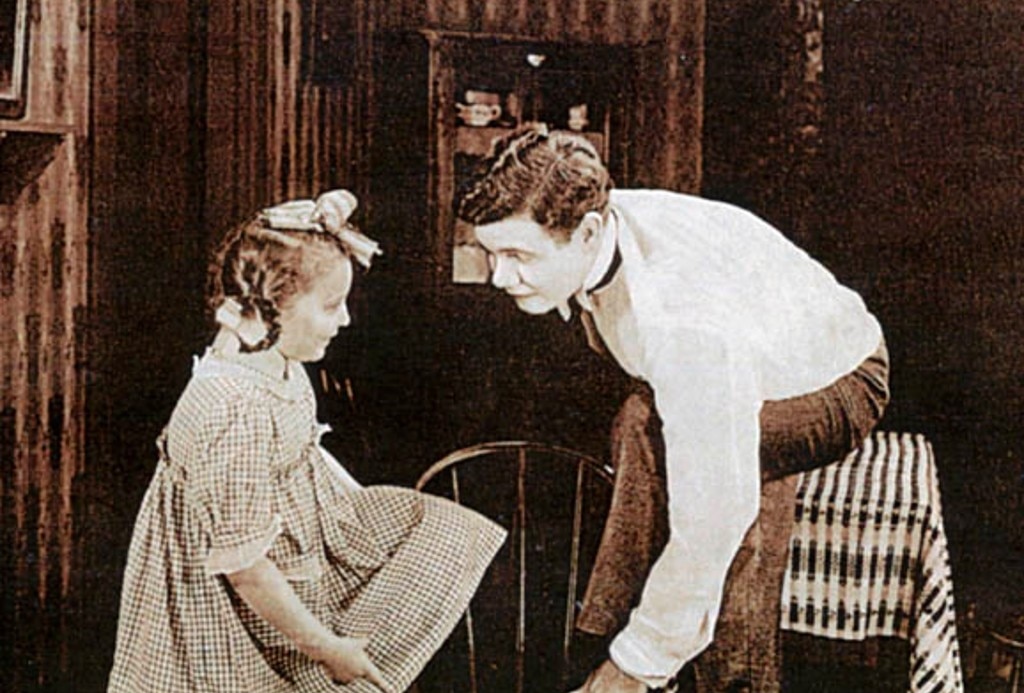
Babe Ruth, fresh from his sale to the New York Yankees by the Boston Red Sox, plays a
character simply known as "Babe" in Headin' Home (1920, Yankee Photo
Corp./States Rights), a five-reel comedy-drama. By 1927, Ruth's off-the-field revelry had
become such common knowledge that New York Times sportswriter/columnist John Kieran
could casually refer to him as the "Playboy of Baseball" in a piece written the day after the
Bambino hit his record-breaking 60th homerun. But seven years earlier, Ruth still could be
cast as a clean-living, mother-loving all-American boy: a character who is the polar
opposite of the real Bambino. In Headin' Home, which qualifies as a genuine
cinematic novelty, the Babe plays a humble chap who resides with his mother and kid
sister in the small town of Haverlock. This Babe spends his spare hours chopping down
trees and fashioning them into baseball bats-and he is fated to become a homerun-hitting
baseball hero.
Just as Babe Ruth was becoming the ballplayer who epitomized the 1920s, Headin'
Home was the one baseball film that embodied the mass-marketing of the sport. No
measly movie palace could house it during its New York premiere. Fight promoter Tex
Rickard reportedly paid $35,000 to book the film into Madison Square Garden, where it was
screened from September 19-26, 1920. Variety, the motion picture trade publication,
informed its readers that moviegoers could purchase everything "from Babe Ruth
phonographic records to the Babe Ruth song, 'Oh You Babe Ruth,' which was sung and
played by Lieut. J. Tim Bryan's Black Devil Band, which accompanied the picture."
Producer: William Shea, Herbert H. Yudkin
Director: Lawrence C. Windom
Screenplay: Arthur 'Bugs' Baer, Earle Browne
Cast: Babe Ruth (Babe), Ruth Taylor (Mildred Tobin), William Sheer (Harry Knight),
Margaret Seddon (Babe's Mother), Frances Victory (Pigtails).
BW-56m.
His Last Game (1909-Independent Moving Picture Company) spotlights an
American Indian ballplayer: Bill Going, the star of the Choctaw team, who is about to
compete in a championship game against Jimtown. Gamblers from Jimtown attempt to
persuade Going to throw the game-another common plot device in the era's baseball
movies.
BW-12m.
The Ball Player and the Bandit (1912-Broncho Film Company) is directed by
Francis Ford, elder brother of iconic Hollywood filmmaker John Ford as well as a prolific
silent film director-actor. The leading player is Harold Lockwood, a rising screen star who
rivaled Douglas Fairbanks, William S. Hart, and Wallace Reid in popularity before his
untimely death at age 31 in the 1918 influenza epidemic. Lockwood plays the "ballplayer"
of the title: Harry Burns, a college star who heads for Arizona after he is forced to leave
school. The "bandit" is Red Dan, a varmint with larceny in his heart. Even though he is far
from a ballyard, Harry cleverly employs his baseball skills to thwart Red Dan.
Producer: Thomas H. Ince
Director: Francis Ford
Cast: Harold Lockwood, Joe King, Shorty Hamilton, Francis Ford
BW-10m.
by Rob Edelman, author of Great Baseball Films and Baseball on the Web
Silent Baseball Part 1
by Rob Edelman | August 17, 2007
SIGN UP FOR OUR NEWSLETTERS

CONNECT WITH TCM