Greta Garbo took on Hollywood's biggest studio and won her case before she would set
foot on the set of Love, the 1927 adaptation of Tolstoy's Anna Karenina.
Not only did she get MGM to raise her salary, but through a carefully timed "illness," she even got them to give her the leading man she wanted.
Although Garbo had been at MGM for just two years, in which time she had
only had two films released, she knew she was worth more than the $600 a
week her current contract gave her. She had scored solid reviews and
strong box office with her first two American films. As studio publicists
raved about her torrid love scenes with John Gilbert in the still
unreleased Flesh and the Devil, and gossip about their offscreen
romance spread, her fan mail began to approach her leading man's 5,000 letters a
week.
At Gilbert's urging -- they were living together at the time -- she
campaigned for a new contract to start at $5,000 a week. Instead, studio
head Louis B. Mayer simply informed her that she was to start work on an
adaptation of Anna Karenina co-starring Ricardo Cortez and Lionel
Barrymore and directed by Dmitri Buchowetsky. Only Garbo wouldn't report
to work. Mayer put her on suspension, threatened to have her deported,
threatened to replace her with a look-alike and even threatened to burn off
her current contract with minor roles. But she just laughed him off,
countering that if she had to she could stay in the U.S. by marrying
Gilbert, whom Mayer hated.
Then MGM released Flesh and the Devil, which turned out to be
Garbo's biggest hit to date. Realizing that he needed the independent star
more than she needed him, Mayer finally agreed on a contract raising her
salary to $2,000 a week, increasing to $4,000 the second year, $5,000 the
third and $6,000 the fourth. And still it wasn't enough. The new contract
wasn't supposed to kick in until Anna Karenina was completed, so
Garbo got sick -- too sick to report to work for a month. And she won
again, convincing Mayer to backdate the contract to the beginning of the
year.
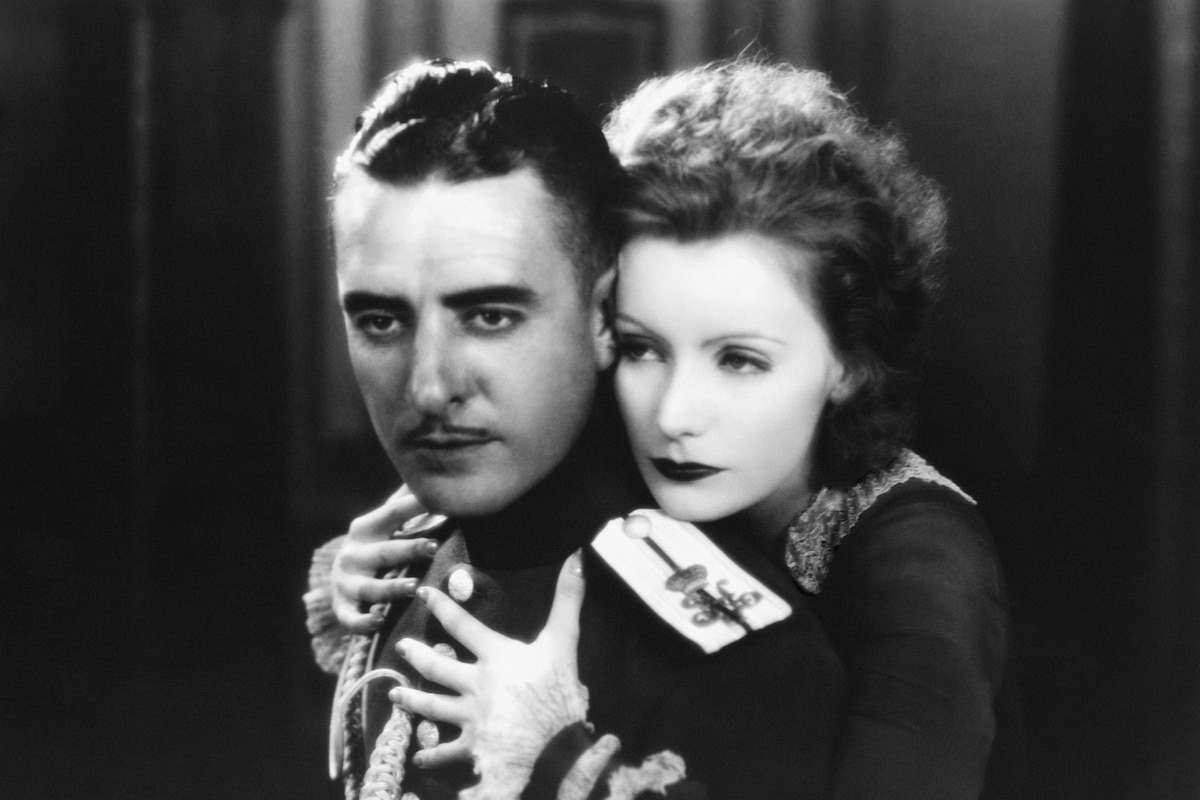
Conveniently, Garbo's return to work coincided with the completion of
Gilbert's latest picture. With the tremendous box-office reaction to their
teaming, Thalberg decided to replace Cortez with Gilbert. In addition, he
brought on Edmund Goulding, already famous for his ability to showcase
female stars, to direct. With the new team, Thalberg decided to change the
film's title to something reflecting the star pairing. Someone suggested
Heat, but that would have resulted in marquees reading "John Gilbert
and Greta Garbo in Heat." Instead, he called the picture
Love, using the tag line, "John Gilbert and Greta Garbo in
Love....What more could be said about a picture -- see it."
And that's just what the public did. The film scored solidly at the box
office, despite mixed notices. Most of the reviewers found the film rather
one-sided, putting all the focus on Garbo at the expense of the other
performers. This was tempered by their delight in Garbo's work. Mordaunt
Hall in the New York Times said "Greta Garbo, the Swedish actress,
outshines any other performance she has given on the screen" and called her
"a blonde Mona Lisa." Variety used language that seems rather
inappropriate today in light of what Garbo's career would become; they
called her "the biggest skirt prospect now in pictures."
One element helping the film's box office was the addition of a happy
ending that reunited Anna and Vronsky after her husband's death. At least
it helped outside the major American cities, where this rather original
take on Tolstoy's story played like gangbusters. For the major U.S. cities
and Europe, however, the film kept the novel's original ending, with Garbo
throwing herself in front of a train - the same ending that would be used
when Garbo re-made the film, with Fredric March in the lead, in 1935. For
this TCM presentation, both endings will be shown, giving viewers a chance
to decide for themselves how Anna's tortured romance should have
ended.
Producer & Director: Edmund Goulding
Screenplay: Frances Marion, Lorna Moon
Titles: Marian Ainslee, Ruth Cummings
Based on the novel Anna Karenina by Leo Tolstoy
Cinematography: William H. Daniels
Art Direction: Cedric Gibbons, Alexander Toluboff
Score: Howard Dietz, Walter Donaldson, Ernst Luz
Principal Cast: Greta Garbo (Anna Karenina), John Gilbert (Vronsky), George Fawcett (Grand Duke), Emily Fitzroy (Grand Duchess), Brandon Hurst (Karenin), Philippe De Lacy (Serezha, the Child).
BW-83m.
by Frank Miller
Love (1927)
by Frank Miller | July 28, 2003
SIGN UP FOR OUR NEWSLETTERS

CONNECT WITH TCM