Kings Row (1942), Sam Wood's epic tale of life in a small
turn-of-the-century town, begins on a deceptively optimistic note: a
billboard that promotes the Midwestern hamlet as "A Good Town. A Good
Clean Town. A Good Town to Live In and a Good Place to Raise Your
Children." Kings Row is a eulogy for the well-mannered lifestyle
of the Victorian Era. "A whole way of life. A way of gentleness and honor
and dignity," one character laments, "These things are going... and they
may never come back to this world."
But the film gradually reveals that all is not idyllic in this sleepy
American town. Beneath the film's surface of quaint nostalgia and
small-town melodrama appear signs of widespread malaise, revealing the
community of Kings Row as a melting pot of gossip, jealousy, mental
illness, possessive parents, class-rivalry, murder and suicide.
Robert Cummings stars as Parris Mitchell, an ambitious youth who begins the
study of psychiatry under mentor Dr. Alexander Tower (Claude Rains).
Parris's pal, Drake McHugh (Ronald Reagan), is a small-town dandy who
chooses to live off his trust fund while romancing several local girls,
including Louise Gordon (Nancy Coleman), daughter of the town physician
(Charles Coburn). The propriety of Louise and Drake's relationship is
carefully guarded by Mrs. Gordon (Dame Judith Anderson) who seeks to
preserve her daughter's reputation, even at the expense of her
happiness.
Best remembered as the grim Mrs. Danvers in Alfred Hitchcock's
Rebecca (1940), Anderson was perfectly cast as Mrs. Gordon. With
her high starched collars and elaborate lace finery, she comes to represent
the Victorian mindset at its most repressive and inflexible.
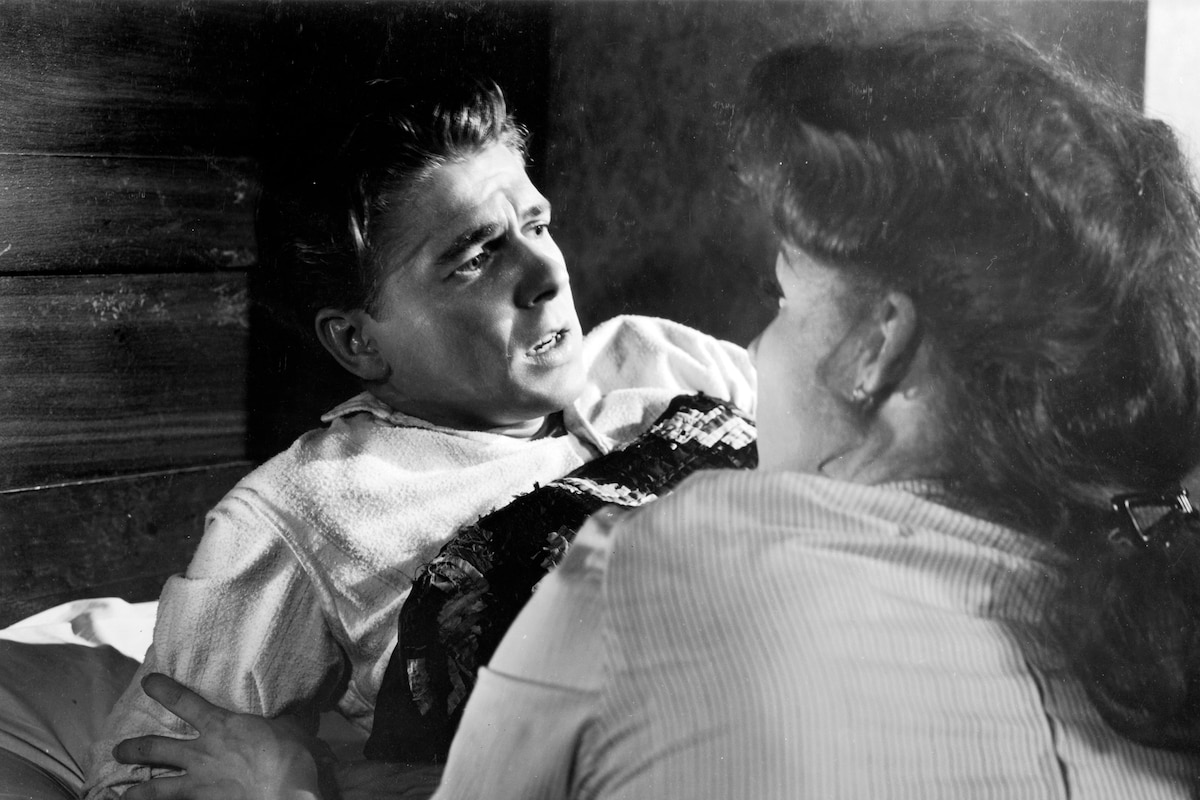
Eventually the Gordons' bottled-up resentment toward Drake is released when
the young lothario is injured in a train accident and the kindly small-town
doctor spitefully amputates both of the boy's legs. This tragic plot twist
provided Reagan with the greatest acting opportunity of his career, and the
lines he uttered upon discovering his mutilated body later became the title
of his autobiography, "Where's the rest of me?"
It was initially believed that Henry Bellamann's novel could never be
passed by the censors. Joseph Breen, of the Hays Office, wrote the
producers that "To attempt to translate such a story to the screen, even
though it be re-written to conform to the provisions of the Production Code
is, in our judgment, a very questionable undertaking from the standpoint
of the good and welfare of this industry." Thanks to the resourcefulness
of screenwriter Casey Robinson (who judiciously removed the novel's
suggestions of incest, homosexuality and euthanasia), Kings Row was
finally able to reach the screen without sacrificing the integrity of its
troubling message, earning Academy Award nominations for Best Picture, Best
Director and James Wong Howe's "Midwestern Gothic" cinematography.
Director: Sam Wood
Producer: Hal B. Wallis
Screenplay: Casey Robinson
Based on the novel by Henry Bellamann
Cinematography: James Wong Howe
Production Design: William Cameron Menzies
Music: Erich Wolfgang Korngold
Cast: Ann Sheridan (Randy Monoghan), Robert Cummings (Parris Mitchell),
Ronald Reagan (Drake McHugh), Claude Rains (Dr. Alexander Tower), Betty
Field (Cassandra Tower), Charles Coburn (Dr. Henry Gordon), Judith Anderson
(Mrs. Harriet Gordon), Nancy Coleman (Louise Gordon).
BW-127m. Closed captioning. Descriptive Video.
by Bret Wood
Kings Row
by Bret Wood | January 17, 2003
SIGN UP FOR OUR NEWSLETTERS

CONNECT WITH TCM