"I'm tired of playing second fiddle to the ghost of Beethoven."
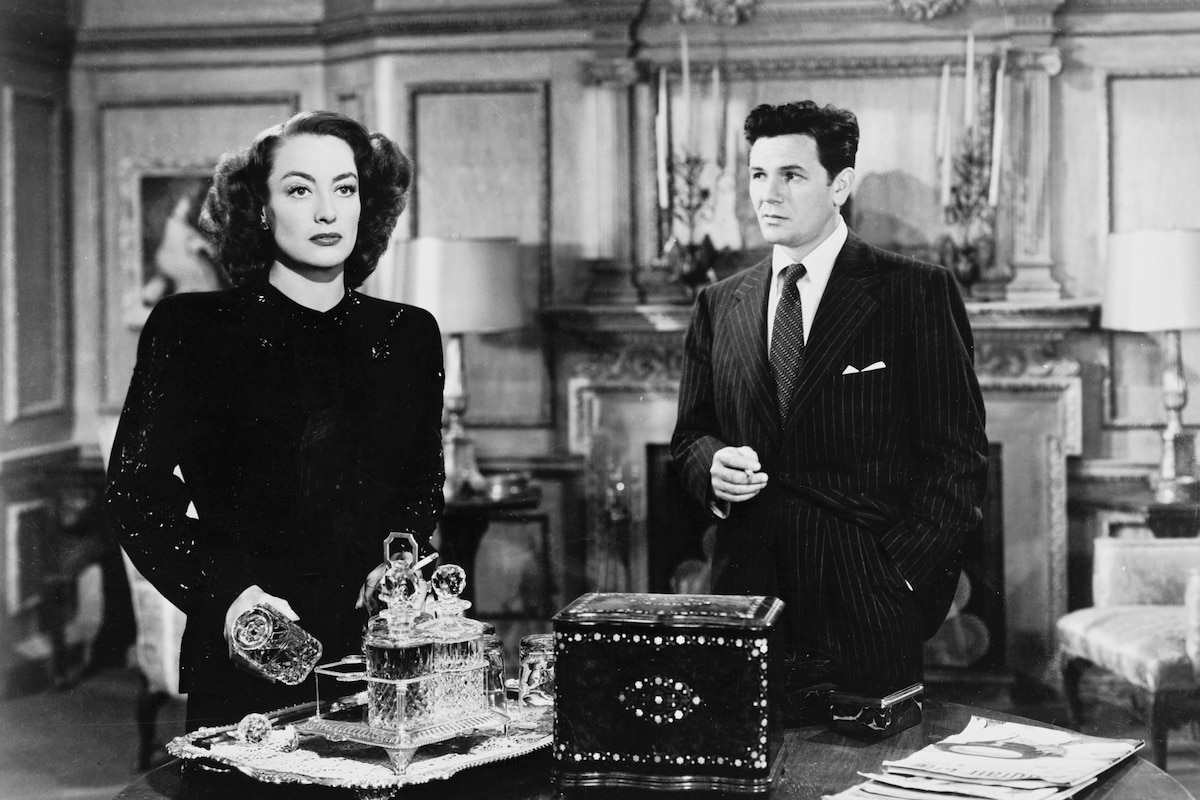
Joan Crawford, Humoresque (1946)
However her character may have felt in this 1946 romantic drama, on-screen
Joan Crawford played second fiddle to nobody. Although John Garfield had
the larger role, as a ghetto boy who rises to fame and fortune as a
classical violinist, Crawford dominated the film. From her first
appearance, fending off a circle of admirers all trying to light her
cigarette, to her final scenes as she walks into the ocean to save
Garfield's career, the film showcased Crawford in one of her most complex
roles.
Humoresque was adapted from a Fannie Hurst short story that had been
filmed as a silent in 1920. The 1946 version was inspired less by a desire
to remake her classic tearjerker than by Warner Bros.' need to get
something out of a very expensive and lengthy screenplay Clifford Odets had
written for Rhapsody in Blue, their musical biography of composer
George Gershwin. The Odets take on his story was good, but a little
heavier on social commentary than they'd planned. But his story of a slum
boy whose musical talents are exploited by the wealthy had potential, so
producer Jerry Wald matched it with Hurst's similar tale to create a
vehicle for John Garfield.
Odets had created a particularly strong characterization for the role of
Helen Wright, a wealthy neurotic who sponsors the violinist's career in
hopes of making beautiful music with him. Wald considered such luminaries
as Tallulah Bankhead and Barbara Stanwyck for the part. When Crawford --
who was generating a lot of buzz with her first Warners' film, Mildred
Pierce (1945) -- expressed an interest in it, Wald jumped at the chance.
During filming, Crawford won the Oscar® for Mildred Pierce, so
Wald ordered her role expanded and even got the studio to raise the film's
budget, partly to pay for more glamorous gowns designed by Adrian and more
loving close-ups of his leading lady.
Crawford was thrilled to be working with Garfield on the film. Like her
former husband Franchot Tone, he had come to Hollywood after work with the
pioneering Group Theatre, whose socially conscious plays and deeply
personal acting inspired by the writings of Stanislavsky had always
intrigued her. At one point in the '30s, she had even considered leaving
Hollywood to work with them. She also was attracted to Garfield's brazen
masculinity. On their first meeting, he said, "So you're Joan Crawford,
the big movie star! Glad to meet ya," and pinched her breast. At first
she bristled, but then she smiled and said, "I think we're gong to get
along just fine."
She wasn't quite as comfortable with director Jean Negulesco, however.
Crawford always liked her directors to talk her through her performances,
but Negulesco preferred to watch his actors in rehearsal and work with what
they gave him. After she went to Wald in tears about not getting any
guidance, Negulesco painted her a portrait of her character and presented
it to her with a note reading, "Dear Joan, This is the Helen Wright I see
and dream of -- and only you could give her to me." From then on, she
claimed, she knew exactly what he wanted, and, indeed, she turned in what
many critics consider her best performance.
Along with Crawford's performance, Humoresque is notable for the
very serious approach the filmmakers took to its setting in the world of
classical music. Isaac Stern was hired for $25,000 to record the film's 23
classical pieces, including the special arrangement of Wagner's "Prelude
and Love Death" from Tristan und Isolde played over Crawford's final
scenes. Garfield studied the violin so he could appear in long shots. For
close-ups he wore a jacket with cutaway sleeves. One violinist crouched
out of camera range and put his arm through the jacket's right sleeve to
operate the bow. Another hid behind Garfield and wore the left sleeve to
supply the fingering. After shooting one scene this way, pianist Oscar
Levant, who improvised many of his lines as Garfield's sidekick and
accompanist, quipped, "Why don't the four of us do a concert tour?"
Humoresque proved to be a big success for Warner Bros. and Crawford.
With this and Mildred Pierce scoring at the box office, the studio,
which had gotten her for a song when she left MGM, gave her a new contract
for seven years at $200,000 a picture. Years later, the film would be
spoofed on SCTV Network 90, with Catherine O'Hara as a hilariously
overdressed Joan Crawford and classical violinist Eugene Fodor standing
alone to provide his own playing in the Garfield role.
Producer: Jerry Wald
Director: Jean Negulesco
Screenplay: Clifford Odets, Zachary Gold
Based on the Story by Fannie Hurst
Cinematography: Ernest Haller
Art Direction: Hugh Reticker, Clarence Steensen
Music: Franz Waxman
Principal Cast: Joan Crawford (Helen Wright), John Garfield (Paul Boray),
Oscar Levant (Sid Jeffers), J. Carrol Naish (Rudy Boray), Joan Chandler
(Gina), Ruth Nelson (Esther Boray), Craig Stevens (Monte Loeffler), Paul
Cavanagh (Victor Wright), Bobby [later Robert] Blake (Paul Boray as a
Child).
BW-125m. Closed captioning.
by Frank Miller
Humoresque
by Frank Miller | January 17, 2003
SIGN UP FOR OUR NEWSLETTERS

CONNECT WITH TCM