In the Caribbean of the 1830s, a beautiful but prim young lady, Manuela (Judy Garland), is to enter
into an arranged marriage with the rich, fat, old town mayor, Don Pedro Vargas (Walter Slezak).
When an actor named Serafin (Gene Kelly) gets a look at Manuela, however, and sees how she longs
for adventure and excitement, he romances her by pretending to be the notorious pirate "Mack the
Black" Macoco. Little does Manuela know that the real Macoco is in fact Don Pedro, who has been
living an assumed existence in order to escape his infamous past.
That's the basic storyline of The Pirate (1948), director Vincente Minnelli's sensuous and
dazzling costume musical still revered for its flamboyant use of Technicolor. Newly out on DVD from
Warner Home Entertainment in a good print and with an impressive array of extras, the picture now
has a real chance to fix its unfair reputation as a stagy, hammy, overdone misfire. Some
Pirate defenders have described the film as over the heads of its detractors, but perhaps a
kinder analysis is simply that MGM at the time was giving the public so many more traditional
(though still innovative) musicals, that audiences just weren't sufficiently primed to deal with one this
stylized.
Most musicals, after all, shift from reality-based non-musical sequences into "unreal" musical
numbers and back again. In The Pirate, there is no reality. The entire film takes place in a
fantasy world. Arguably (and paradoxically) the only glimmers of reality in the picture are in the
musical numbers themselves, since the sight and sound of Gene Kelly and Judy Garland performing
is something moviegoers perceive as normal and real.
To Minnelli's - and screenwriters Albert Hackett and Frances Goodrich's - credit, The Pirate
begins with pages of a storybook being turned, telling us in crystal-clear terms that what is to follow
is a fairy tale, a fantasy, make-believe. For a master visualist like Minnelli image is everything, and
the only fair way to watch the film is to take what the images are saying to heart. In this movie about
performers and performing, all three main characters pretend to be someone they're not at one point
or another, sometimes with other characters' knowledge and sometimes without. That's one way
The Pirate creates satire. The entire production is designed to be a tongue-in-cheek send-up
of operettas and swashbucklers like Don Juan or Robin Hood, with dialogue, sets,
colors and performances all purposefully over-the-top. Not realizing this could make the movie a
frustrating experience, but if one accepts the movie on its own terms, it's a tremendous, intelligent
and very funny entertainment.
When Kelly hypnotizes Garland with a rotating mirror, her true self comes out. He releases her
dreams, and her musical performance. She has real passion and excitement underneath her "prim
exterior," as she puts it, and under his spell allows herself to sing, dance, and let her emotions to the
surface. For viewers who allow themselves the same release, it's an enthralling moment.
Kelly's dancing in The Pirate is kinetic and acrobatic, incorporating ballet, Spanish, and
other dancing styles - but no tap. According to his widow Patricia Ward Kelly, it was just the kind of
project he wanted at the time, as he was hungry to showcase alternate types of dancing. The "Pirate
Ballet" sequence, a fantasy dance which takes place in Garland's imagination, is mightily impressive,
with Kelly dancing and swinging a sword energetically while endless explosions of fire and smoke
go off around him. The lighting and color create a strong third dimension here, an effect Kelly and
Minnelli were always striving to achieve.
Some of Kelly's non-musical scenes involve so much choreography that they qualify as de facto
dance numbers, such as where Garland furiously throws just about every object in a room at him and
he must constantly move out of the way. In another sign of how purposefully jokey The
Pirate sought to be, Kelly styled his scenes as the actor Serafin after John Barrymore and his
scenes as the pirate Macoco after Douglas Fairbanks. And in a nod to all the overacting on display,
Kelly even jokes to Slezak at one point, "You should try underplaying sometime. Very
effective."
As for Garland, she is beautifully glamorized by Minnelli (her husband at the time) and handles her
role with great humor. One could reasonably argue that she - and the movie as a whole - does not
have enough songs, but she does perform them beautifully, including "You Can Do No Wrong," "Love
of My Life" and the erotic "Mack the Black." The Cole Porter score also includes "Nina" and "Be a
Clown," a song which feels out of place in this film but nonetheless became its most popular tune.
Kelly performs it with the Nicholas Brothers, and at the end it's reprised as a vaudeville routine
between Kelly and Garland, an experienced vaudevillian who relished the chance to perform it.
Another song, "Voodoo," was ultimately deleted after Louis B. Mayer deemed it too steamy. An audio
version remains as an extra, but aside from a snippet that can be seen in the trailer, the filmed
number itself is gone. (Mayer ordered the negative burned.)
Well worth watching on this DVD is an illuminating 20-minute featurette about the making of The
Pirate, featuring Liza Minnelli (Minnelli and Garland's daughter), Patricia Ward Kelly, Fayard
Nicholas and various film historians explaining the genesis of the movie and its troubled production
and reception. On his commentary track, historian John Fricke goes into the details even further.
Garland was having serious psychological problems during filming as well as issues with her
marriage.
Other extras include a trailer (in excellent shape), deleted songs (audio only), a blah Pete Smith
Specialty short, a very funny Tom and Jerry cartoon, Roger Edens' guide-track versions of some
songs, and radio interviews with Kelly and Garland.
The Pirate is available by itself or as part of the collection Classic Musicals From the
Dream Factory, Volume 2, a set of seven movies. The others are Words and Music (1948),
That Midnight Kiss (1949), Toast of New Orleans (1950), Royal Wedding (1951),
The Belle of New York (1952) and That's Dancing (1985). It's a mixed bag, but The
Pirate is the truest gem of the lot. Extras abound in the collection, with commentaries, vintage
shorts, new documentaries, cartoons, outtakes, alternate song versions, radio interviews and trailers
galore, all up to Warner Home Entertainment's usual impeccable standards.
For more information about The Pirate, visit Warner
Video.
To order The Pirate, go to
TCM Shopping.
by Jeremy Arnold
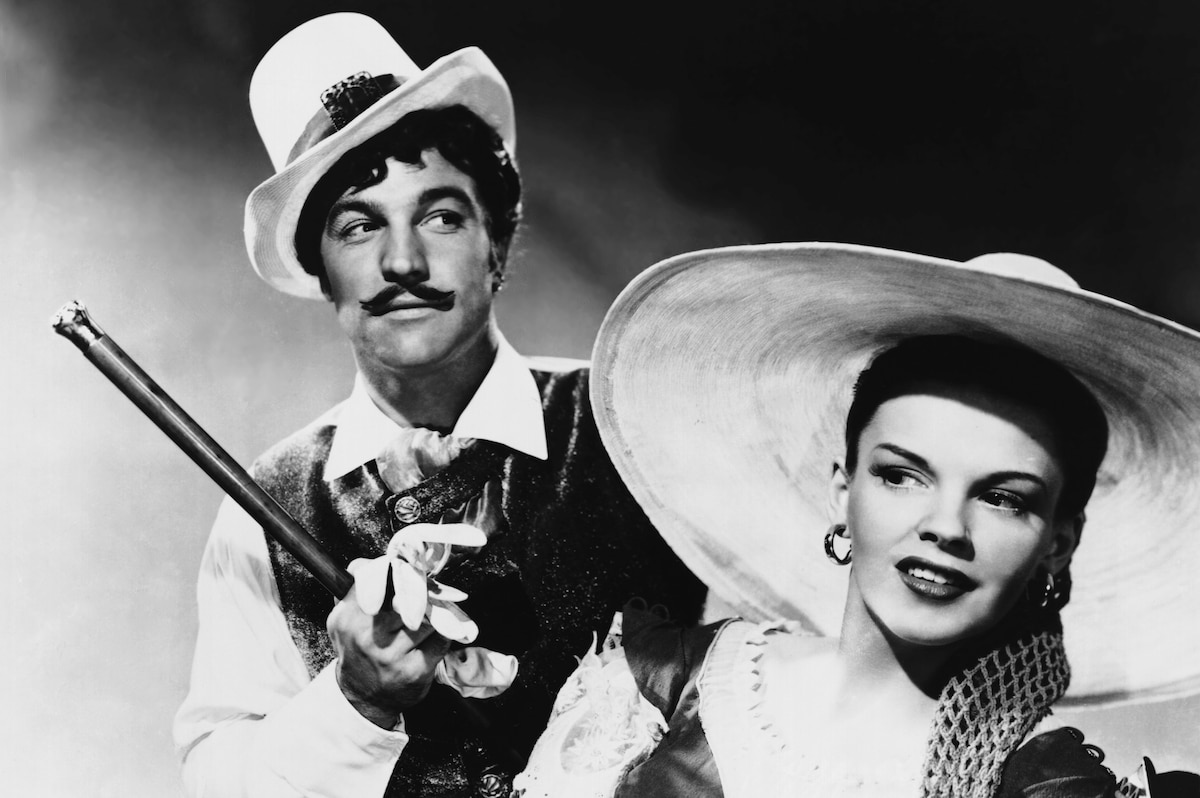
The Pirate - Judy Garland and Gene Kelly in THE PIRATE on DVD
by Jeremy Arnold | August 06, 2007
SIGN UP FOR OUR NEWSLETTERS

CONNECT WITH TCM