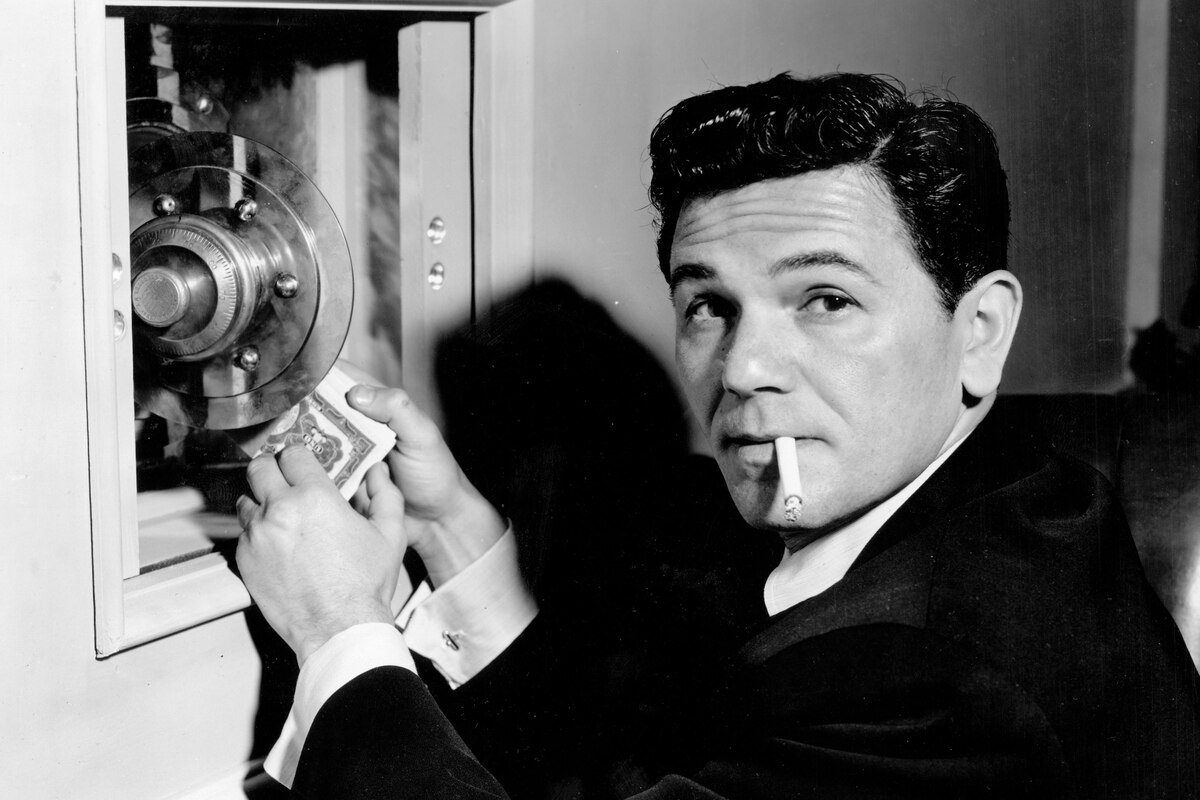
A relentlessly grim and mesmerizing film noir, Force of Evil (1948) presents a world thoroughly steeped in corruption. Director Martin Scorsese has called the film a seminal influence on his own gangster dramas (Mean Streets, 1973, Goodfellas, 1990). Especially impacting Scorsese's own movie antiheroes was Force of Evil's star John Garfield, as corrupt lawyer Joe Morse, a man whose face is "a landscape of moral conflict."
In a role that typified the harsh, cynical edge he could bring to his pictures,
Garfield is a powerful, selfish Wall Street lawyer who grew up on the streets
(like Garfield himself, a product of Bronx street gangs) but has risen to a
place of undeniable importance.
But that rise has been as underhanded as that of a classic Pre-Code gold digger
sleeping her way up the corporate ladder. Garfield's "office in the clouds" was
bought through allegiance to a criminal mob who use him as their brains in a
scheme to gain control of the city's smalltime illegal gambling trade. Fixing
the July 4th gambling racket so that the popular bet of "776" comes up the
winner, Joe and mob boss racketeer Ben Tucker (Roy Roberts) plan to drive all of
the small time numbers racketeers out of business when they are unable to pay
out the winning bets.
Director Abraham Polonsky makes a bitter comparison between the money-oriented
corruption practiced by lawyers like Joe with the more explicit graft of
mobsters like Tucker. Both refer to the men not included in their scam as "suckers."
And that casual dismissal of ordinary people is also seen in the film's opening
overhead shot of pedestrians whose ant-like scurrying down on the street below
only reaffirms Joe's God-like roost.
Joe's one attempt to reach out to the "little man" backfires and ends up
jeopardizing the entire criminal plan. Joe's older brother Leo (Thomas Gomez),
who¿ in ill health, operates a small time racket out of a miniscule office, and
Joe is determined to bring him into Tucker's scheme before his office is wiped
out with the rest of the small-change money-rackets. But Leo will have nothing
to do with the scheme. A line is drawn in the sand, with both brothers engaged
in a battle that soon has disastrous and bloody consequences.
Also drawn into the turmoil is Leo's pretty, naive secretary Doris Lowry
(Beatrice Pearson). Joe is drawn to her innocence despite being involved in a
sordid relationship with Tucker's wife Edna, played by one of
the classic film noir femme fatales - Marie Windsor (The Killing 1956,
The Narrow Margin, 1952), whose performance in the film was highly
praised.
Force of Evil was Polonsky's first directing effort after a successful
screenwriting debut with the hit film Body and Soul (1947). Polonsky
wrote the script for Force of Evil, along with Ira Wolfert who also wrote the
novel, Tucker's People, that the film was based on. Their first draft of
the screenplay was deemed so harsh that the censorial Breen office demanded a
rewrite. Though it received mixed reviews upon its original release, the movie
has since become highly regarded; noted critic Andrew Sarris called it, "one of the great films of the modern American cinema."
Polonsky had a remarkable vision both pictorial and thematic that he brought to the screen in Force of Evil. The film's punchy, stylized visuals and pessimistic tone have made it into a film noir classic. Unfortunately, Polonsky was never allowed to
flourish as a director.
It is unfortunate that Polonsky, a member of the Communist Party, fell out of
favor in the industry after he was deemed an uncooperative witness during the
HUAC trials in 1951 and blacklisted from working in Hollywood. Though Polonsky
went on to write TV scripts under an assumed name and eventually returned to
movie work in the late Sixties with such notable efforts as Tell Them Willie
Boy Is Here (1969) and Romance of a Horsethief (1971), the
blacklisting significantly jeopardized his career arc.
Garfield was also branded an "uncooperative" during the HUAC trials, suspected
of being a Communist or supportive of Communist causes along with actors such as
Edward G. Robinson, Paul Muni, Sylvia Sidney and Melvyn Douglas. Garfield's
career was not destroyed as some were by the HUAC trials, but he did turn to the
stage as a momentary sabbatical from film work. Garfield was initially
discussed for the lead as Stanley Kowalski in Elia Kazan's Broadway direction
of Tennessee Williams' A Streetcar Named Desire. But Garfield's
insistence on also starring in the film and his desire for a short-term theater
run led to a negotiating deadlock. The role eventually went to a little-known
actor named Marlon Brando.
Director: Abraham Polonsky
Producer: Bob Roberts
Screenplay: Abraham Polonsky and Ira Wolfert based on his novel, Tucker's
People
Cinematography: George Barnes
Production Design: Richard Day
Music: David Raksin
Cast: John Garfield (Joe Morse), Beatrice Pearson (Doris Lowry), Thomas Gomez (Leo Morse), Howland Chamberlain (Freddy Bauer), Roy Roberts (Ben Tucker), Marie Windsor (Edna Tucker).
BW-79m. Closed captioning.
by Felicia Feaster
Force of Evil
by Felicia Feaster | January 17, 2003
SIGN UP FOR OUR NEWSLETTERS

CONNECT WITH TCM