Produced in 1934 at Universal Studios, The Black Cat was a film that
could not possibly fail. At least that was how filmmaker Edgar G. Ulmer
sold the idea to Universal Studios producer Carl Laemmle, Jr. By teaming
the newborn horror genre's darkest stars -- Bela Lugosi and Boris Karloff
-- in their first film together, and splashing the name Edgar Allan Poe
above the title, The Black Cat was as close as a Depression-era
studio could come to a sure thing.
So confident was Laemmle that he allowed the ambitious Ulmer virtually free
rein on the picture. Ulmer responded by crafting a story from scratch with screenwriter
Peter Ruric, casting aside three different Black Cat treatments
already sitting in the script department, as well as Poe's story itself,
retaining only a mere trace of the original text. "The Edgar Allan Poe
story is not a story you can dramatize," said Ulmer frankly.
While Ulmer may have been afforded creative freedom in making The Black
Cat, Universal kept him on a short leash nonetheless. The film was
budgeted at a third of what the studio had spent on Dracula (1931)
or Frankenstein (1931), and allowed a brief fifteen-day shooting
schedule. Because Ulmer had a genius for crafting ambitious films on
incredibly low budgets, The Black Cat looks as though it cost twice
as much as it did.
Ulmer's background was primarily as a set designer. Working in the German
theatre circa 1910, and under legendary stage director Max Reinhardt, Ulmer
carried his skills to the cinema, collaborating with Fritz Lang and F.W.
Murnau on such classics as Metropolis (1927) and Sunrise
(1927). As a director, he had found few opportunities in America, making a
series of low-budget silent Westerns for Universal, and a syphilis
education film for the Canadian Social Health Council. Ulmer knew that
The Black Cat was his golden opportunity.
Rather than exploring the 1843 tale of psychological disintegration, Ulmer
looked for inspiration in the horrors of the recent past. While working on
The Golem (1920) in Germany, Ulmer met novelist Gustav Meyrinck, who
"was contemplating a play based on Doumond, which was a French fortress the
Germans had shelled to pieces during World War I; there were some survivors
who didn't come out for years," explained Ulmer in a 1970 interview with
Peter Bogdanovich. "And the commander was a strange Euripedes figure who
went crazy three years later, when he was brought back to Paris, because he
had walked on that mountain of bodies."
Thus Ulmer found his Poe-worthy setting: Castle Poelzig, built atop the
bloodstained ruins of Fort Marmaros. Early in the film, a pair of
newlyweds (David Manners and Jacqueline Wells) journey through the stormy
Hungarian countryside in the direction of Poelzig's lair. Like a morbid
tour guide, the taxi driver proudly describes the surrounding battlefield,
"tens of thousands of men died here. The ravine down there was piled
twelve deep with dead and wounded men. The little river below was swollen,
red, a raging torrent of blood." Immediately thereafter the car swerves off
the road and the taxi driver himself joins the army of the dead, while the
travelers venture on foot to the imposing Castle Poelzig. Journeying with
them is Dr. Vitus Verdegast (Lugosi), who is a survivor of the bloody
Marmaros battlefield upon which they tread. When they arrive at the
mountaintop mansion, Verdegast recognizes Poelzig (Karloff) as a
bloodthirsty officer in the war. Within the walls of Castle Poelzig a
mental battle ensues, a murderous game of chess in which the young lovers
are used as pawns by the sinister Poelzig and vengeful Verdegast.
This might appear to be the typical dark-and-stormy-night drama but at the
moment when the weary travelers ring Poelzig's doorbell, The Black
Cat dramatically upends the conventions of the typical "Old Dark House"
thriller. Instead of the gloomy, stone-walled castle, they find themselves
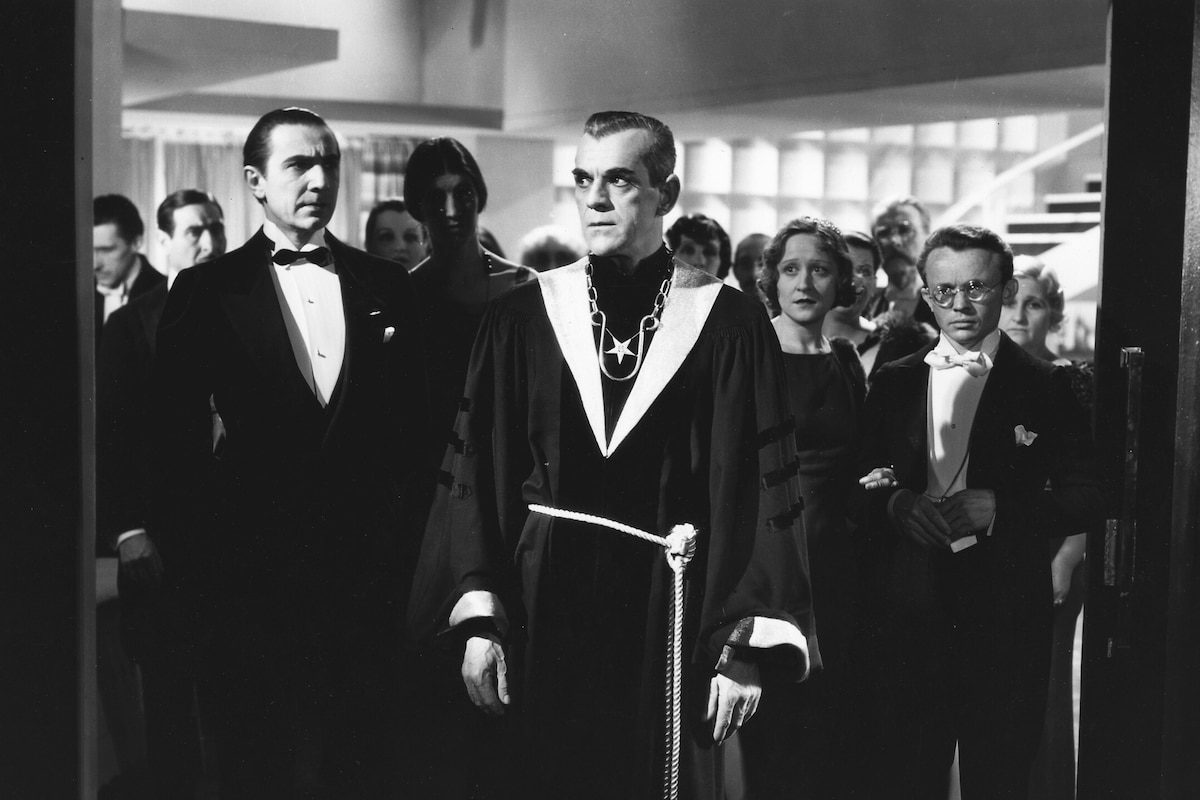
in a sleek mansion of glass bricks, a stainless-steel staircase, chrome
fixtures and neon lights. "It was very much out of my Bauhaus period,"
Ulmer dryly explained.
As a production designer, The Black Cat is Ulmer's greatest
achievement. Poelzig's castle is a masterpiece of 1930s Deco architecture,
designed to mirror the icy detachment and steely demeanor of its lord. The
Karloff character was named in tribute to one of Ulmer's architectural
mentors, Hans Poelzig, who supervised Ulmer's work on The Golem. To
a degree, Karloff's performance was also governed by Ulmer's
ultra-modernist vision. Gowned in silky black robes, his hair combed and
shaved into sharp angles, he moves stiffly, almost robotically through the
gleaming halls. When the character is first introduced, lying in bed with
his unconscious bride, the script indicates, "the upper part of a man's
body rises slowly, as if pulled by wires, to a sitting position." Karloff
scoffed at this mechanical approach to performance. "Aren't you ashamed to
do a thing like that," he asked Ulmer, "that has nothing to do with
acting?" Ulmer persisted and as a result Karloff gives one of the most
understated yet unsettling performances of his career.
Lugosi, meanwhile, occupied the opposite extreme, having a tendency to
overact that was only exaggerated by his thick Hungarian accent. Ulmer
cleverly moderated Lugosi's performance by limiting his screen time,
focusing more on reaction shots of other characters. "You had to cut away
from Lugosi continuously," Ulmer said, "to cut him down."
Supporting actor David Manners was another Universal horror veteran, though
one of a lower profile. Manners had played the straight man in such
cornerstone shockers as Tod Browning's Dracula and Karl Freund's
The Mummy (1932), and reprised his role as the handsome young man
trying to protect his bride from evil incarnate.
The Black Cat was produced shortly before the Production Code
tightened its reins on the motion picture industry, at a time when clever
filmmakers could still weave a surprising amount of adult material into a
film if they exercised a subtle touch. Even under these somewhat liberal
circumstances, it is mind-boggling how many diabolical flourishes Ulmer
heaped into this mere 65-minute film. The film climaxes as a group of
worshipers arrive at Poelzig's castle to participate in a black mass during
which Joan is to be sacrificed on an altar of Satan. Interrupting the
proceedings, Verdegast lashes Poelzig to his own torture rack and skins him
alive with a small knife.
When the first cut of The Black Cat was screened for the Laemmles
(studio head Carl Sr. and producer Carl Jr.), they were shocked by the
horrors Ulmer had created. Lugosi, meanwhile, expressed angry
disappointment to find that once again he was playing a villainous
character, exhibiting some of the same murderous and lustful urges of the
evil Poelzig. Ulmer grudgingly agreed to reshoot certain scenes,
downplaying the brutality of the "skinned alive" sequence, and making
Verdegast more of a protector of Joan's virtue than a threat to it. Rather
than being discouraged and bitter by the imposed changes, the crafty Ulmer
took advantage of the extended shooting schedule to add a few new scenes,
including the film's most perverse sequence. In the underground dungeon --
the stony depths of the old Fort Marmaros -- Poelzig leads Verdegast on a
tour of his trophies: a series of beautiful women, dead, embalmed,
exquisitely posed in glass display cases. It was never obvious to the
studio brass, but in addition to being a sadist and Satanist, Poelzig was
also a necrophile.
Upon its release, The Black Cat turned out to be the highly
profitable "sure thing" Ulmer had promised. One would expect the director
to be generously rewarded for his efforts but the film instead almost ended
his career -- but not for reasons that are readily apparent. His script
assistant on the set was Shirley Castle Alexander, who was married to one of
Laemmle, Sr.'s favorite nephews, Max Alexander. Ulmer and the script girl
fell in love during production and Shirley soon left her husband for the
mysterious and intellectual filmmaker. When Edgar and Shirley were
married, they had no choice but leave Hollywood, where Ulmer felt he would
be professionally blackballed. They moved to New York and began a career
making independent features on extremely small budgets, including Yiddish
films (Green Fields, 1937), a black cast film (Moon Over Harlem, 1939), a film for Ukrainian immigrants (Cossacks in Exile, 1939) and melodramas (Girls in Chains, 1943). Banished to a B-movie purgatory of low-end studios, laboring under financially
restrictive circumstances, Ulmer still managed to flourish artistically,
savoring the freedom to experiment that the studio system seldom
allowed.
Producer: Carl Laemmle, Jr.
Director: Edgar G. Ulmer
Screenplay: Peter Ruric, "Suggested by" the story by Edgar Allan Poe
Cinematography: John Mescall
Production Design: Edgar G. Ulmer
Music Supervisor: Heinz Roemheld
Principal Cast: Boris Karloff (Hjalmar Poelzig), Bela Lugosi (Vitus Verdegast), David
Manners (Peter Alison), Jacqueline Wells (Joan Alison), Harry Cording
(Thamal).
BW-66m.
by Bret Wood
The Black Cat (1934) - The Black Cat (1934)
by Bret Wood | September 26, 2003
SIGN UP FOR OUR NEWSLETTERS

CONNECT WITH TCM