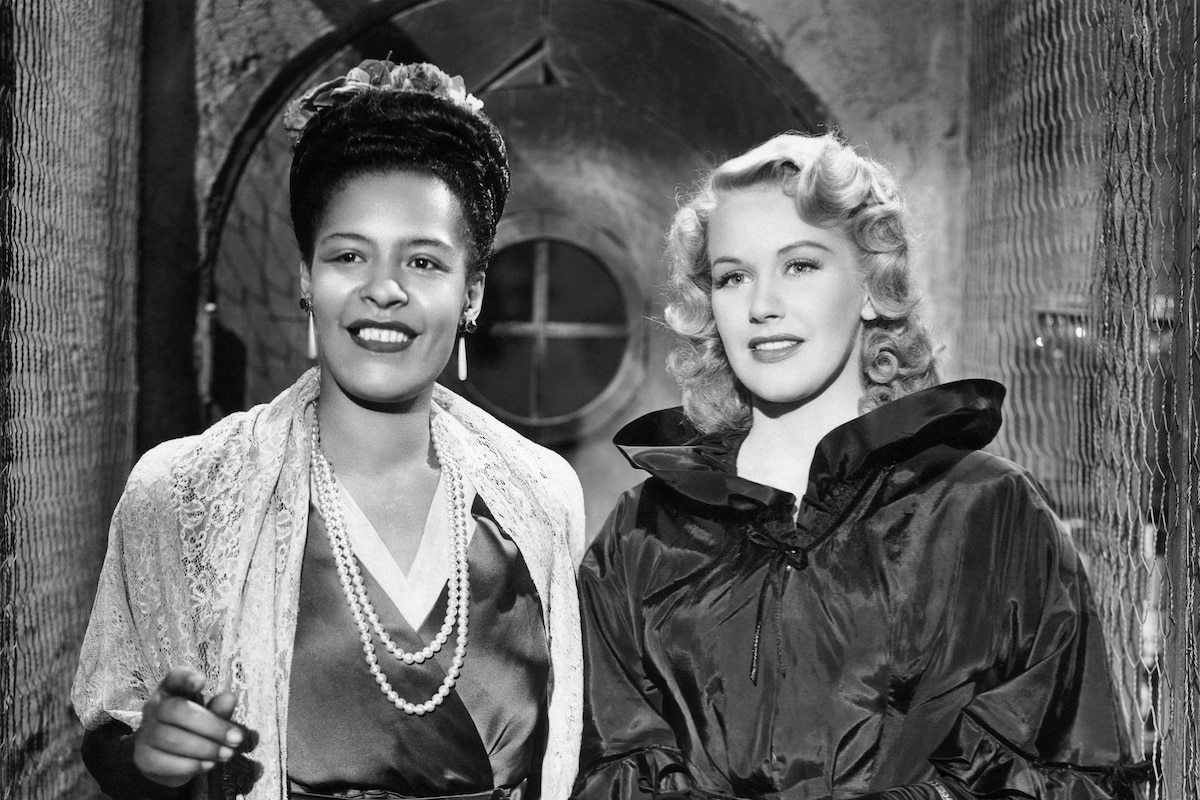
How's this for a dynamite screen team - Billie Holiday and Louis Armstrong? They appear together and separately in New Orleans (1947), a fictitious love story set during the end of the Golden Age of jazz circa 1917 - the year Storyville ceased to be the Crescent City's hot spot. Unfortunately, Holiday and Armstrong are not the stars. Those duties fall to Dorothy Patrick as a high-society girl and Arturo de Cordova as the man of her dreams, a jazz connoisseur who just happens to own the most elegant casino on Basin Street. Their love affair encounters major resistance from Patrick's class-conscious parents who disapprove of their daughter's enthusiasm for the emerging music scene on the poor side of town. In one of the more outlandish plot turns, history is rewritten to add a little drama to the romance - Patrick's mother uses her political connections to shut down Storyville and force de Cordova to close his cabaret.
More interesting for what it could have been instead of what it is, New Orleans started off as a starring vehicle for Holiday and Armstrong, cast as jazz artists who leave the south to seek their musical fortunes elsewhere. Through each new rewrite of the script, however, their parts became less and less prominent until they were finally reduced to secondary characters while a new storyline was fashioned around a romance between a white opera singer and a white club owner known as the "King of Basin Street." Typical of Hollywood's treatment of many black entertainers during this era, this "new, improved" version of New Orleans was obviously based solely on box-office considerations; the studio was afraid southern theater owners wouldn't book the film with black actors in the leads, but it was also true that the largest majority of moviegoers in America at that time were white and not that interested in black culture or jazz musicians.
In an ironic twist of fate, Billie Holiday, who had managed to avoid domestic service - the only work available to most black women - for most of her life, now found herself cast as a servant. According to Donald Clarke in his biography, Wishing on the Moon: The Life and Times of Billie Holiday, she didn't want to turn down an opportunity to appear in a motion picture and told composer/journalist Leonard Feather, "I'll be playing a maid, but she's really a cute maid." Once production began, Holiday created a few problems on the set due to her frequent tardiness, but the studio musicians didn't mind since they were getting paid for any overtime. Leading lady Dorothy Patrick also reportedly complained to Arthur Lubin that Holiday was a shameless scene-stealer. The director, however, recognized Lady Day's genuine artistry and later commented that Holiday made Dorothy Patrick look like "a hole in the screen." To demonstrate Lubin's point, just compare Holiday's rendition of "Do You Know What It Means to Miss New Orleans" with Ms. Patrick's performance of the number.
Yet, while Holiday shines in her brief scenes in New Orleans, the film provides a much more prominent showcase for Louis Armstrong, who had already appeared in ten feature films prior to this (Holiday only made one previous film short, Symphony in Black, 1935). It's a rare opportunity to see the real "King of Basin Street," strutting his stuff alongside another New Orleans jazz legend - Kid "Ory" - while performing some of that city's most famous and representative songs - "New Orleans Stomp" (written by Joe "King" Oliver), "Buddy Bolden's Blues" (written by Jelly Roll Morton), "West End Blues," "Shim-Me-Sha-Wabble," "Basin Street Blues," and many more. Armstrong's duet with Holiday on "The Blues Are Brewin'," though, might be the showstopper.
As an attempt to tell the history of jazz through a love story that spans forty years, New Orleans is a laughable failure. But as a visual and aural record of two of the most influential musical talents in the history of jazz, the film is a must-see. Jazz aficionados will also enjoy spotting other legendary musicians in the background - Woody Herman and His Orchestra, Barney Bigard, Russell Moore, Charlie Beal, Zutty Singleton, and Lucky Thompson to name a few. And, yes, that is Shelley Winters in a minor role playing Arturo de Cordova's secretary.
Producer: Jules Levy
Director: Arthur Lubin
Screenplay: Herbert Biberman, Dick I. Hyland
Art Direction: Rudi Field
Cinematography: Lucien N. Andriot
Film Editing: Bernard W. Burton
Principal Cast: Dorothy Patrick (Miralee Smith), Arturo de Cordova (Nick Duquesne), John Alexander (Col. McArdle), Irene Rich (Mrs. Smith), Louis Armstrong (Himself), Marjorie Lord (Grace Volselle), Billie Holiday (Endie).
BW-90m.
by Jeff Stafford
New Orleans
by Jeff Stafford | January 16, 2003
SIGN UP FOR OUR NEWSLETTERS

CONNECT WITH TCM