It is one of Hollywood's most revered myths-the talented yet undiscovered starlet from some
flyover backwater, desperate to make it big in the city. Forget American Idol, this stuff
goes all the way back to the dawn of mass media. You could be forgiven for wondering which
was more numerous: the wanna-be stars or the movies made about them.
One of the earliest strains of the form came in the charming 1926 comedy Ella
Cinders starring Colleen Moore. She wins a contest that sends her off to Hollywood for a big
break, only to discover to her heartbreak that the competition was a sham and she is now lost and
alone in LA. Moore finds laughs in the material, but in 1926 there was a brewing scandal in the
industry about the hapless young girls who washed into town because of phony prizes only to be
forced into prostitution to pay the bills.
This then is the ugly underbelly of the great Hollywood myth: for every star that is
discovered there are countless others who are not. The line between using one's beauty and
body to entertain strangers for money and exploiting one's beauty and body to sexually gratify
strangers for money is thin enough to be easily blurred. In MGM's 1933 feature Dancing
Lady, a ravishingly young Joan Crawford plays a dancer whose struggle to find meaningful
and artistically valid employment obliges her to perform half-nude in burlesque houses along the
way (an idea repeated in Peter Jackson's remake of King Kong).
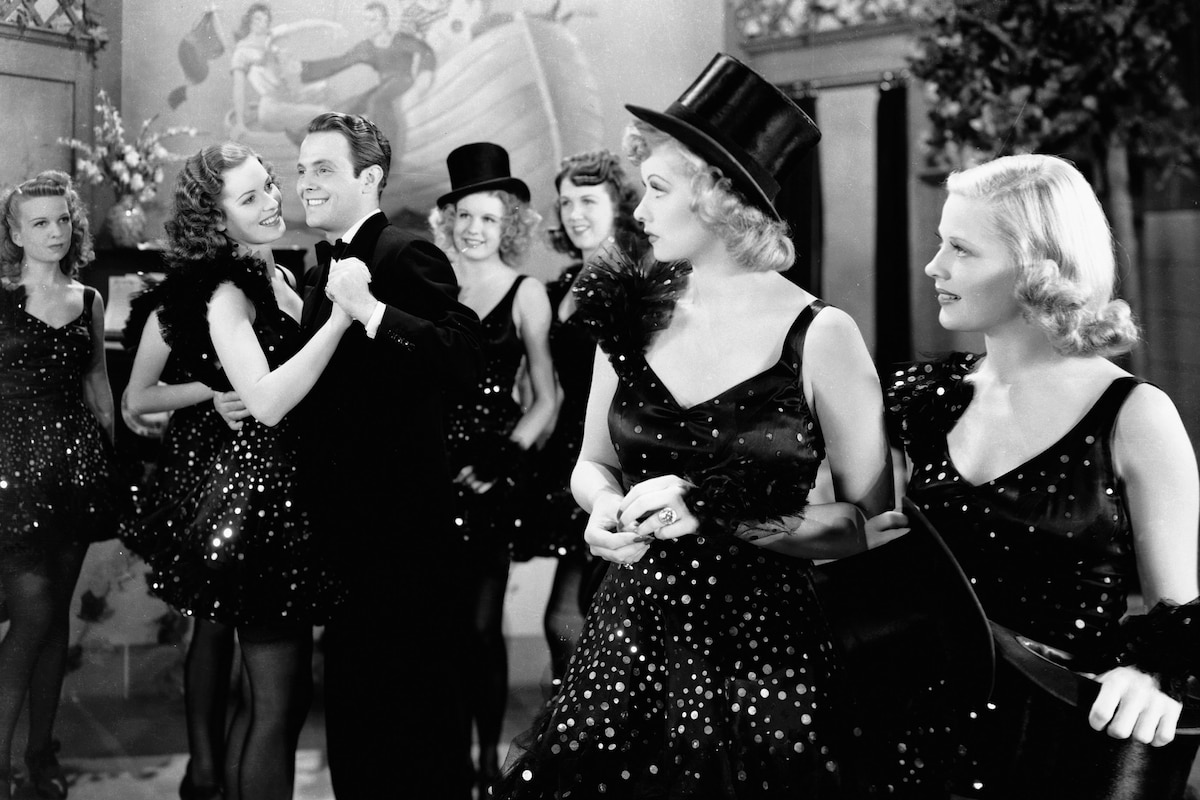
The 1940 RKO romantic comedy Dance, Girl, Dance wades in the same pool,
but with its own distinctive voice. Roommates Judy and Bubbles are aspiring dancers who ply
their trade anywhere their intrepid manager (Maria Ouspenskaya) can finagle them a gig. Judy
(top-billed Maureen O'Hara) is a serious artist with some genuine god-given ability and a
schoolmarm's personality that works against her own interests. By stark contrast, her friend and
rival Bubbles (played by the brilliant Lucille Ball more than ten years before making TV history)
has little more than moxie, but when it comes to shaking her booty she does it with a wild
abandon that Judy could never muster. Bubbles gets the breaks, and quickly makes a name for
herself-as a top stripper!
Say what you will about the respectability of Bubbles' career-erm, sorry, she's now
called Tiger Lily White-at least she lives well and on her own terms, while Judy faces despair
and ruin. Judy takes a humiliating job as Tiger Lily's stooge, interrupting the striptease routine
with some highbrow ballet intended to rile the audience into heckling her offstage.
In taking the job as Tiger Lily's stooge, Judy has to retreat emotionally into herself.
Whatever artistic value her dancing has is (as far as she knows) recognized only by her, and earns
her nothing but ridicule and hostility from her audience. Yet it also brings her money, stability,
even some fame-and creates opportunities that her previous career path could not. For all the
film does to plod through the shopworn story beats of the Star is Born paradigm, this
question of Judy's career choices and what they mean is the true meat of the movie.
All this, and a Lucy striptease too-the girl has moves! Tiger Lily is a savvy
businesswoman in a film full of sharp women, turning her liabilities into strengths as she shores
up an entertainment empire, much as the real-life Lucy would do over the next four decades.
Both Tiger Lily and Judy are insecure, frightened girls, who conceal their self-doubt
inside an increasingly brittle shell of cynicism. Over the course of the film, both women become
alarmingly harsh, until all their pent-up aggression is unleashed in a violent catfight, and a
chilling screed by Judy as she attacks her own fans. Dance, Girl, Dance winds itself up in
a somewhat bland courtroom denouement, but after such riveting drama before hand, a softball
ending is almost welcome.
The DVD box thoughtfully signals that this underrated treat comes courtesy of one of the
only woman filmmaker in classical Hollywood, Ms. Dorothy Arzner. Actually, the box says she
was the only one, but Ida Lupino fans may beg to differ. Nevertheless, Arzner's womanly insight
combines with her two strong stars, Maureen O'Hara and Lucille Ball, to give an overused story
setup some remarkably fresh air. The male leads are no slouches either: Ralph Bellamy plays a
dance maestro honestly scouting Judy for her talent, while the always fun Louis Hayward plays a
drunken philandering rich reprobate.
There are lots of movies about young talents yearning for their big break, few have this
much kick in the bottle. Warner Brothers is packaging this with other early Lucy Ball films, which
might confuse some buyers into expecting more Lucy than you actually get here. As is common
with Warner's classic releases, they pair Dance, Girl, Dance with a vintage Vitaphone
comedy short and a Looney Tunes cartoon. Neither is germane to the main feature, but both are
more than welcome besides.
For more information about Dance, Girl, Dance, visit Warner Video.
To order Dance, Girl, Dance, go to
TCM Shopping.
by David Kalat
Dance, Girl, Dance - Maureen O'Hara & Lucille Ball in DANCE, GIRL, DANCE on DVD
by David Kalat | June 28, 2007
SIGN UP FOR OUR NEWSLETTERS

CONNECT WITH TCM