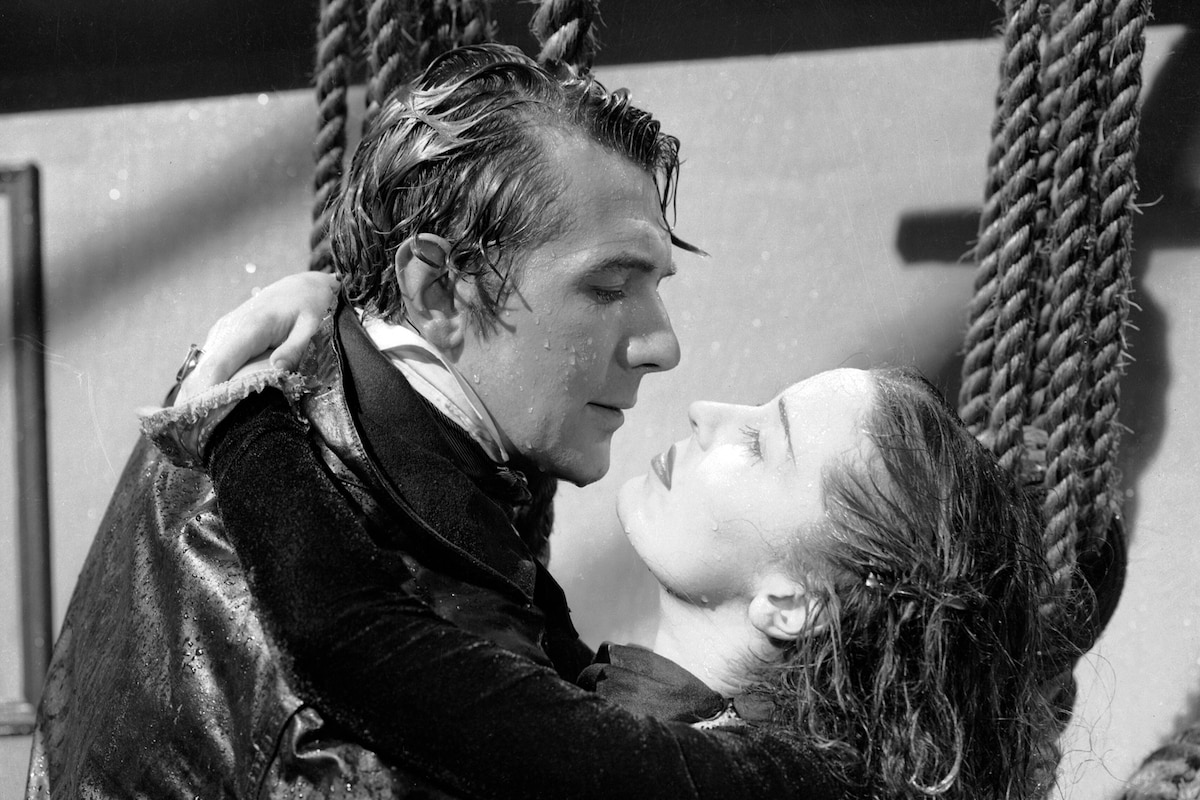
Sons of the Sea (1941) tells the story of David and Charles MacIver, two Scottish brothers who became pioneers in the steamship industry. Produced by Warner Brothers-First National/Teddington Studios in Britain, the film was released in the U.K. under the title Atlantic Ferry. The film is a classic case of fact vs. fiction, with questions arising about the accuracy of its depiction of actual events. Some sources suggest that one brother, Charles, was invented for purely dramatic purposes. Yet the movie is based on a story by Derek and Wynne MacIver, descendants of the shipping family, who would surely have known what truly happened. In any case, most accounts do agree on David MacIver's role in events.
In 1838, David MacIver, Canadian shipping magnate Samuel Cunard, and several other businessmen formed the British and North American Royal Mail Steam Packet Company. A few years later, the company won a bid on mail service between England and the United States. The success of mail transport quickly led to transatlantic passenger and cargo service. And as portrayed in the film, one of the company's first steamships, called Britannia, did sail from Liverpool to Boston in 1840. The company would later change its name to Cunard and dominate Atlantic passenger service for decades. Cunard is still operating today (though the company is now part of the Carnival Corporation). Among the famed ships in its fleet are the soon-to-be-retired Queen Elizabeth 2, the massive Queen Mary 2 launched in 2004 and the Queen Victoria due to set sail in December 2007. Not a bad legacy for a company that set out to deliver mail.
In Sons of the Sea, the brothers MacIver are played by Michael Redgrave (as Charles) and Griffith Jones (David). Redgrave, father of actresses Vanessa and Lynn, had already found stardom in Hitchcock's The Lady Vanishes (1938). He would go on to a distinguished career in films like The Importance of Being Earnest (1952) and The Loneliness of the Long Distance Runner (1962). Redgrave would also receive an Oscar nomination as Best Actor for Mourning Becomes Electra (1947). Griffith Jones found greater success on stage than in the movies. After attending the Royal Academy of Dramatic Arts, he appeared in London productions such as Lady Windermere's Fan alongside John Gielgud and the Noel Coward play Quadrille opposite Alfred Lunt and Lynn Fontanne. Jones' movie career included a turn as Robert Taylor's rival in A Yank at Oxford (1938) and he played love interest to mermaid Glynis Johns in Miranda (1948). Jones rounded out his career with an impressive 25-year run with the Royal Shakespeare Company.
Redgrave and Jones find themselves in competition not only over business, in Sons of the Sea, but also for the affections of Valerie Hobson. She plays the daughter of a potential backer in the film. Hobson had been signed to a contract by Universal in 1934 when she was just 17-years old. She appeared in a number of films for the studio in a short time, including The Bride of Frankenstein and Werewolf of London (both 1935), before returning to England in 1936. Hobson continued working in the British cinema, in films like Ealing's Kind Hearts and Coronets (1949), until 1954 when she married future scandal-plagued Minister of War John Profumo.
Another Sons of the Sea contributor worth noting is screenwriter Emeric Pressburger. Pressburger, half of Britain's critically lauded filmmaking team of Powell & Pressburger, began his writing career in Germany in the early 1930s. He had just five English screenplays to his credit at the time he co-wrote Sons of the Sea.
Finally, it's helpful to place Sons of the Sea in the proper historical context. The film was made at a time when England was suffering under the German Blitz and was urging the U.S. to enter the war. Given the circumstances of the day, it's no wonder Sons of the Sea unabashedly sings the praises of friendship between the U.S. and Britain. The film ends with one such speech, with Cunard, over newsreel footage of the launch of the Queen Elizabeth, saying, "I see that white wave churned by the paddles of the Britannia being a well trodden highway and over it the peoples of America and Britain mixing into one fellowship. Their disputes settled as among friends and their united determination opposing any challenge to human liberty or freedom whenever and wherever it is made."
The film's flag-waving likely played well on both sides of the Atlantic. Sons of the Sea would be released in America on February 7, 1942, just two months after the attack on Pearl Harbor and the subsequent U.S. entry into the war.
Producer: Culley Forde, Max Milder
Director: Walter Forde
Screenplay: Derek MacIver (story), Wynne MacIver (story), Gordon Wellesley, Edward Dryhurst, Emeric Pressburger
Cinematography: Basil Emmott
Film Editing: Terence Fisher
Art Direction: Norman Arnold
Music: Jack Beaver
Cast: Michael Redgrave (Charles MacIver), Valerie Hobson (Mary Ann Morison), Griffith Jones (David MacIver), Hartley Power (Samuel Cunard), Margaretta Scott (Susan Donaldson), Bessie Love (Begonia Baggot).
BW-91m.
by Stephanie Thames
Sons of the Sea
by Stephanie Thames | June 25, 2007
SIGN UP FOR OUR NEWSLETTERS

CONNECT WITH TCM