Director Andre De Toth once said, "I saw Crime Wave (1954) as a snake sliding
through the night; a small snake with saliva, wanting to swallow big things as it slithers
through the gutter of the night of crime... Since the day I started to make pictures, I wanted
to shoot one like Crime Wave... I wanted the viewer not only to eavesdrop on life,
but to live it as it was happening. There is a big difference, in emotional involvement,
between watching from the safety of the shore a man swept away by a raging torrent, and
being in that torrent."
Crime Wave, now available as one of the ten titles in Warner Home Entertainment's
new Film Noir Classic Collection, Vol. 4, is tough, gritty and first-rate, largely because
of De Toth's ability to achieve the realistic effect he described. He shot the picture in 13 days
entirely on L.A. locations (mostly the Glendale area), using natural light and on-location
sound wherever possible. There's even some handheld camerawork thrown in, which feels
visceral instead of showy. For one scene, De Toth efficiently uses only a telephone and two
hands (along with off-screen voices) to convey the action. There is not one ounce of fat in
the finished product.
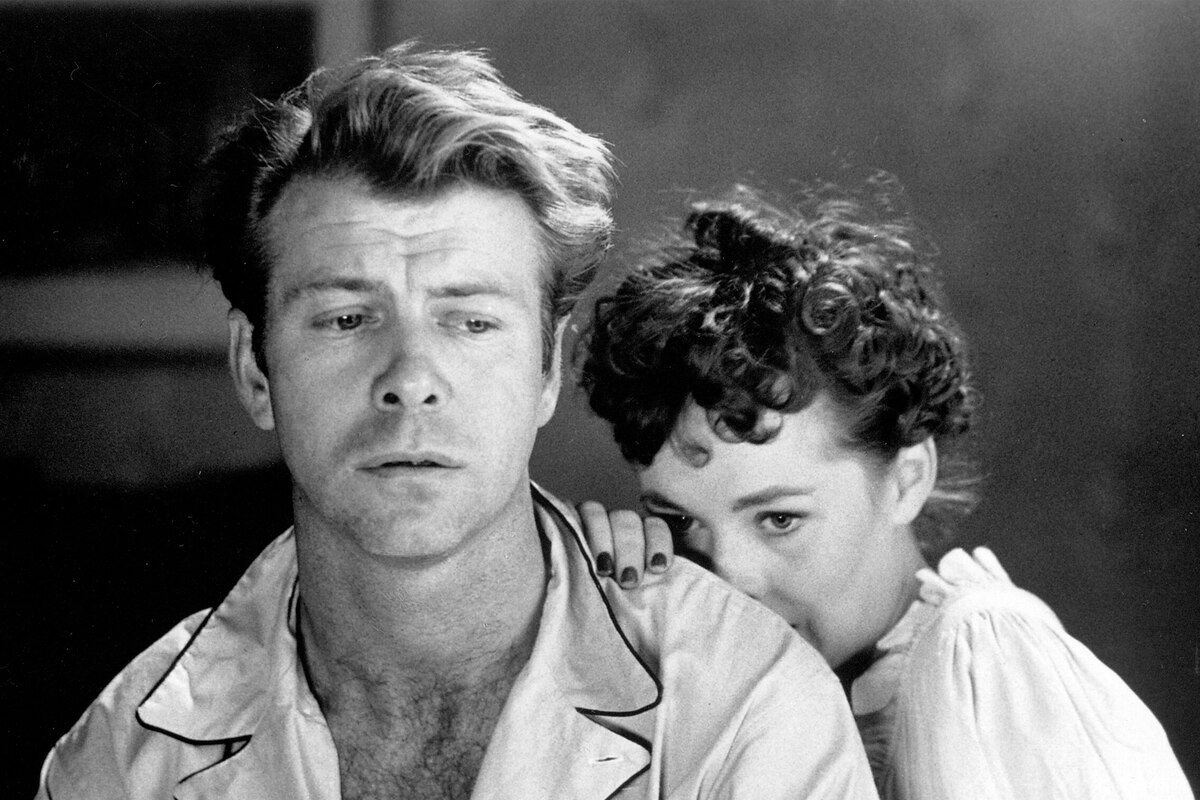
The movie tells a simple story. A gang of hoodlums holds up a gas station one dark night,
but things go awry and a shootout leaves a cop dead and one bad guy (Nedrick Young)
wounded. Young splits from his cohorts and finds his way to the nearby apartment of Gene
Nelson, a parolee and old prison-buddy who is now married to Phyllis Kirk and trying to lead
a straight-arrow life. Of course, this being a film noir, Nelson finds himself getting sucked
into the lives of his shady friends against his wishes. Eventually he is wanted for murder and
chased through the city by police detective Sterling Hayden, in one of his best, most
scowling performances.
Standard stuff this may be, but De Toth really elevates it into something special. The
locations add hugely to the yarn's immediacy. For a climactic sequence in a Bank of
America branch, De Toth got permission to shoot in a real one for one night only, and he
made the most of it. The opening gas station shootout, filmed in downtown L.A., is
straightforward and shocking - superbly staged in every way. Despite its quick shooting
schedule, Crime Wave looks quite beautiful, with deep blacks, crisp shadows and
carefully framed compositions well-served by the fine DVD transfer. De Toth's
cinematographer was the ace Bert Glennon, whose credits also included Rio Grande
(1950), They Died With Their Boots On (1941), Stagecoach (1939), Blonde
Venus (1932) and many other all-time classics.
Toothpick-chewing Sterling Hayden may be terrific in Crime Wave, but Nelson and
Kirk also turn in excellent, sensitive performances, and Charles Bronson (billed as Charles
Buchinsky) steals his scenes as one of the bad guys. Tim Carey, perhaps the best-ever player
of movie psychos, plays one here, as another of the crooks. The aforementioned Nedrick
Young was also a screenwriter who happens to have written the script for the other
film noir sharing this disc: Decoy (1946). Young was a fine writer whose career was
badly affected when he was blacklisted. Eddie Muller, on his commentary track, fills in the
details and provides his usual interesting points on this film. Joining in the conversation is a
jokey James Ellroy; between the two of them, they're able to identify just about all the
locations used in Crime Wave - no small feat! Also on the disc is a trailer and a
brief featurette including filmmakers, critics, and De Toth himself (from an archival
interview) discussing the film.
For more information about Crime Wave, visit Warner Video.
To order Crime Wave, go to
TCM Shopping.
by Jeremy Arnold
Crime Wave - Sterling Hayden & Charles Bronson in CRIME WAVE on DVD
by Jeremy Arnold | May 01, 2007
SIGN UP FOR OUR NEWSLETTERS

CONNECT WITH TCM