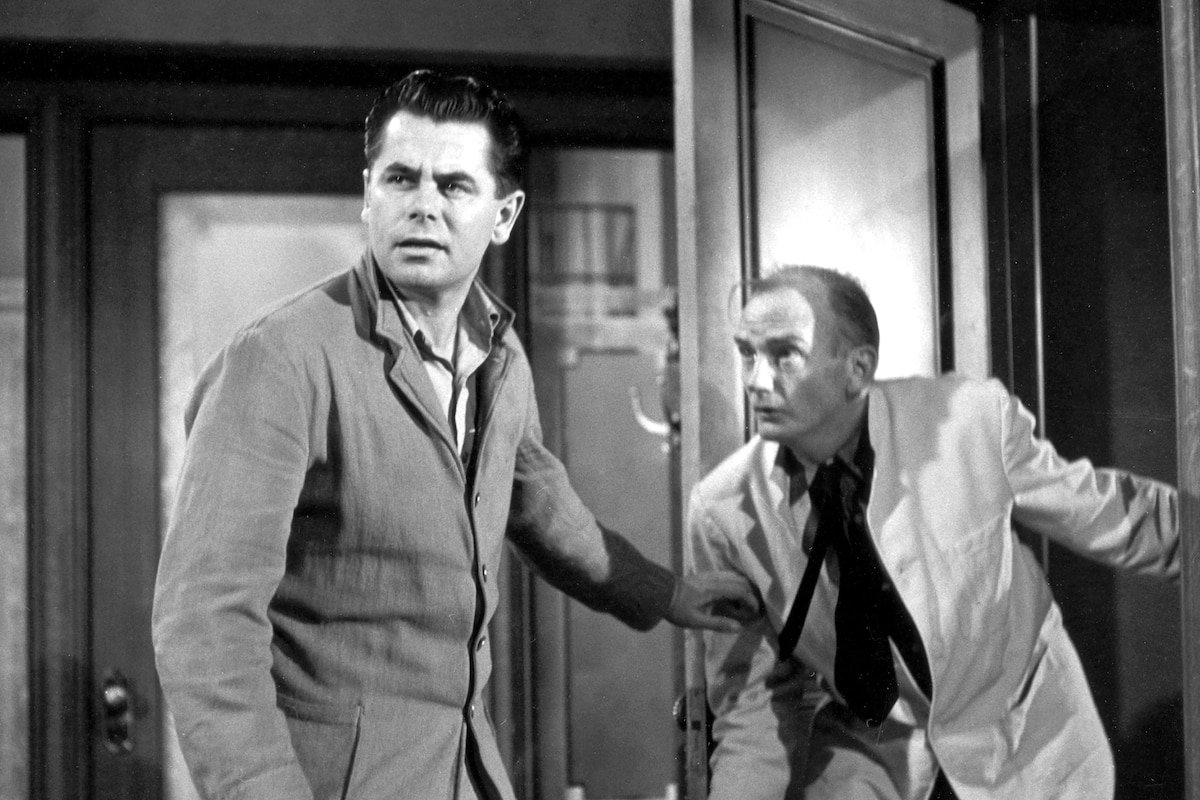
One of the few films to present a positive portrayal of a prison warden, the incarceration drama Convicted opened in 1950 during a wave of jailhouse films following the classic Brute Force in 1947. American everyman Glenn Ford stars as Joe Hufford, who's sent up the river following his dubious conviction for the nightclub death of a bigwig politician's son. Life in the big house proves tough on Joe, who decides to join in an ill-fated breakout attempt rigged by a loathsome stool pigeon, Ponti (Frank Faylen). Fortunately a scuffle with one of the guards lands Joe in solitary, allowing him to dodge the grim fate of his co-conspirators. Soon Joe develops a rapport with the new warden, George Knowland (Broderick Crawford), the former D.A. on his case whose daughter Kay (Dorothy Malone) also takes an interest in the prisoner.
Based on a popular 1929 play by Pulitzer Prize winner Martin Flavin, the basic story of Convicted was already a familiar one thanks to past screen versions in 1931 (by Howard Hawks as The Criminal Code, featuring the first big role for Boris Karloff) and again in 1938 (John Brahm's more obscure Penitentiary), plus alternate Spanish and French versions prepared in 1932 (Criminel and El codigo penal). The complicated set-up for Ford's character essentially boils down to his decision whether to adhere to the prison "code of silence," which requires a man to never snitch on another inmate even if he himself is set to take the punishment. While the prior versions were almost entirely concerned with this moral quandary and fit the template of pre-code crime films popularized by the likes of James Cagney, Convicted instead betrays the influence of film noir with its dank and shadowy visuals courtesy of director-for-hire Henry Levin and inventive cinematographer Burnett Guffey, a maestro of monochromatic imagery whose credits ranged from the masterful thriller My Name Is Julia Ross (1945) to major studio work with All the King's Men (1949), Nicholas Ray's In a Lonely Place (1950), From Here to Eternity (1953), and fascinating late-period noirs like Scandal Sheet and The Sniper (both 1952), The Strange One (1957), and Screaming Mimi (1958). Not surprisingly, he remained in demand until his retirement in 1971 and earned two Academy Awards, working on projects as diverse as Bonnie and Clyde (1967), Birdman of Alcatraz (1962), the wildly underappreciated How to Succeed in Business without Really Trying (1967), and even two 1961 assignments with cult favorite William Castle, Homicidal and Mr. Sardonicus.
Of course, the biggest commercial draw of Convicted was the opportunity to see the first teaming of all-American box office draws Glenn Ford and Broderick Crawford, who clicked so well they reunited again for Fritz Lang's 1954 noir, Human Desire, and the oddball 1956 western, The Fastest Gun Alive. A solid leading man since the World War II era riding high from his pair of 1946 hits, Gilda and A Stolen Life, Ford became an archetypal "American dad" type in a number of popular westerns, thrillers, and dramas, remaining busy well into the 1990s. Meanwhile Crawford had cultivated a more weather-beaten, take-no-guff persona able to deliver tricky and fast-paced dialogue. His smash stage success in Of Mice and Men in 1937 quickly translated to a film career peaking with an Academy Award as Best Actor for the aforementioned All the King's Men. In 1950 he also reversed audience expectations with his hilarious turn in Born Yesterday, solidifying a professional reputation he parlayed into many films, television programs and radio plays for the next four decades.
Among the colorful supporting cast featuring such familiar faces as Will Geer (later famous as Grandpa on The Waltons), Ed Begley and Whit Bissell, the showiest moments go to rising star Dorothy Malone, who was just beginning to prove herself as leading lady material. However, she wouldn't reach full mainstream acceptance until she earned an Oscar for mamboing her way into screen immortality in Douglas Sirk's immortal soap masterpiece, Written on the Wind (1956), a definite step up from the prior year's trauma of appearing as Liberace's love interest in Sincerely Yours. Malone teamed with Sirk again in 1958 for another satisfying heavy-breathing opus, The Tarnished Angels, but her film career soon fizzled out after a handful of memorable turns in the same year's trashy camp classic, Too Much, Too Soon, and 1960's much-neglected disaster epic, The Last Voyage. A life-threatening illness during her tenure on the 1960s soap opera Peyton Place and a subsequent lawsuit against the producers and studio further hampered any major future projects, though she did continue to pop up occasionally in TV guest star roles and eccentric exploitation films (The Day Time Ended [1980], The Being [1983]).
In an odd side note, a third name on this film carried over from All the King's Men: rising composer George Duning, one of the three uncredited composers on that film. His work was impressive enough to earn him solo scoring duties on Convicted, and his atmospheric work confirmed his promise with Columbia executives enough to propel him to the big time with two other films mentioned above, From Here to Eternity and Scandal Sheet, which earned enough prestige to keep him busy turning out melodies for all the major studios well into the 1980s.
Producer: Jerry Bresler
Director: Henry Levin
Screenplay: William Bowers, Seton I. Miller, Fred Niblo, Jr., Martin Flavin (play)
Cinematography: Burnett Guffey
Film Editing: Al Clark
Art Direction: Carl Anderson
Music: George Duning
Cast: Glenn Ford (Joe Hufford), Broderick Crawford (George Knowland), Millard Mitchell (Malloby), Dorothy Malone (Kay Knowland), Carl Benton Reid (Captain Douglas), Frank Faylen (Ponti).
BW-91m.
by Nathaniel Thompson
Convicted (1950)
by Nathaniel Thompson | April 17, 2007
SIGN UP FOR OUR NEWSLETTERS

CONNECT WITH TCM