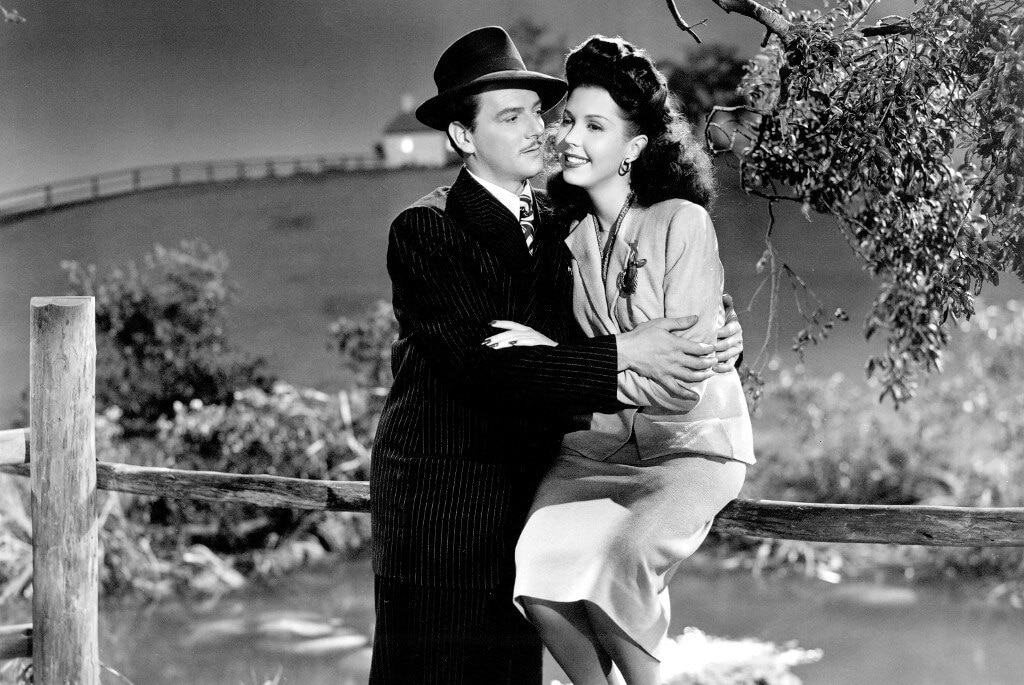
Eve Knew Her Apples (1945) was Columbia's first attempt to remake its seminal screwball hit It Happened One Night (1934) as a musical. The film took a streamlined approach to the story in its 64-minute running time whereas the original had clocked in at 105 minutes. Ann Miller takes on the Claudette Colbert role in Eve Knew Her Apples and this time, instead of an heiress, Miller plays a runaway radio star named Eve. Columbia contract man William Wright steps into Clark Gable's shoes to play the reporter looking for a scoop. The film also features four songs performed by Ann Miller "An Hour Never Passes," "I'll Remember April," "I've Waited a Lifetime" and "Someone to Love." Eve Knew Her Apples was an unusual film for Miller for the simple fact that she sings but NEVER dances in the movie.
Ann Miller is best known for her late '40s and '50s MGM musicals such as On the Town (1949) and Kiss Me Kate (1953). But Miller actually got her Hollywood start under contract at RKO, where she appeared in pictures like New Faces of 1937 (1937), Stage Door (1937) and Radio City Revels (1938). After a brief stint in New York, where she appeared in George White's Scandals of 1939, Miller returned to Hollywood and was signed to a 7-year contract with Columbia. Between 1941 and 1946, she made ten movies for the studio all of them musical. Some of the more memorable titles include: Go West, Young Lady (1941), Reveille with Beverly (1943) and Carolina Blues (1944).
Miller made just one more film for Columbia after Eve Knew Her Apples, retiring from the screen to get married. Columbia chief Harry Cohn (who Miller respected despite his infamous reputation) sued her for breaking her contract. And two years later, after Miller's marriage failed, Cohn would not take her back. It ended up being Miller's big break her next film would be The Kissing Bandit (1948) which launched her MGM career.
Miller's leading man in Eve Knew Her Apples was William Wright. Miller and Wright had already made three films together; the first was True to the Army (1942) for Paramount. Miller's co-star in that film was Allan Jones and Wright was seventh billed. Then Miller and Wright were paired together for the first time in Reveille with Beverly in 1943 and starred opposite each other again in Eadie Was a Lady (1945). Wright spent the most productive years of his career at Columbia where he often appeared in supporting roles. He turned up in two Boston Blackie entries, Boston Blackie Goes Hollywood (1942), where Wright played the heavy, and One Mysterious Night (1944). Wright's other, more notable Columbia films include Murder in Times Square (1943), directed by Lew Landers; the Joe E. Brown comedy The Daring Young Man (1942); and the Budd Boetticher suspense film Escape in the Fog (1945), starring Nina Foch.
Wright would occasionally take smaller parts in bigger studio productions such as the atomic bomb drama The Beginning or the End (1947) where he appears much further down on the cast list. On the other hand, the low-budget studios of Hollywood's "Poverty Row" offered Wright the chance to play a number of starring roles. He played the lead in King of the Gamblers (1948) for Republic and starred opposite Erich von Stroheim in The Mask of Diijon (1946) for PRC. Wright even played the title role in another PRC production -- Philo Vance Returns (1947).
Columbia would make a second musical version of It Happened One Night in 1956 with You Can't Run Away from It. This time, the adaptation was more faithful to the original, down to detailed scene re-enactments. You Can't Run Away from It starred June Allyson and Jack Lemmon and was directed by Allyson's husband, Dick Powell.
Producer: Wallace MacDonald
Director: Will Jason
Screenplay: Eddie Moran, Rian James
Cinematography: Burnett Guffey
Film Editing: Jerome Thoms
Art Direction: Carl Anderson
Music: Gene de Paul, Jimmy Kennedy, Don Raye
Cast: Ann Miller (Eve Porter), William Wright (Ward Williams), Robert Williams (Steve Ormond), Ray Walker (George McGrew), Charles D. Brown (Joe Gordon), John Eldredge (Walter W. Walter II).
BW-64m.
by Stephanie Thames
Eve Knew Her Apples
by Stephanie Thames | April 17, 2007
SIGN UP FOR OUR NEWSLETTERS

CONNECT WITH TCM