True Confessions, the 1981 crime drama directed by Ulu Grosbard, is a movie
that had to happen. It's based on John Gregory Dunne's bestselling 1977 novel, one of
the rare modern mysteries to deserve real literary respect. The story was inspired by the
notorious Black Dahlia murder that made tabloid headlines in 1947 and still remains
unsolved. And it has a pair of fascinating main characters: two brothers whose
professions, policeman and priest, reflect different but complementary attitudes toward
evil, transgression, and sin.
The brothers are Tom Spellacy, a Los Angeles cop, and Des Spellacy, a Roman
Catholic priest. Their relationship is cordial but cool-each is surprised at how the other
turned out and skeptical of how the other deals with the cold, hard facts of contemporary
urban life. Along with family ties, they're linked by connections to Jack Amsterdam,
once a sleazy hoodlum and now a business tycoon who's despised by Tom because of
his hypocrisy but treated well by Des since he helps Catholic community projects in the
area. Further complications arise as Tom investigates the horrific murder of a young
woman named Lois Fazenda, who-like the victim of the actual Black Dahlia case-is
found in a gruesomely mutilated condition, her corpse cut in half at the waist. Also like
the real Black Dahlia victim, she becomes famous in the newspapers under a
posthumous nickname: the Virgin Tramp.
As he probes more deeply into the case, Tom finds that Lois was acquainted with his
own girlfriend, the proprietor of a cheap brothel where, it so happens, an errant priest
recently died. She also had links to Amsterdam, whose slimy tentacles reach almost
everywhere. Other players in the story include an aging monsignor on his way to forced
retirement in the middle of nowhere; a savvy old cardinal who places high value (perhaps
too high) on Des's skills as a wheeler-dealer; and Tom's partner Frank Crotty, a
hardened detective whose petty corruption doesn't cancel his determination to make bad
guys pay dearly for their wickedness.
Grosbard, a successful stage director, has helmed only seven films during his forty-year
screen career. But at his best, he shows an unsurpassed flair for eliciting superb
performances from his actors. (See the 1978 crime picture Straight Time and the
1995 music drama Georgia for excellent examples.) So it's no surprise that
True Confessions draws much of its dramatic power from its extraordinary
cast.
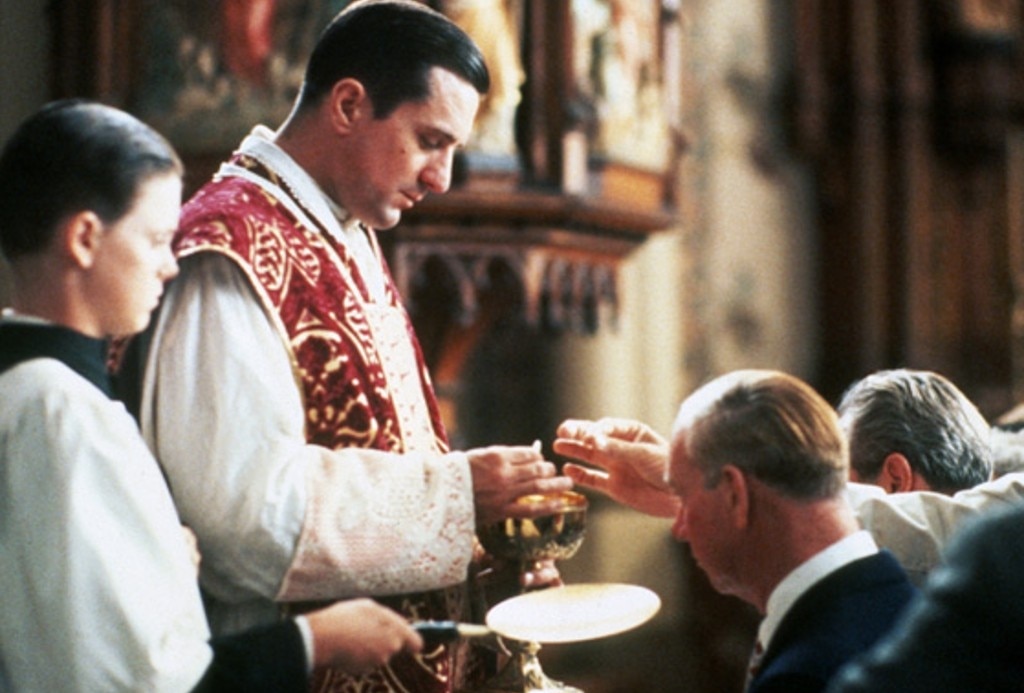
What is surprising is that Robert De Niro, arguably the most gifted movie actor of
his generation, gives one of his rare below-par performances under Grosbard's guidance;
he captures Des's solidity and steadfastness but has less success with the inner
contradictions that ultimately endanger Des's cherished career. This said, De Niro
remains captivating to watch even in his most understated mode; and at a few privileged
moments he comes close to unveiling the profound ambivalence that roils Des's
conflicted soul.
The great Robert Duvall is at his greatest playing Des's big brother Tom, whose
hard-working habits mask an unsavory past as a bagman for Amsterdam's illegal
payoffs. Although he knows how the law is supposed to work, he's more committed to
his idea of how it ought to work. Increasingly disgusted by Amsterdam's
arrogance, he embarrasses Des with public outbursts of rage and hate against the
crooked boss. At the same time he pursues the Virgin Tramp case wherever it may lead,
which turns out to be closer and closer to home.
Another high-caliber performance comes from Kenneth McMillan as Tom's partner
Crotty, whose blend of morbid humor and crusty cynicism plays beautifully off Tom's
versions of the same qualities. Applause also goes to Cyril Cusack as the cardinal;
Burgess Meredith as the old monsignor; Rose Gregorio as Tom's mistress; and
especially Charles Durning, who manages to humanize Amsterdam without making him
anything other than the nasty, hypocritical felon he is. In the technical area, top honors
go to cinematographer Owen Roizman for vividly conveying both the splendor of Catholic
ritual and the grittiness of LA's underworld.
The screenplay, by novelist Dunne and his wife Joan Didion, preserves the overall
structure of Dunne's book, beginning and ending with a reunion of Tom and Des years
after the Virgin Tramp case. Key lines of dialogue are also retained, although they're
sometimes moved around a bit. The picture has occasional slack moments, but on the
whole Grosbard and company keep its dramatic momentum pumping along.
Reviews of True Confessions have been all over the map. Vincent Canby of the New
York Times called it "one of the most entertaining, most intelligent and most
thoroughly satisfying commercial American films in a very long time," establishing
Grosbard as "a major American film maker." By contrast, Roger Ebert wrote in the
Chicago Sun-Times that although it "contains scenes that are just about as good
as scenes can be," the movie as a whole left him "disoriented and disappointed." I
similarly deemed it "a disappointing stab at...truly adult cinema" in my Christian
Science Monitor review, chiding it for "too little energy and too much sensationalism
around the edges." I hereby change my tune, though. The movie is more powerful today
than when it was new, including De Niro's acting, which now strikes me as less dully
monotonous than boldly minimalist.
Given the major talents who contributed to True Confessions, it's a shame that
MGM doesn't provide so much as a theatrical trailer to enhance the DVD edition. The
film itself looks fine, though, and the mostly superlative acting comes across with
undiminished oomph. Like the novel it's based on, Grosbard's film is an admirable
success, if not quite a total one.
For more information about True Confessions, visit MGM. To order True Confessions, go
to
TCM Shopping.
by David Sterritt
True Confessions - Robert De Niro & Robert Duvall in TRUE CONFESSIONS on DVD
by David Sterritt | April 16, 2007
SIGN UP FOR OUR NEWSLETTERS

CONNECT WITH TCM