The ads for the 1952 Western Montana Belle promised "Warm Lips...Hot Lead." They might also have mentioned cold feet, as the film was actually four years old when RKO Studios owner Howard Hughes finally put this fanciful tale of female outlaw Belle Star into release. The reason for the delay? The film starred his protégée Jane Russell, in only her fourth screen appearance, and Hughes wanted to give it special handling, which in this case meant holding it back from release until Russell had had a chance to establish herself as a screen star.
Hughes had discovered the sometime model and full-time doctor's receptionist when he was planning The Outlaw (1943), a sex-charged Western about Billy the Kid (Jack Buetel) and a fiery half-breed (Russell). While censorship problems, largely stemming from the photography of Russell's impressive figure, kept the film off screens for years, he kept Russell under contract to do basically nothing. In 1946, he started loaning her to other studios to keep her busy and keep publicity flowing for the still mostly unreleased The Outlaw.
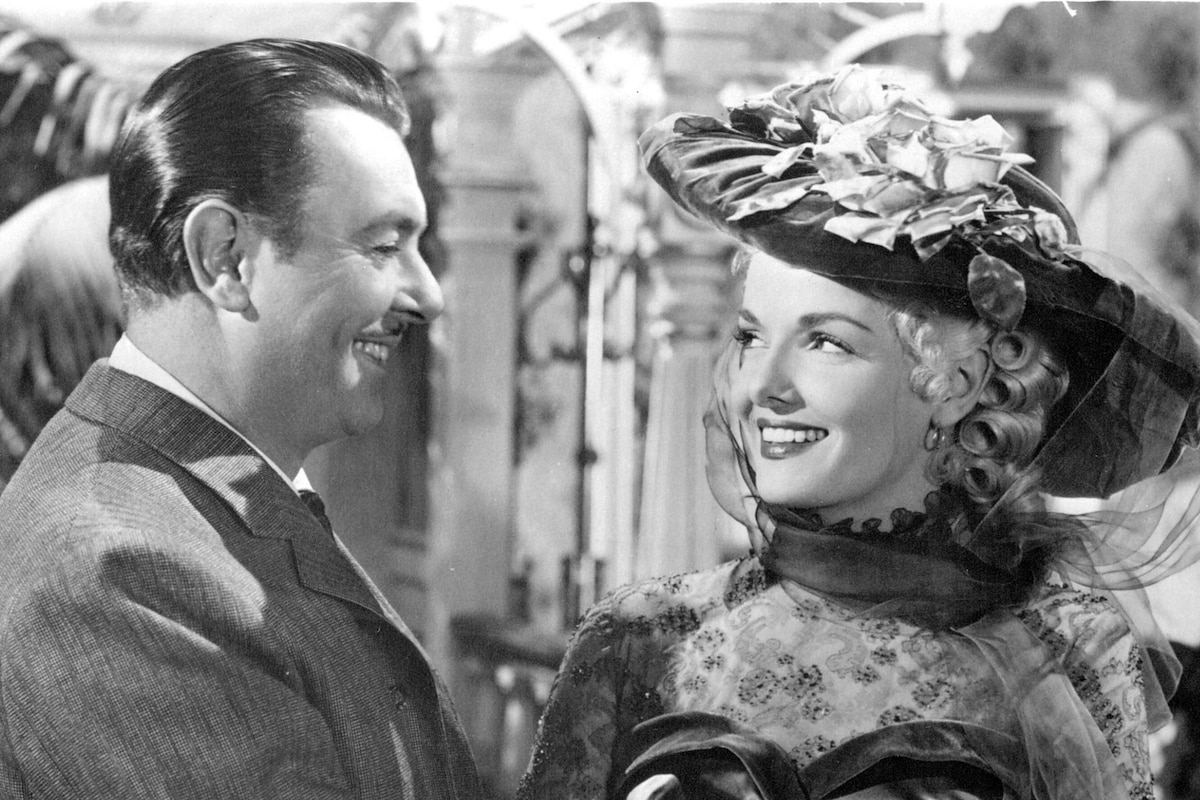
After completing work on Bob Hope's comic Western The Paleface (1948), which would generate the first decent reviews of her career, Russell took a trip to Republic Studios for Montana Belle. Although Republic was primarily known for making B movies with second-string talent, Russell was lucky to work with director Allan Dwan, a major talent who spent most of the talkie era doing low-budget films, and George Brent, a major star in his days at Warner Bros. who had gone independent after World War II. It also featured up-and-coming action star Scott Brady, whom Russell would hire years later when she produced and starred in Gentlemen Marry Brunettes (1955).
Dwan had started his career working with D.W. Griffith in the earliest days of filmmaking. He had been one of the first directors making the trek West to Hollywood and had been instrumental in making stars of Douglas Fairbanks and Gloria Swanson. Although he wouldn't go quite that far with Russell, at least he found the perfect way to make the relative newcomer comfortable on screen -- he let her sing. As part of the film's plot, Russell goes into hiding after a series of daring robberies (dressed as a man, a daunting task for any costumer) and becomes Brent's partner in a dance hall. The actress suggested the musical scenes as a logical extension of that plot development, and Dwan agreed. He even allowed her to sing "The Gilded Lily," a song by Russell's friend Portia Nelson, along with the 1892 standard "My Sweetheart's the Man in the Moon." Russell had always been musical, singing and playing piano as a child. Not only were her musical scenes her most effective in Montana Belle, but when word spread that she could sing, she started getting radio work and even a recording contract. Many of her later films would include musical numbers for her, and she would score her biggest on-screen hit as half of a nightclub act with Marilyn Monroe in Gentlemen Prefer Blondes (1953). Years after making her last film, she would even hit Broadway as Elaine Stritch's replacement in the musical Company.
Unfortunately, the rest of Montana Belle failed to measure up to its musical interludes. When Hughes got a look at the film, he paid $600,000 to buy it from Republic. His plan was to hold up release until he had made Russell a big enough star that the picture couldn't damage her career, a move he also undertook with It's Only Money (aka Double Dynamite [1951]), a comedy with Frank Sinatra and Groucho Marx she made at RKO shortly after Hughes bought the studio in 1948. That film would get out a year sooner than Montana Belle, which didn't see the light until 1952. By that time, Russell had scored in two films with Robert Mitchum, His Kind of Woman (1951) and Macao (1952), and re-teamed with Hope for Son of Paleface (1952), films that gave her a much stronger box-office standing than she had enjoyed in 1948. The reviews were still weak -- the film hadn't turned into a winner just sitting on the shelf -- but at least they acknowledged her current status while dismissing the early film. Variety's notice was typical: "It's safe to say that her more recent efforts are much better."
Montana Belle has fared marginally better in recent years thanks to a renewed interest in Dwan's career. It has been re-examined in a more favorable light along with his other Republic films such as Sands of Iwo Jima (1949) and Belle le Grand (1951). Even acknowledging the film's weaknesses, The Encyclopedia of Western Movies cited Russell's as the best big-screen interpretation of the legendary Belle Starr.
Producer: Howard Welsch
Director: Allan Dwan
Screenplay: Horace McCoy, Norman S. Hall
Based on a story by Howard Welsch & M. Coates Webster
Cinematography: Jack Marta
Art Direction: Frank Arrigo
Music: Nathan Scott
Cast: Jane Russell (Belle Starr), George Brent (Tom Bradfield), Scott Brady (Bob Dalton), Forrest Tucker (Mac), Andy Devine (Pete Bivins), John Litel (Matt Towner), Ray Teal (Emmett Dalton), Roy Barcroft (Jim Clark), Glenn Strange (Deputy), Iron Eyes Cody (Cherokee).
C-82m. Closed captioning.
by Frank Miller
Montana Belle
by Frank Miller | April 13, 2007
SIGN UP FOR OUR NEWSLETTERS

CONNECT WITH TCM