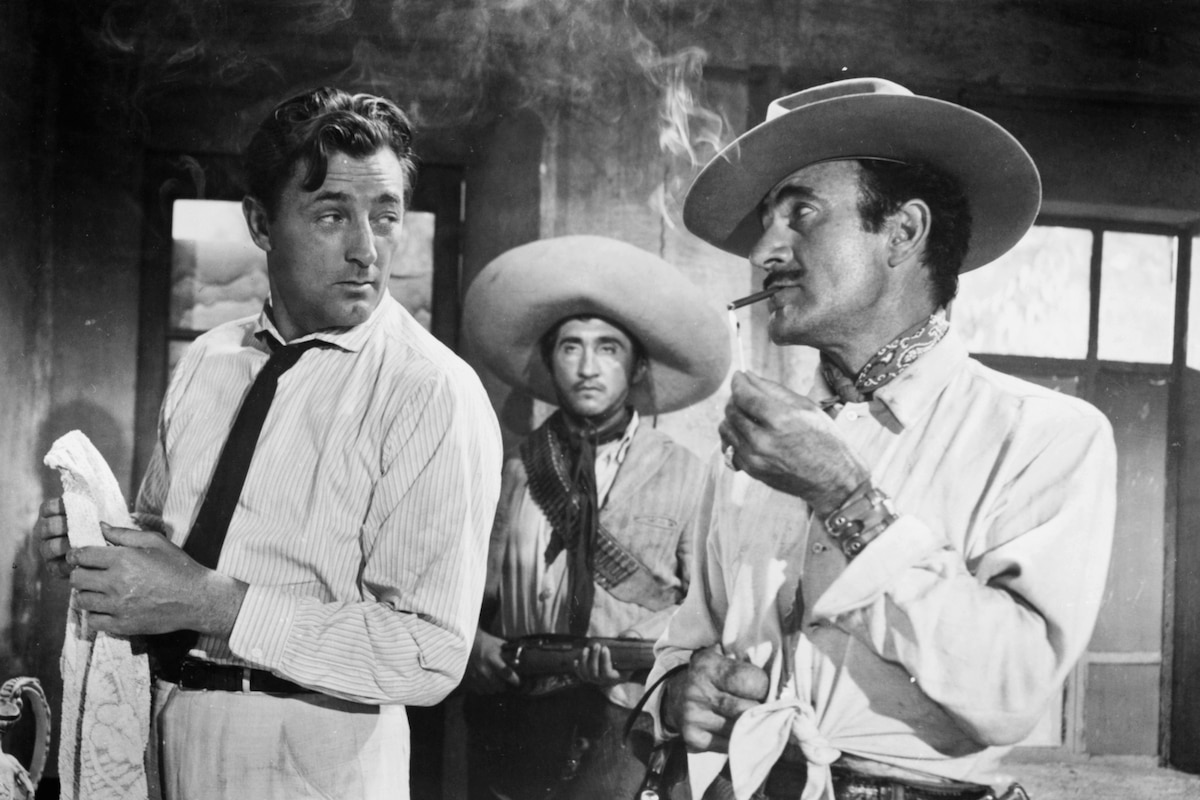
Bandido! (1956) was made shortly after Robert Mitchum's split from home studio RKO and his chancy turn as a murderous, sexually repressed preacher in Charles Laughton's then-underrated The Night of the Hunter (1955). With the box office failure of Laughton's only attempt at directing, Mitchum likely had his eye on the profit margin, for his subsequent string of assignments were formulaic no-brainers on the order of Man with the Gun (1955) and Foreign Intrigue (1956). Both films featured Mitchum in fish out of water mode, entering dangerous territory with an agenda of righting wrongs. The formula for Bandido! was little different, although its original aspirations were quite sophisticated.
The script for Bandido had its origin in an idea by writer Earl Felton, who had been brought in to rewrite the ending of the Howard Hughes-produced His Kind of Woman (1951) at RKO. A victim of childhood polio, Felton got around on crutches, his legs locked into metal braces, but he managed to keep up with Mitchum on bar crawls through Hollywood and became a trusted confidante. Picking up on Mitchum's image of himself as "a soldier of fortune," Felton crafted a treatment set during Mexico's 1916 revolution, with Mitchum as a gringo adventurer who befriends guerilla leader Pancho Villa while an American movie company gets it all on film. Enthusiasm within the industry ran high for Felton's treatment and Richard Fleischer (who had helmed the reshoots on His Kind of Woman) agreed to direct.
While Mitchum and Fleischer toiled on other projects, Felton banged out the script, which bore the title Bandido!. Unfortunately, both Mitchum and his director hated the finished result, which rejected the planned meta-western in favor of a flat shoot-em-up and replaced the legendary Pancho Villa with a vaguely Villaesque surrogate. Although Fleischer tried to back out of the deal, the threat of litigation from United Artists brought him back. By way of revenge, Fleischer commanded Felton to travel with the crew to Mexico and be available for rewrites during principal photography. Traveling south with Mitchum, Felton and Fleischer were Zachary Scott (cast as Mitchum's rival in the armament business) and Gilbert Roland (as the Pancho Villa stand-in Colonel Escobar), while German actress Ursula Thiess (then the wife of actor Robert Taylor) was brought along to be Mitchum's leading lady. Location shooting was grabbed in coastal Acapulco as well as inland in Cuernavaca and Tepoztlán (with the ranks of extras filled out by men who had fought with and against Pancho Villa forty years earlier) while interiors were shot at Mexico City's Churubusco Studios. As Mitchum had a percentage of Bandido!'s profits, his legendary thirst for mischief was largely held in check. Trouble did rear its head in the aftermath of a bar fight, where Mitchum's stand-in, Tim Wallace, allegedly decked a senorita who was the mistress of a Mexican policeman. When local gossip marked Mitchum as the assailant, the actor fled his hotel to seek refuge in Richard Fleischer's rented posada until the situation blew over.
If Earl Felton's script for Bandido! was nothing to write home about the production itself was complicated from a logistical standpoint, involving the movement of hundreds of extras in coordination with special effects explosions and human and animal stunt work. Injuries sustained by the cast included shredded skin for Mitchum (who did most of his own stunts), a dislocated knee for Zachary Scott and cuts and bruises suffered by Ursula Thiess when she was thrown off of her feet during a scene shot aboard a moving train. Another scare came when a car in which Mitchum and Felton were passengers was stopped in the Zona Rosa by the Mexican police. A search of the trunk netted a parcel of marijuana, at which point Mitchum was detained by the authorities until a fine of $10,000 was paid by Bandido! production manager John Burch. The cast and crew left Mexico the next morning and, according to Fleischer, "no one was late for the plane."
In the end, Mitchum and Fleischer were able to custom Bandido! more toward their liking and audiences responded more enthusiastically to Mitchum's return to devil-may-care heroics. The combination of Richard Fleischer's muscular direction and Ernest Laszlo's widescreen cinematography was another plus, although the latter was for years impossible to appreciate in faded, center-framed television broadcasts. Over fifty years since the production wrapped and ten years after Mitchum's death in 1997, the time has come for an honest reappraisal of a film that Mitchum biographer Lee Server considers "one of his most personal works... bringing his gaudiest daydreams to life and allowing audiences, if they so desired, to share in the fun."
Producer: Robert L. Jacks
Director: Richard Fleischer
Screenplay: Earl Felton
Cinematography: Ernest Laszlo
Film Editing: Robert Golden
Art Direction: Jack Martin Smith
Music: Max Steiner
Cast: Robert Mitchum (Wilson), Ursula Thiess (Lisa Kennedy), Gilbert Roland (Col. Escobar), Zachary Scott (Kennedy), Rodolfo Acosta (Sebastian), Jose Torvay (Gonzalez).
C-92m.
by Richard Harland Smith
Sources:
Robert Mitchum: A Biography by George Eells
Robert Mitchum: "Baby, I Don't Care" by Lee Server
The United Artists Story
Ephraim Katz Film Encyclopedia
The BFI Companion to the Western Edward Buscombe, ed.
Western Films: A Complete Guide by Brian Garfield
Bandido
by Richard Harland Smith | April 13, 2007
SIGN UP FOR OUR NEWSLETTERS

CONNECT WITH TCM