In the years following his Oscar®-winning and internationally successful epic
Lawrence of Arabia (1962), producer Sam Spiegel sought out material that
could match and even surpass that personal victory. Often working on several
projects simultaneously, the tireless mogul began production on The Chase
(1966) starring Marlon Brando while working out the details on his subsequent
project, The Night of the Generals (1967). The critical and box office
failure of The Chase, however, convinced Spiegel he had not exercised
enough control over that production. As a result, he was determined to more
closely monitor the making of The Night of the Generals.
Based on a best-selling novel by Hans Hellmut Kirst along with some plot
elements taken from James Hadley Chase's book The Wary Transgressor,
The Night of the Generals would boast a major international cast,
reuniting Peter O'Toole and Omar Sharif from Lawrence of Arabia in the
key roles, plus Tom Courtenay, Christopher Plummer, Donald Pleasence, Joanna
Pettet, Philippe Noiret and French chanteuse Juliette Greco in a brief cafe scene.
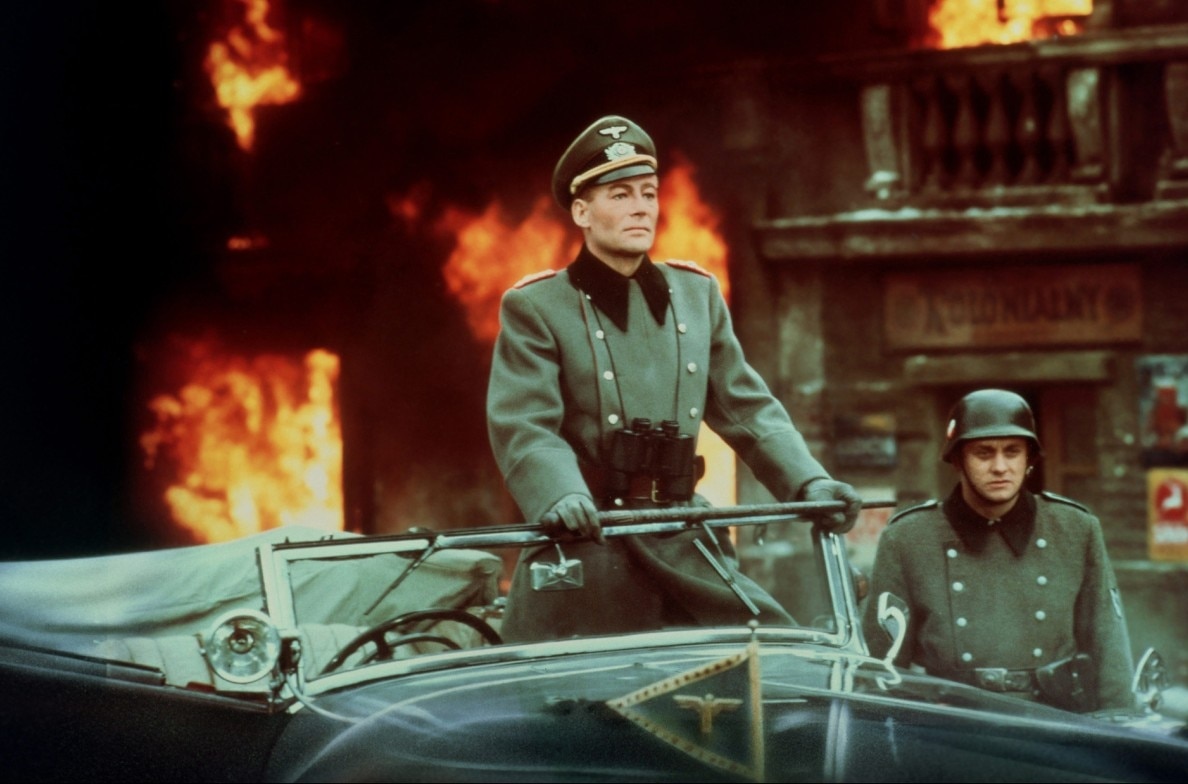
The story is set in Warsaw in 1942 and opens with the brutal murder of a prostitute
who was also a secret German agent. Heading the investigation, Major Grau
(Sharif) of German Intelligence focuses on three prime suspects - General
Kahlenberg (Pleasence), General von Seidlitz-Gabler (Charles Gray) and General
Tanz (O'Toole). Unfortunately, Grau's persistence on capturing the killer of what
seems an insignificant murder victim eventually frustrates the High Command and
he is transferred. Two years later, Grau is in Paris when another prostitute is
murdered and strangely enough, all three of the original suspects are also in the
city. Which one is the killer? But more importantly, are these murders related to a
bigger conspiracy such as a plot to assassinate Hitler? The novel which critiques
the morality and behavior of the Nazi elite in the guise of a psychological
whodunit had a personal connection for Spiegel. He had fled Berlin in 1933 when
Hitler came to power and General Tanz represented the mentality that had forced
Spiegel to emigrate to the U.S.
The direction of The Night of the Generals was entrusted to Anatole
Litvak, one of an older generation of European directors still working in
Hollywood along with Billy Wilder and William Wyler. Litvak had scored several
critical and commercial hits during his career - Mayerling (1936),Sorry,
Wrong Number (1948), The Snake Pit (1948) - but it had been more than
ten years since he had enjoyed a similar success with Anastasia in 1956.
Hollywood insiders were curious as to why Spiegel chose Litvak to helm The
Night of the Generals when there were so many dynamic young directors
emerging on the scene. But despite the fact that Spiegel and Litvak were old
friends, the real reason is that Litvak owned the rights to the book and wouldn't
relinquish them unless he was allowed to co-produce and direct.
To adapt the novel for the screen, Spiegel tried out three different screenwriters -
Robert Anderson, Paul Dehn, and Gore Vidal - and before he was finished he had
added a fourth, novelist Joseph Kessel (Belle de Jour), who along with
Dehn, were the only ones to receive a screen credit. The selection of the
technical crew equally reflected Spiegel's determination to hire the best in the
business - Oscar-winning production designer Alexandre Trauner (The
Apartment, 1960), music composer Maurice Jarre (who had scored
Lawrence of Arabia and Doctor Zhivago, 1965) and French
cinematographer Henri Decae (The 400 Blows, 1959), who shot the movie
on locations in Warsaw, Paris and Hamburg, Germany.
Initially Dirk Bogarde had been considered for the role of Major Grau but Spiegel
eventually offered it to Omar Sharif who had become an international celebrity
after his two epics for David Lean. According to author Natasha Fraser-Cavassoni
in her biography Sam Spiegel, Sharif had at first, "resisted the role. His
lawyer had written to Horizon Pictures that not only would it be "injurious to his
career," but that playing a Nazi officer was going against his "political and moral
beliefs." He finally agreed when he heard that O'Toole was part of the cast.
However, there was a growing resentment from both men toward Spiegel. They
had become major film stars, but were being paid ridiculously low salaries
because of the "slave contracts" and the film option agreements that they signed
when they made Lawrence of Arabia. As a result, Sharif was officially
getting 7,500 pounds ($19,086.75) and O'Toole was getting 15,000 pounds ($38,175).
This was in comparison to Donald Pleasence, a well-known character actor, who
was playing a lesser role in the film, but was being paid $80,000."
O'Toole was in the process of completing How to Steal a Million (1966) with
Audrey Hepburn in Paris at the same time as he was filming The Night of the
Generals. Since the two sets were not far apart, logistics were not a problem
but some say O'Toole was already so deeply into his character as the sadistic,
cold-blooded Tanz that it was affecting his final scenes with Hepburn in the
William Wyler romantic comedy. O'Toole's behavior on and off the set also didn't
match his reputation as a hellraiser. For the most part, he stayed aloof from
everyone except his makeup artist, his stuntman and his assistant. And in one
instance, he received permission to leave the production for a bicentenary
celebration at the Bristol Old Vic (his alma mater) but was so late in returning to
the set that an entire day of shooting was lost, costing Spiegel and Columbia a lot
of money. Realizing his mistake, however, he gathered the entire cast and crew
together and apologized to them, which was not something a star of his caliber
would normally do.
For Omar Sharif, The Night of the Generals proved to be a most
unpleasant experience due to the character he was playing. "It was January," he
recalled in his autobiography. "We were shooting in the streets of Warsaw. It was
bitter cold. Between shots I walked into a little cafe, wearing my costume. I'd just
wanted a cup of coffee and hadn't even thought about the uniform. I looked
around and what did I see? Panic-stricken faces, people with tears welling up in
their eyes." I'm no German!" I yelled quickly. "I'm making an American movie. I'm
an American." I even usurped a nationality to help reassure them. Nobody said a
word. The barman refused to serve me. I suddenly understood the incongruity of
that German uniform in a peaceful neighborhood cafe. I sensed the sadness that it
inspired. I went out in dismay....Twenty-two years had elapsed without mitigating
the pain and horror. On that day I learned that time can't make people
forget."
As for Spiegel, he was micromanaging the film to such a degree that he was
alienating everyone. According to Gore Vidal, "Sam was constantly insulting Tola
[Anatole Litvak]...'If you can't direct, you should quit, you know.' He would say
stuff like that in front of the crew. It was unforgivable. And the way Tola would
take it: he had a spray for his asthma and he would spray into his mouth." Gore is
also convinced that O'Toole's anger at Spiegel resulted in the actor sabotaging
the movie through his performance. "When I saw the film I realized that he had
killed it, absolutely, with a shot through the heart...He comes on insane, there's no
development; and you know he's the murderer from the first moment you see
him...He is so mad in his first scene that he has no place to go except stay insane
all the way through the picture, and this was all resentment at Sam."
When The Night of the Generals was released, most critics mirrored
Gore's opinion of the film. Time magazine called it "a murky mystery story
of Nazi Germany...As the villain, Peter O'Toole exhibits the now celebrated
twitching upper lip and glazed stare that some viewers have seen once or twice
too often..." Judith Crist of the N.Y. World Journal Tribune dismissed it as
"a slow-paced and pedestrian film that dissipates its promise early on and
carefully sidesteps the issues it raises." And Bosley Crowther of The New York
Times wrote "I wish it were more sophisticated and articulate about the crime
of war, not just about the idiosyncrasies of a Nazi general who likes to kill
prostitutes." However, there were some positive reviews as well with Hollis Alpert
of the Saturday Review proclaiming it "a handsome film...a more logical,
understanding, and historically aware example of the thriller genre than we are
accustomed to seeing."
Critical reviews aside, The Night of the Generals was not a hit with
audiences. In fact, it was a bona fide box office disaster and most of the blame
was due to Spiegel whose desire for total control had ruined the collaborative
creative process. Vidal later told him, "Sam, you know for all your passion for
meddling on the script, if ever there was a time when you as a producer were
needed, it was during the shooting to watch the rushes. You should have done
that every day and kept track of Tola."
Spiegel's glory days were truly behind him now. After Lawrence of Arabia
in 1962, he produced a string of box office failures - The Chase, The Night of
the Generals, The Happening (1967). Even his comeback film, the historical
epic Nicholas and Alexandra (1971) was a disappointment in relation to its
costs. He finished out his career with another box office bomb The Last
Tycoon (1976) and his final film Betrayal (1983), a critically acclaimed
film version of a Harold Pinter play that was small in scale and a modest art
house success. It was the exact opposite of the type of high profile film Spiegel
had built his career on.
Producer: Anatole Litvak, Sam Spiegel
Director: Anatole Litvak
Screenplay: Paul Dehn, John Kessel, Hans Hellmut Kirst (novel)
Cinematography: Henri Decae
Film Editing: Alan Osbiston
Art Direction: Auguste Capelier
Production Design: Alexandre Trauner
Music: Maurice Jarre
Cast: Peter O'Toole (General Tanz), Omar Sharif (Major Grau), Tom Courtenay
(Lance Cpl. Kurt Hartmann), Donald Pleasence (Maj. Gen. Kahlenberg), Joanna
Pettet (Ulrike von Seydlitz-Gabler), Philippe Noiret (Insp. Morand).
C-148m. Letterboxed.
by Jeff Stafford
SOURCES:
Peter O'Toole by Michael Freedland
The Eternal Male by Omar Sharif
Sam Spiegel by Natasha Fraser-Cavassoni
Spiegel: The Man Behind the Picture by Andrew Sinclair
Filmfacts
The Night of the Generals
by Jeff Stafford | April 13, 2007
SIGN UP FOR OUR NEWSLETTERS

CONNECT WITH TCM